Edited Collections
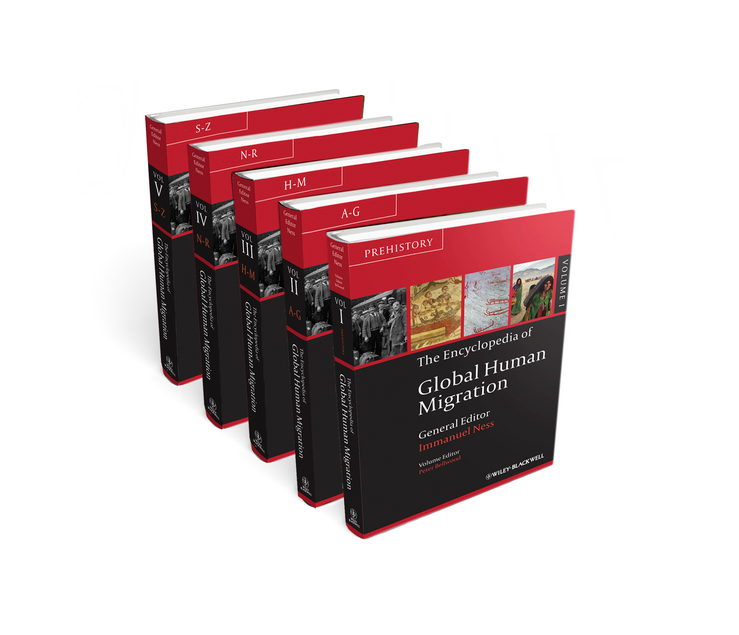
The Encyclopedia of Global Human Migration (2013)
Edited by: Immanuel Ness
The Encyclopedia of Global Human Migration provides a complete exploration of the prominent themes, events, and theoretical underpinnings of the movements of human populations from prehistory to the present day. It includes thematic interpretations and theories of migration, as well as the significant contemporary scientific discoveries and scholarly interpretations that have...
Purchase This Book
Book Infromation
The Encyclopedia of Global Human Migration provides a complete exploration of the prominent themes, events, and theoretical underpinnings of the movements of human populations from prehistory to the present day. It includes thematic interpretations and theories of migration, as well as the significant contemporary scientific discoveries and scholarly interpretations that have reshaped the way historians and social scientists analyze and map the past.
Book Overview
Contributor Notes
Katherine Barbara Aaslestad is Professor of History at West Virginia University. She has published on Germany during the Napoleonic era in Central European History and European History Review, as well as in a number of collected volumes. Her book, Place and Politics: Local Identity, Civic Culture, and German Nationalism in North Germany during the Revolutionary Era appeared in 2005.
Manolo Abella headed ILO's International Migration Program for many years where he steered the organization’s work in assisting member states to improve their policies on labour migration. He is now Senior Research Associate of the Centre for Migration Policy and Society, University of Oxford, and a member of the Advisory Board of the World Bank’s “Migrating out of Poverty” project and the European Commission’s Migration Futures project. He has contributed extensively to the literature on labour migration and is coauthor (with Philip Martin and Christiane Kupstch) of Managing Labor Migration in the 21st Century.
Younes Abouyoub is Research Scholar at the Department of Middle Eastern, South Asian, and African Studies, Columbia University, New York. He has worked in Sudan as a consultant and researcher for the Joint Mediation Support Team established by the United Nations and the African Union to help find a political solution to the Darfur crisis, and on the Panel of Experts on the Sudan set up by the UN Security Council. He is currently working on a book on Darfur.
Gregory Acevedo, is an associate professor of social work in the Fordham University Graduate School of Social Service. His work has focused on the political, economic, and sociocultural circumstances of Puerto Ricans and other Latino groups in the United States. His scholarly work tackles a broad array of social policy issues related to immigration and globalization and how these issues manifest themselves at the level of community.
Robert Adelman is Associate Professor of Sociology at SUNY–Buffalo and currently serves as Director of Graduate Studies. An urban sociologist studying social stratification in the United States, Adelman analyzes patterns, trends, and processes related to residential segregation and neighborhood inequality, immigration, internal migration, and labor-force differences by race, ethnicity, and nativity. Adelman has published in a variety of journals including American Sociological Review, Demography, and Social Forces. He is also the book review coeditor of City & Community.
Oluwakemi Abiodun Adesinateaches at the Osun State University, Osogbo, Ikire Campus, Nigeria. Her research interests are in historical migration, international commercial sex trafficking, gender, and women’s studies. Most notable among her publications are: “Putting Africa on the map: contemporary migrations, livelihoods and the socio-economic landscape,” and “Between culture and poverty: The Queen Mother phenomenon and the Edo international sex trade” (both 2005).
Charles T. Adeyanju is assistant professor of sociology in the Department of Sociology and Anthropology at the University of Prince Edward Island, Canada. Throughout his academic career he has conducted research and written on transnational migration, race and ethnicity, social inequality, and media and society. He is the author of Deadly Fever: Racism, Disease and a Media Panic (2001).
Ali Afani is a graduate student in political science at Brooklyn College, studying international relations, diplomacy, and policy. His main research focus is on multilateral lending agencies and Africa.
Tamer Afifi is Associate Academic Officer in the Environmental Migration, Social Vulnerability and Adaptation section of the United Nations University Insitute for Environment and Human Security. He mainly works in the area of environmental change and forced migration. His work focuses mainly on economic aspects of and modeling techniques in association with environmental migration.
Victor Agadjanian is Ellen Elizabeth Guillot International Distinguished Professor and Director of the Center for Population Dynamics at Arizona State University. His research has dealt primarily with gender, reproductive and family change, migration, and HIV/AIDS in sub-Saharan Africa and Central Eurasia.
Alexandra Y. Aikhenvald is Distinguished Professor and Research Leader (People and Societies of the Tropics) in the Cairns Institute of James Cook University. She has worked on descriptive and historical aspects of Berber languages, and has published a grammar of Modern Hebrew and several grammars of Arawak languages from Brazil, including Bare (1995) and Warekena (1998), in addition to grammars for Tariana from Northwest Amazonia (2003), and Manambu from East Sepik, Papua New Guinea (2008).
- A. Ajalais senior lecturer in the Department of Geography at Obafemi Awolowo University Ile-Ife, Nigeria. He specializes in urban and regional planning, and focuses on development, inequality, poverty, livelihood studies, and tourism. He has published more than 20 journal articles in addition to commissioned papers and dissertations.
Junichi Akashi is an assistant professor in the Graduate School of Humanities and Social Sciences, University of Tsukuba. He is the author of Japan’s Immigration Control Policy: Foundation and Transition (in Japanese, 2010).
David O. Akeju is a doctoral student in the sociology department, and program officer, Gender Mainstreaming Program, University of Ibadan, Nigeria. His broad interests are in the family and households in Africa, especially gender issues, health, and wellbeing of vulnerable populations, particularly children, and he has also participated in research on mobility and vulnerability among nomads. Two papers in preparation are “The gender dimension of vulnerability among orphans in Nigeria” and “Cultural and demographic considerations in defining orphans and vulnerable children in Nigeria.”
Ahmet Akgündüz is lecturer at the Faculty of Economics and Administrative Sciences of Izmir University, Turkey, and a researcher at the Department of Sociology and Anthropology of University of Amsterdam, The Netherlands. From 1993 to October 2010 he was affiliated to the Institute for Migration and Ethnic Studies at the University of Amsterdam. His publications include Labour Migration from Turkey to Western Europe, 1960–1974: A Multidisciplinary Analysis (2008).
Akanni Akinyemi is a senior lecturer in the Department of Demography and Social Statistics, Obafemi Awolowo University, Ile Ife, Nigeria. He is currently a researcher with the African Center for Migration and Society, University of Witwatersrand, South Africa.His core area of research is on migration, aging, and reproductive health in Nigeria and Africa. He has published extensively on migration issues in Nigeria.
Robert Aldrich is Professor of European History at the University of Sydney. He is the author of The Seduction of the Mediterranean: Writing, Art and Homosexual Fantasy, Colonialism and Homosexuality (1993), and Gay Life-Stories (2012), and editor of Gay Life and Culture: A World History (2006).
Bryant Allen retired from the Australian National University in 2009 and is now a Visiting Fellow in the State Society and Governance in Melanesia Project, College of Asia and the Pacific, the Australian National University, Canberra. His main interests are in the sustainability of agricultural systems and rural development. With Mike Bourke and Robin Hide, he has defined, mapped, and described all Papua New Guinea agricultural systems.
Richard B. Allen teaches African, Indian, and Middle Eastern history at Framingham State University, MA. He is the author of Slaves, Freedmen and Indentured Laborers in Colonial Mauritius (1999) and numerous articles on European slave trading in the Indian Ocean and indentured labor in the colonial plantation world.
Gur Alroey is Professor of Jewish History in Modern Times at the University of Haifa. He is author of Immigrants: Jewish Immigration to Palestine in the Early Twentieth Century (2004); The Quiet Revolution: The Jewish Emigration from the Russian Empire in the Early Twentieth Century (2008); Seeking a Homeland: The Jewish Territorial Organization (ITO) and Its Struggle with the Zionist Movement, 1905–1925 (2011); and Bread to Eat & Clothes to Wear: Letters from Jewish Migrants in the Early Twentieth Century (2011).
Ida Altmantaught at the University of New Orleans for 24 years before joining the history department at the University of Florida in 2006. Her research focus is on the history of early Mexico, the Caribbean, and the Atlantic world. Her most recent book is The War for Mexico’s West: Spaniards and Indians in New Galicia, 1524–1550 (2010).
Anita Alves Pena is an assistant professor of economics at Colorado State University. Her research interests are in public-sector economics, labor economics, and economic development and her current research relates to undocumented and documented immigration, public policy, poverty, and agricultural labor markets.
Ernesto Friedrich de Lima Amaral is professor in the Political Science Department at the Federal University of Minas Gerais, Brazil. His research is related to migration, demographic transition, economic development, and evaluation of public policies. He has had papers published in the Population Review, Urban Geography and Brazilian Journal of Population Studies.
Atholl Anderson is an Emeritus Professor of the Australian National University. He specializes in the archaeology, palaeoecology, and traditional history of islands, and in maritime migration and seafaring. He has undertaken research across the Pacific and Indian Oceans and in Scandinavia. He is the author of Prodigious Birds (1989) and The Welcome of Strangers (1998), coeditor of The Global Origins and Development of Seafaring (2010), and editor of the Journal of Pacific Archaeology.
Rikke Andreassen is a researcher, teacher, and consultant in the fields of migration, communication, discrimination, and equality, addressing racial/ethnic and gender equality issues. Among her published articles are: “Sing a song but stay out of politics” (2010); and “Veiled debates: gender and gender equality in European national narratives” (2011).
Rutvica Andrijasevic is a lecturer at the Centre for Labour Market Studies, Leicester University. Her expertise is in the areas of gender, sexuality, and citizenship in Europe. She is the author of Migration, Agency and Citizenship in Sex Trafficking (2010). She is also a member of the editorial collective Feminist Review.
José-Ignacio Antón is Lecturer in Economics at the University of Salamanca in Spain. His areas of expertise are migration, labor and public economics. He has authored five books, 14 book chapters and 13 articles in academic journals.
Cátia Antunes is assistant professor in the history department, University of Leiden. Her research interests are economic history, debates on globalization and world history, European expansion and cross-cultural relations in the early modern period. Her PhD dissertation Globalisation in the early modern period: the economic relationship Amsterdam–Lisbon, 1640–1705 was published in 2004. In 2007–8 she was Fulbright Research Fellow in History at Yale University, while working on her monograph Amsterdam and the Atlantic: Cross-Cultural Business Networks, 1580–1776 (2011).
Shinzo Araragi is a historical sociologist and professor in the Department of International Relations, Sophia University, Tokyo. He specializes in studies of ‘Manchukuo’ and the Japanese Empire and post-colonialism in East Asia. He wrote Historical Sociological Study on Japanese Immigrants to ‘Manchukuo’ (Kourosha, 1994) and was an editor of Migration and Repatriation: The Rise and the Fall of the Japanese Empire (2008) and Experiences as Japanese Left-behind in China (2009), among other works.
Djane Kabran Aristide is a PhD student specializing in social ecology at the Department of Anthropology, Anthropological Institute of Development Science, University of Cocody, Abidjan. He is also a member of several research networks including CODESRIA and UAPS. His research and scholarship focuses on environmental education, environmental psychology, and the influence of migration on the human environment.
Marie-Pierre Arrizabalagais Associate Professor of US history at the University of Cergy-Pontoise, France. She has published on the history of the family and inheritance to explain massive emigration to America. She coedited (with Tindara Addobbo et al.) Gender Inequalities, Households and the Production of Well-being in Modern Europe (2010), guest-edited a special issue of Sociale/Social History entitled: Women and Emigration to North America and coedited (with A. Fauve-Chamoux) an issue of History of the Family: An International Quarterly, on inheritance.
Irena Ateljevic is a visiting professor of socio-spatial analysis at Wageningen University, The Netherlands, and scientific associate at the Institute for Tourism, Zagreb, Croatia. Her research focuses on critical praxis and action research contributing toward ameliorating a distressed, divided, and unsustainable world. She has applied this theoretical perspective into critical tourism studies, women’s empowerment, transformative education, teaching, and action-oriented projects in “peripheral” communities of Croatia and India.
Oliver Auge is Professor of Regional History at the Christian Albrechts University in Kiel. He is a member of numerous scientific commissions and spokesman of the Societas Historica of the Collegium Philosophicum of the CAU in Kiel. He writes on aspects of medieval imperial and regional history and the history of towns, churches, and universities, together with history of nobles and dynasties. His latest monograph is “Handlungsspielräume fürstlicher Politik im Mittelalter. Der südliche Ostseeraum von der Mitte des 12. Jahrhunderts bis in die frühe Refomationszeit [Scopes of action of princely policies in the Middle Ages: the southern Baltic Sea region from the middle of the 12th century until the early Reformation period] (2009).
Donald Avery is Professor of History (Emeritus) at the University of Western Ontario and a consultant in the field of immigration policies, health security, and conflict studies. During his academic career he published five books and anthologies, including Reluctant Host: Canada’s Response to Immigrant Workers, 1986–1994 (1995), wrote more than 80 scholarly articles, book chapters, and book reviews, and participated in seven film documentary projects.
James Olabisi Ayodele is a lecturer in the Department of Sociology and Anthropology at Obafemi Awolowo University, Ile-Ife, Nigeria. His research and writing focuses on political sociology and criminal justice. He has published essays in leading international journals and publications on demographics and social policy in Africa, such as African Sociological Review and the Journal of Applied Security Research.
Farooq Azam has worked extensively on migration and development issues, especially with ILO, the World Bank and IOM, and the World Bank and DFID on social sectors development, in the South Asia and Southeast Asia regions and in Bosnia and Herzegovina. He has been fellow of the University of Leeds, UK, University of Copenhagen and University of Odense, Denmark, University of Newcastle, Australia, and East–West Center, USA.
Saër Maty Bâ is Lecturer in Film Studies at Bangor University (School of Creative Studies and Media). Previously he held research and teaching fellowships in media studies at the universities of St. Andrews and East London. His articles appear in peer-reviewed film journals; his recent work includes essays and film critiques for The World Cinema Directory/Africa and book chapters on ethnographic and epic cinemas.
Fabio Baggio is the director of the Scalabrini International Migration Institute in Rome. He worked as director of the Scalabrini Migration Center (SMC) in Quezon City from 2002 to 2010. He is the coeditor (with Laura Zanfrini) of Migration Management and Ethics: Envisioning a Different Approach (2009).
Miloslav Bahna is a research fellow at the Institute for Sociology, Slovak Academy of Sciences. His PhD thesis deals with post EU enlargement migration from Slovakia and other new EU member states. He is a representative of Slovakia in the International Social Survey Programme and a co-founder of the Slovak Archive of Social Data. His work has been published in International Migration Review and other journals.
James A. Banks holds the Kerry and Linda Killinger Endowed Chair in Diversity Studies, and is Founding Director of the Center for Multicultural Education at the University of Washington. His research focuses on multicultural education and diversity and citizenship education in a global context. He is the author of Teaching Strategies for Ethnic Studies (8th edn, 2008), and the editor of the Encyclopedia of Diversity in Education (2012).
Michael Banton was Professor of Sociology in the University of Bristol from 1965 to 1992. He was a member of the United Nations Committee Against Racial Discrimination from 1985 to 2001, and chairman of the committee from 1996 to 1998. He is author of The International Politics of Race (2002).
Manuel Barajas is Associate Professor of Sociology at California State University–Sacramento. He specializes in migration studies, Chicana/o studies, and race, gender, and class inequality. He is author of The Xaripu Community across Borders: Labor Migration, Community, and Family (2009) and coauthor (with Elvia Ramirez) of “Beyond home–host dichotomies: a comparative examination of gender relations in a transnational Mexican community” (2007).
Graziano Battistella is a Scalabrinian missionary and director of the Scalabrini Migration Center in the Philippines. He worked previously at the Center for Migration Studies in New York and the Scalabrini International Migration Institute in Rome. He founded the quarterly Asian and Pacific Migration Journal and has published in specialized journals on migration in Asia and on the rights of migrants.
Philippe Beaujard is Director of Research at the National Center for Scientific Research, Paris, and is affiliated to the World Center for African Studies (CEMAf). A specialist in the history of Madagascar and of the Indian Ocean, he is author of the two-volume work Les mondes de l'océan Indien (2012).
Marianne Bechhaus-Gerstis a professor at the Institute of African Studies at the University of Cologne, Germany. Her research focuses on medieval Nubia, the history of the African diaspora in Germany, and Germany’s colonial history. Her publications include: Treu bis in den Tod: Von Deutsch-Ostafrika nach Sachsenhausen. Eine Lebensgeschichte [Faithful till death: from German East Africa to the Sachsenhausen Concentration Camp] (2007) and The (Hi)story of Nobiin – 1000 years of Language Change (2011).
Richard Bedford is Professor of Population Geography and Director of the Population Studies Center at the University of Waikato. He is a specialist in migration studies, focusing on population movement in the Asia-Pacific region. He is author and coauthor of leading research studies and journal articles on the Pacific region and Australia/New Zealand, including (with Charlotte Bedford) “International migration and climate change: a post Copenhagen perspective on options for Kiribati and Tuvalu” and (with Charlotte Bedford and Elsie Ho) “Engaging with New Zealand’s Recognized Seasonal Employer Work Policy: The Case of Tuvalu” (both 2010).
Martin Bell is Professor of Geography and Director of the Queensland Centre for Population Research, University of Queensland. In addition to research on internal migration in Australia, his main scholarly contributions have focused on circular mobility and on measures for cross-national comparisons of internal migration.
Peter Bellwood is Professor of Archaeology at the Australian National University in Canberra. His current fieldwork projects relate mostly to the Southeast Asian Neolithic, especially in Vietnam and the Philippines. He has also worked extensively in Polynesia, Indonesia, and Malaysia.
He is the author of First Farmers (2005), Prehistory of the Indo-Malaysian Archipelago (2007), and First Migrants (in preparation), among other books and edited volumes.
Ariana Berengaut served as research assistant for the Committee on Conscience at the US Holocaust Memorial Museum from 2008 to 2011. She was previously a member of the speechwriting team on Barack Obama’s successful presidential primary campaign. Her Master’s specialization was in African Studies.
David Beresford-Jonesis a research associate at the Max Planck Institute for Evolutionary Anthropology, Leipzig, and a fellow of the McDonald Institute for Archaeological Research, Cambridge. His work seeks to bring together archaeology, archaeobotany, and geomorphology for the better understanding of prehistoric human ecology. He also has interests in the synthesis of archaeology and historical linguistics, especially in the Andes, and in the archaeobotany of the Upper Palaeolithic.
Lutz Berger is Professor of Middle Eastern Studies at Kiel University. His main research interests are premodern Middle Eastern cultural history, and political ideologies in the contemporary Islamic world, especially Turkey. His publications include Gesellschaft und Individuum in Damaskus 1550–1791 [Society and the individual in Damascus, 1550—1791] (2007); and Islamische Theologie [Islamic theology] (2010).
Daniela Berghahn is Reader in Film Studies at Royal Holloway College, University of London. Between 2006 and 2008, she led the international research network Migrant and Diasporic Cinema in Contemporary Europe under the Arts and Humanities Research Council’s strategic program Diasporas, Migration and Identities. Her recent publications include European Cinema in Motion: Migrant and Diasporic Film in Contemporary Europe (coedited with C. Sternberg, 2010); Turkish German Dialogues on Screen (special issue of New Cinemas, 2009); and Hollywood behind the Wall: The Cinema of East Germany (2005).
Richelle Bernazzoli is a doctoral candidate in political geography at the University of Illinois at Urbana-Champaign. Her research interests include the state and governance, the critical geopolitics of identity and security, international integration, and Southeastern Europe. Her current research involves ethnographic work on identity, security, and the state in Croatia’s Euro-Atlantic integration process. She has published on the topics of militarization, citizenship, and hegemony in Political Geography, Geopolitics, and Geography Compass.
Federica Bertagna is visiting assistant professor in the history of journalism at the University of Verona. She has published numerous articles on the history of Italian migration, and is the author of the monograph La Patria di riserva. L’emigrazione fascista in Argentina [The reserve homeland: Fascist emigration in Argentina] (2006) and the essay “Italy” in The Encyclopedia of European Migration and Minorities (2011).
Giorgio Bertellini is Associate Professor in Screen Arts and Cultures and Romance Languages and Literatures at the University of Michigan. He has published widely on questions of film form and geographic, racial, and national difference in American and European cinema, including, as author, Emir Kusturica (1996; 2011) and of the award-winning Italy in Early American Cinema: Race, Landscape, and the Picturesque (2009), and as editor or coeditor The Cinema of Italy (2004; 2007); The Nation/National in Early Cinema (2008); and Silent Italian Cinema: A Reader (forthcoming).
Yifen T. Beus is Associate Professor of International Cultural Studies at Brigham Young University– Hawaii. Her teaching and research interests include modernity, reflexivity, intertextuality, cultural identity, (trans)nationalism, and Orientalisms in cinema and postcolonial literature. Her recent publications include: “Postcolonial beaux’ stratagem: dancing and singing back with Carmen” (2008) and “After the last sky: a liminal space” (2006).
Vibha Bhalla is an associate professor in the Department of Ethnic Studies at Bowling Green State University, OH. Her work focuses on professional Asian Indian migration to the United States, and on the ways gender shapes migration and settlement. She is currently working on a manuscript on Asian Indian migration to metropolitan Detroit.
Kaushik Bhaumik is Deputy Director of the Osian’s Cinefan Festival of Asian and Arab Cinema, New Delhi, India. He has published extensively on Bombay and World Cinema and has recently started writing on modern Indian art. He is coeditor of Visual Sense: A Cultural Reader (2008) and author of From the Bazar to the Nation: Bombay Cinema, 1896–1936 (2005).
Robert R. Bianchi is a senior principal research fellow at the National University of Singapore’s Middle East Institute and a lecturer at the University of Chicago Law School. He is the author of Unruly Corporatism: Associational Life in Twentieth-Century Egypt (1989) and Guests of God: Pilgrimage and Politics in the Islamic World (2004).
Naluwembe Binaisa is a research fellow in the Sussex Centre for Migration Research, UK. Her interests are in the field of diaspora, development, and digital technologies. Publications include: “Negotiating ‘belonging’ to the ancestral homeland: Ugandan refugee descendants ‘return’” (2011) and “Diasporic landscape: theoretical reflections on African migrants’ everyday practices of ‘home’ and ‘belonging’” (forthcoming).
Nathan Blank is a political science instructor at Big Sandy Community and Technical College, KY. His PhD dissertation “Government–business relations in the Philippine overseas employment program” examines the policy-making relationships and roles between the private and public sector within the large-scale labor export program in the Philippines. He has broad interests in development politics, international political economy, and comparative development strategies.
Václav Blažek is a professor of comparative Indo-European linguistics at Masaryk University in Brno, Czech Republic. He concentrates on Indo-European, Afroasiatic and Uralic linguistics, but some of his studies have also been devoted to Nilo-Saharan, Kartvelian, North Caucasian, Elamite, Dravidian, Altaic, ‘Palaeo-Siberian’, Ainu, Austric, and Australian languages. In addition to many contributions to linguistics journals and edited volumes, he is the author of Numerals: Comparative-etymological Analyses of Numeral Systems and Their Implications: Saharan, Nubian, Egyptian, Berber, Kartvelian, Uralic, Altaic and Indo-European languages (1999) and a biography of Werner Winter (2011).
Marcelline Block is lecturer in history at Princeton University, teaching the history and cinema of World War II. She edited World Film Locations: Paris (2011) and Situating the Feminist Gaze and Spectatorship in Postwar Cinema (2008; 2010) as well as writing many book and journal articles in English, French, and Russian.
Robert Blust is a historical linguist with special interest in the Austronesian language family. He is the author of The Austronesian Languages (2009), and over 200 other publications on Austronesian linguistics and culture history, as well as several other topics, including the origin of the worldwide belief in dragons. His largest project, the Austronesian Comparative Dictionary, is still ongoing.
- Roger Böhningheaded the migration program at the International Labor Office, Geneva, for 15 years. His publications includeStudies in International Labour Migration (Macmillan, 1984) and a manual, Employing Foreign Workers (ILO, 1996).
Manuela Bojadžijev is assistant professor at the Institute for European Ethnology at the Humboldt University of Berlin. She is author of Die windige Internationale. Rassismus und Kämpfe der Migration [The windy international. Racism and the struggles of migration] (2008) and coedited the book Konjunkturen des Rassismus [Conjunctures of Racism] (2001) among other works.
Marcelo Borges is Associate Professor of History and chair of the Latin American, Latino, and Caribbean Studies Program at Dickinson College, PA, where he teaches courses on Latin American history and comparative migrations. His publications include Chains of Gold: Portuguese Migration to Argentina in Transatlantic Perspective (2009), a special issue of Portuguese Studies Review on Portuguese migration, and articles on migration and labor history.
Michael Borgolte is Professor of Medieval History at Humboldt University, Berlin; he founded an Institute for the Comparative History of Europe in the Middle Ages, Berlin, in 1998; and became a full member of the Berlin-Brandenburg Academy of Sciences and Humanities in 2005 and Fellow of the Max-Weber-Kolleg, Erfurt, in 2008/9. His latest monographs include: Europa entdeckt seine Vielfalt 1050–1250 [Europe: the discovery of diversity, 1050–1250] (2002) and Christen, Juden, Muselmanen. Die Erben der Antike und der Aufstieg des Abendlandes 300–1400 n. Chr. [Christians, Jews and Muslims: the heirs of antiquity and the ascent of Western Europe, ce 300–1400] (2006).
Ulbe Bosma has been senior researcher with the International Institute for Social History since 1997. From 1993 to 2007 he coordinated the Sephis program. His main interests are colonial history, labor migration and plantation societies. He has published numerous books, monographs, edited volumes, chapters in books, and has authored or coauthored essays in international refereed journals on colonial history and labor migration. His current research project is on labor relations in cane sugar production in India and Indonesia.
Bridget Brereton is Emerita Professor of History at the University of the West Indies, St. Augustine, Trinidad & Tobago. She is the author or editor of several books on the social history of the Caribbean after slavery, and the history of Trinidad & Tobago, and former president of the Association of Caribbean Historians. Among her authored books are Race Relations in Colonial Trinidad, 1870–1900 (1979) and A History of Modern Trinidad, 1783–1962 (1981), and she is the editor of vol. V of the UNESCO General History of the Caribbean, The Caribbean in the Twentieth Century (2004).
Caroline B. Brettell is University Distinguished Professor of Anthropology at Southern Methodist University, TX. She has published extensively on various dimensions of migration in Europe and the United States and is an expert on Portuguese migration. Most recently, she has been working on Indian immigrants in the United States.
Oli Brown is a senior researcher at the International Institute for Sustainable Development, a Canadian development policy think-tank. His main areas of interest lie in conflict prevention, peacebuilding, and environmental management. For several years he has been analyzing the impact of climate change on migration and international security. Recent publications include Migration and Climate Change (2008) and (with Robert McLeman) “A recurring anarchy?: The emergence of climate change as a threat to international peace and security” (2009).
Colette V. Browne is Professor in Social Work at the Myron B. Thompson School of Social Work, and Director of the Center on Aging at the University of Hawaii at Manoa. Her research on ethnogerontology, gender issues and age, and social and health disparities in later life has been published in journals including Gerontologist, Social Work, Health and Social Work, Education for Health.
Angela Bruch is a paleobotanist at the ROCEEH research center funded by the Heidelberg Academy of Sciences and Humanities at Senckenberg Research Institute in Frankfurt am Main, Germany. Her research focuses on the understanding of spatial and temporal differences in the reaction of terrestrial ecosystems to Pleistocene global climatic changes, with particular emphasis on the quantitative reconstruction of terrestrial paleoenvironments, including climate quantification based on plant fossils. During the last decade she contributed to the reconstruction of Neogene environments in Eurasia.
Ulf Brunnbauer is a professor of history and Southeastern and Eastern Europe and the director of the Southeastern Institute at the University of Rosenburg (Germany). He specializes in Balkan and Southeast European politics and his research focuses on historical anthropology and social history of Southeast Europe from the 19th century to the present; Balkan migrations; historical family research; Muslim minorities; and socialism, historiography and nation-building in Southeastern Europe. He is editor of History Research Institutes in Southeast-Europe. A Handbook (2004).
Marc Buggeln is a post-doctoral student at the Humboldt University, Berlin and a world authority on concentration and death camps. He is editor of the journals WerkstattGeschichte and Sozial.GeschichteOnline. He has recently published Arbeit & Gewalt. Das Außenlagersystem des KZ Neuengamme [Labor and violence: the external storage system of the Neuengamme concentration camp] (2009), Der Bunker Valentin. Marinerüstung Zwangsarbeit Erinnerung [The submarine bunker "Valentin": Marine armor, forced labor and memory] (2010) and “Building to death” (2009).
Joachim Burger is Professor of Anthropology at Johannes Gutenberg University, Mainz, Germany. His research is on the population genetics of interaction between early Neolithic farmers and late hunter-gatherers in Europe. He draws inferences from ancient and modern DNA data using next-generation sequencing technology and biostatistical methods. In addition, he works on the domestication process and the early population history of domestic animals. His publications include “Ancient human DNA” (with K. Kirsanow, 2012).
Allan Burns is Professor of Anthropology at the University of Florida, specializing in applied anthropology, Mexico and Central America, medical anthropology, language and culture, and immigration. He was president of the Society for Applied Anthropology (2009–2011). His research has focused on the Mayan language and culture in the Yucatan, Chiapas, Guatemala, and Guatemalan refugees in Florida. He has published over 90 articles and book chapters, two books, and many applied anthropology reports.
Kathy Burrell is Reader in Migration and Material Culture at De Montfort University, Leicester, UK. Her research focuses on Polish migration to the UK since the 1950s concentrating on mobility and material culture. Her most recent publications include the edited volume Polish Migration to the UK in the “New” European Union: After 2004 (2009).
Frank Caestecker is a historian affiliated to the University of Ghent (Belgium). He researches migration and migration management policies in Western Europe and the United States during the 19th and 20th centuries. He is author of Alien Policy in Belgium, 1840–1940: The Creation Of Guest Workers, Refugees and Illegal Aliens (2000) and editor (with Bob Moore) of Refugees from Nazi Germany and the Liberal European States (2010).
Claudio Canaparo is Visiting Professor at the Department of Iberian and Latin American Studies, Birkbeck College London, and Associated Researcher at the Catholic University of Louvain-la-Neuve, Belgium. Themes of his works include sociology of knowledge, epistemology and colonialism, authorship theory, and the relation between science and writing. He has published many books both in English and Spanish, including Ciencia y escritura [Science and writing] (2003), Geo-epistemology: The Manufacture of an Author (2000), and Latin America and the Location of Knowledge (2009).
Sonia Cancian teaches history at Concordia University, Montreal, and is affiliated with the University of Minnesota’s Immigration History Research Center, and the Center of Ethnic Studies, University of Montreal. Her fields of interest include immigrant letters, epistolary narratives, international migration, gender, family, and emotions. She is the author of Families, Lovers, and their Letters: Italian Postwar Migration to Canada (2010), and is currently working on a large collection of love letters.
Nancy C. Carnevale is Associate Professor of History at Montclair State University and author of A New Language, A New World: Italian Immigrants in the United States, 1890–1945 (2009), winner of a 2010 American Book Award. She is coeditor of the book series, Critical Studies in Italian America.
Mike T. Carson focuses his primary archaeological research in the Pacific Islands on chronological sequences, integrated natural-cultural histories, landscape evolution, and human-environmental relational studies in Micronesia, Melanesia, and Polynesia. His most current work concerns the earliest settlement period and paleohabitat in the Mariana Islands of Micronesia. His publications include “Palaeohabitat of first settlement sites 1500–1000 bc in Guam, Mariana Islands, western Pacific” (2011).
Timothy Champion is Professor of Archaeology in the University of Southampton. He specializes in the later prehistory of Britain and western Europe, as well as in the history and politics of archaeology. Coauthored and coedited books include Prehistoric Europe (1984), Settlement and Society: Aspects Of West European Prehistory in the First Millennium bc (1985), and Nationalism and Archaeology in Europe (1996).
Elic Chan is a PhD candidate in the Department of Sociology at the University of Toronto. His major areas of interest include immigration, ethnic communities, and ethnic non-profit organizations. His research has been published in the International Migration Review, International Migration, and Sociological Quarterly among other journals.
Kam Wing Chan is Professor of Geography at the University of Washington. His research focuses on China’s urbanization, migration, employment, and the household registration system. In recent years, he has also served as a consultant for the United Nations, World Bank, and other organizations on a number of policy and research projects. He is the author of Cities with Invisible Walls: Reinterpreting Urbanization in Post-1949 China (1994).
Dawn Chatty is University Professor in Anthropology and Forced Migration, and Deputy Director of the Refugee Studies Centre, University of Oxford. Her research interests include coping strategies and resilience of refugee youth, nomadic pastoralism and conservation, gender and development, health, illness and culture. She is the author of: Dispossession and Displacement in the Modern Middle East (2010) and Nomadic Societies in the Middle East and North Africa: Facing the 21st Century (2006), editor of Deterritorialized Youth: Sahrawi and Afghan Refugees at the Margins of the Middle East (2010) and coeditor (with Bill Finlayson) of Dispossession and Forced Migration in the Middle East and North Africa (2010).
Xiangming Chen is Dean and Director of the Center for Urban and Global Studies at Trinity College, Hartford, CT, and Distinguished Professor in the School of Social Development and Public Policy at Fudan University, Shanghai. His research focuses on comparative and transnational research of global–local relations in urban and regional contexts of China and Asia. He is author of As Borders Bend: Transnational Spaces on the Pacific Rim (2005), and coauthor (with Anthony Orum) of The World of Cities: Places in Comparative and Historical Perspective (2003), among many other works.
Sealing Cheng is an anthropologist, and professor in the Women's and Gender Studies Department, Wellesley College, MA. She taught previously at the University of Hong Kong and at the University of Amsterdam. Her work focuses on sexuality, prostitution, migration, trafficking, and human rights. She also conducts research in South Korea, the Philippines, Hong Kong and Shanghai. Her work has appeared in Health and Human Rights, International Feminist Journal of Politics, East Asia, and Asia-Pacific Viewpoint.
Ruby Cheung is honorary research fellow in film studies at the University of St Andrews, Scotland. She is the editor of Cinemas, Identities and Beyond (Cambridge Scholars Publishing, 2009), coeditor of Film Festival Yearbook 2: Film Festivals and Imagined Communities (St Andrews Film Studies, 2010), and Film Festival Yearbook 3: Film Festivals and East Asia (St Andrews Film Studies, 2011). Her latest work includes a contribution to the volume The Epic Film in World Culture (edited by Robert Burgoyne, Routledge, 2011).
Lounes Chikhiis a researcher at the National Center for Scientific Research (CNRS) in Toulouse and head of the Population and Conservation Genetics group at the Gulbenkian de Ciência Institute in Lisbon. He has worked on the recent evolutionary history of humans, especially on the Neolithic transition in Europe through data analysis and computer simulations. His publications include “Genetic data and story-telling: from archeogenetics to astrologenetics? An update to ‘Clinal variation in the nuclear DNA of Europeans’” (2012).
Ryszard Cholewinskiworks for the International Migration Program of the International Labour Organization as a migration policy specialist. Prior to joining the ILO, he was senior migration policy and research specialist in the International Organization for Migration in Geneva (2005–10). He has written widely on the human rights of migrants, labour migration, and various aspects of European Union law and policy relating to migration. In particular, he is author of Migrant Workers in International Human Rights Law: Their Protection in Countries of Employment (1997), The Legal Status of Migrants Admitted for Employment (2004), and Irregular Migrants: Access to Minimum Social Rights (2005).
Julia Clancy-Smith is Professor of History at the University of Arizona. She is the author of Mediterraneans: North Africa and Europe in an Age of Migration, c.1800–1900 (2010), which won the 2011 French Colonial Historical Society Book award. She edited North Africa, Islam, and the Mediterranean World from the Almoravids to the Algerian War (2001) and coedited (with Frances Gouda) Domesticating the Empire: Languages of Gender, Race, and Family Life in French and Dutch Colonialism, 1830–1962 (1998). She is currently completing a monograph on education and schooling in colonial North Africa.
Jeffrey H. Cohen is an associate professor of anthropology at the Ohio State University and coeditor of Migration Letters. His research focuses on migration, economic development and food in Oaxaca, Mexico, and Latinos immigrants to the United States. His work has appeared in American Anthropologist, International Migration, and Population, Space and Place and he has also contributed chapters to the books Cooperation and Community: Economy and Society in Oaxaca (2001) and The Culture of Migration in Southern Mexico (2004).
Val Colic-Peisker is a senior research fellow at Royal Melbourne Institute of Technology. Her research focuses on global mobility and migration in association with the themes of class, ethnicity, labor and housing markets, transnationalism, cosmopolitanism and settlement of immigrants and refugees in Australia. She has published in Journal of Sociology, International Migration, Journal of Ethnic and Migration Studies, Journal of Refugee Studies, International Migration Review, Journal of Intercultural Studies, and Global Networks, among others. Her latest book is Migration, Class and Transnational Identities: Croatians in Australia and America (2008).
Elizabeth Collett is a European policy fellow at the Migration Policy Institute, and senior advisor to the Institute’s Transatlantic Council on Migration. She the author of numerous papers on European migration and integration policy, with a particular focus on EU policy development.
Maryse Condé is Professor Emeritus at Columbia University, where she chaired the Center for French and Francophone studies from its foundation in 1997 to 2002. Alongside her academic career in francophone literature she has published ten novels, including Heremakhonon (1976) and Ségou I, Les Murailles de Terre, II, La Terre en Miettes (1984).
Kelly Condit-Shrestha is a PhD candidate in history at the University of Minnesota. Her research focuses on historicizing Korea–US international adoption through the lens of US nation-building and the country’s earlier histories of adoption practice (domestic, overseas international, transnational, and/or transracial adoption), child placement, the influence of refugees, and immigration – as well as the diverging historical narratives of the Korean nation and its adoptees.
Bridget Conley-Zilkic is Research Director with the World Peace Foundation at Tufts University’s Fletcher School. From 2001 to 2011 she worked for the US Holocaust Memorial Museum’s Committee on Conscience in Washington, DC, where she was curator for exhibits on issues related to contemporary genocide, produced the Committee’s educational films, and conducted teacher training sessions introducing educators to issues surrounding genocide prevention today.
Phillip Connor is a researcher at the Pew Research Center’s Forum on Religion and Public Life, specializing in religion and migration. His publications examining immigrant religious adaptation have been published in Journal for the Scientific Study of Religion, Sociological Forum, Ethnic and Racial Studies, International Migration, and International Migration Review.
Dennis Conway is Professor Emeritus, Department of Geography, University of Indiana. His research interests are development, transnational migration, migration–development relationships, and Caribbean tourism. He has coedited three major works on mobility and migration, focusing on the Caribbean, and authored or coauthored numerous journal essays. He is currently researching a project on the return of young transnational professionals to Trinidad.
David Cook-Martín, is Assistant Professor of Sociology at Grinnell College, IO. He is author of The Scramble for Citizens and the Making of Dual Nationality (forthcoming) and his work appears in the Journal of Historical Sociology, the Journal of Ethnic and Migration Studies, and the Journal of Interdisciplinary History and Citizenship Studies.
Martin Cooke is an associate professor in the Department of Sociology and the School of Public Health and Health Systems at the University of Waterloo, ON, and affiliated scientist at the Propel Center for Population Health Impact. His research areas include Canadian social policy and the demography and health of Indigenous peoples. He has written about retirement and pensions policy in Canada, women’s experiences with social assistance, First Nations mobility and migration, and indicators of well-being for Canadian and international Aboriginal populations.
Philippe Couton is an associate professor in the Department of Sociology and Anthropology, and member of the Faculty of Graduate and Postdoctoral Studies at the University of Ottawa. He has published numerous peer-review articles in journals, book chapters, and other reports on citizenship and nationalism, immigration and ethnic relations, and political sociology.
Murray Cox is a senior lecturer at Massey University, New Zealand. He uses genetic information and advanced statistical inference to reconstruct human prehistory, particularly for populations in the Indo-Pacific region. He has published widely on human genetics in the journals Current Anthropology, Proceedings of the National Academy of Sciences USA, and Nature Genetics.
Maurice Crul is a professor at the Free University of Amsterdam and the Erasmus University, Rotterdam. His research interests center on the topic of education and children of immigrants, in a comparative European and transatlantic context. He coordinated the international TIES (The Integration of the European Second generation) project. Recent publications include “The progress in the educational position of children of Turkish descent in the Netherlands. A historic overview” (2010).
Katherine J. Curtis is Assistant Professor of Community and Environmental Sociology at the University of Wisconsin–Madison. Her research examines the causes and consequences of migration and population redistribution, population and environment, and inequality. She is author or coauthor of numerous publications in leading academic journals on spatial and temporal aspects underlying demographic processes.
Sarah Curtis is Professor of Health and Risk at the University of Durham. She is an internationally renowned specialist in the geography of health, focusing on the geographical dimensions of inequalities of health and health care, and how and why varying geographical settings relate to human health inequalities. Her most recent book is Space, Place and Mental Health (2010).
Janine Dahinden is Professor of Transnational Studies at the University of Neuchâtel, Switzerland. She specializes in migration, transnationality, ethnicity, and gender, and has done research work in Switzerland, Kosovo, and Albania. She has written several books on migration issues, among others about Albanian-speaking migrants; in addition, she has published articles on this topic in the Journal of Ethnic and Migration Studies, Ethnic and Racial Studies, Global Networks, and Social Politics.
Enrico Dal Lago is Llecturer in American History at the National University of Ireland, Galway. He is the author of Agrarian Elites: American Slaveholders and Southern Italian Landowners, 1815–1861 (2005) and “American slavery, Atlantic slavery, and beyond: the US ‘Peculiar Institution’” (2011).
Tania Das Gupta is Professor in the Department of Equity Studies and the Department of Sociology at York University, Toronto. She has numerous publications in the areas of race, migration, labour and women, including: Learning From Our History: Community Development by Immigrant Women in Ontario, 1958-86, A Tool For Action (1986); Real Nurses and Others: Racism in Nursing (2009); and (coedited with C. E. James et al.) Race and Racialization: Essential Readings (2007).
Antara Datta is Lecturer in Politics and International Relations at Royal Holloway, London, and author of Refugees and Borders in South Asia – the Great Exodus of 1971 (forthcoming). Her current research focuses on questions of citizenship and nationality in South Asia through a study of the expulsion of the Indian diaspora from Burma and Uganda.
Alexandra Délano is Assistant Professor of Global Studies at The New School, New York. Her research focuses on Mexican migration to the United States and the historical development of Mexico’s diaspora engagement policies. Her articles have appeared in International Migration Review, the Journal of Ethnic and Migration Studies, and International Migration and Social Research. She is author of Mexico and its Diaspora in the United States: Policies of Emigration Since 1848 (2011).
Raúl Delgado Wise is Director of the Doctoral Program in Development Studies at the University of Zacatecas, Mexico, and Executive Director of the International Migration and Development Network. He is author or editor of 15 books and more than 100 essays.
Jean-Paul Descœudrestaught classical archaeology at the Universities of Sydney and Geneva from 1973 until 2009. He is presently Emeritus Professor at the University of Geneva, Honorary Professor at the University of Sydney, and Conjoint Professor at the University of Newcastle, Australia. He is a member of the councils of the Australian Archaeological Institute at Athens, and the founding editor of Mediterranean Archaeology. His primary publications include: Greek Colonists and Native Populations (1990), Pompeii Revisited: The Life and Death of a Roman Town (1994), and Ostia – port et porte de la Rome antique [Ostia – port and gate to Ancient Rome] (2001).
Meena Dhanda is Reader in Philosophy and Cultural Politics at the University of Wolverhampton, UK. Her publications include The Negotiation of Personal Identity (2008) and an edited book Reservations for Women (2008). As a Leverhulme research fellow, she is currently conducting primary research on Dalit Punjabi identity and experience.
Marco Di Branco is a historian teaching Byzantine history at the University of Rome–La Sapienza. He is the author of many articles and books, including Storie arabe di Greci e di Romani [Arab histories of Greeks and Romans] (2009).
Mohammed Dito is vice-president of the Policy Directorate, Bahrain Labor Market Regulatory Agency and has served in leading posts with the Bahrain Ministry of Labor. In He has participated in a wide range of International Labor Organization conferences, symposia, and seminars and has authored and coauthored several articles and research papers on employment issues in the Gulf Cooperation Council countries.
Belinda Dodson is Associate Professor of Geography at the University of Western Ontario, specializing in international development, and concentrating on southern Africa. She is affiliated to the university’s Center for Migration and Ethnic Relations. Hers research focuses on gender dimensions of cross-border migration, xenophobia in South Africa, and urban food security. She is author of numerous peer-reviewed works, including “Locating xenophobia: debate, discourse and everyday experience in Cape Town, South Africa” (2010) and (with A. Goebel and T. Hill) “Urban advantage or urban penalty? A case study of female-headed households in a South African city” (2010).
Heike Drotbohmteaches social and cultural anthropology at Freiburg University and is a fellow of the International Research Center on Work and Human Lifecycle in Global History at Humboldt University, Berlin. Her research on Creole societies in the Caribbean and West Africa concentrates on transnational livelihoods, with regard to stratified reproduction, transnational care relations, and the moral economies of belonging in transnational social fields. She developed a particular interest in the state practice of deportation and the impact of involuntary immobility on social relations in sending countries. Her publications includes: “On the durability and the decomposition of citizenship: the social logics of forced return migration in Cape Verde” (2011).
Jorge Duany is Professor of Anthropology at the University of Puerto Rico, Río Piedras. He has held teaching and research appointments at the universities of Harvard, Connecticut, Florida, Michigan, Pennsylvania, and the Smithsonian Institution. His latest book is Blurred Borders: Transnational Migration between the Hispanic Caribbean and the United States (2011).
Stéphane Dufoix is Associate Professor of Sociology at the University of Paris-Ouest Nanterre, France, and junior member of the University Institute of France. Specializing in historical sociology, his research topics are: exile politics, transnationalism, history and sociology of concepts, epistemology of history and sociology. His most recent publications include Diasporas (2008), as well as a co-edited volume (with Anne de Tinguy and Carine Guerassimoff), Loin des yeux, près du coeur. Les Etats et leurs expatriés [Out of sight, close to the heart : states and their expatriates] (2010).
Marie Christine Dugganis Associate Professor of Economics, Keene State College, NH. She researches economic history and the history of economic thought, and has published works on the relationship between Indians and Spaniards in colonial California. She is currently exploring proposals made for an international financial architecture by John Maynard Keynes and Harry Dexter White at Bretton Woods, New Hampshire in 1944.
Sylvie Durmelat is Associate Professor of French and Francophone Studies in the Department of French at Georgetown University, Washington DC. Her research focuses on colonial legacies, national discourses, in particular the Algerian war, and discourses on taste and foodways. She has published on narratives of immigration and integration in France, Algerian cinema, and Caribbean literature, including Fictions de l’intégration: du mot ‘beur’ à la politique de la mémoire [Fictions of integration: from the word beur to the politics of memory] (2008); and (coedited with Vinay Swamy) Screening Integration: Recasting Maghrebi Immigration in Contemporary France (2011). Her current book project has the working title: “The taste of empire: food exchanges and table matters between France and the Maghreb.”
Christopher Ehret is Distinguished Professor of African history at the University of California–Los Angeles. He has undertaken extensive linguistic, anthropological, and historical fieldwork in Africa and written about the interfaces between archaeological and linguistic reconstructions of the past. His books include The Civilizations of Africa (2002) and History and the Testimony of Language (2011).
Thomas Faist is Professor of Transnational and Development Studies in the Department of Sociology and Director of the Center on Migration, Citizenship and Development at Bielefeld University, Germany. Among his recent publications are Beyond a Border: The Causes and Consequences of Contemporary Immigration (2009) and Diaspora and Transnationalism: Concepts, Theories and Methods (2010).
Ruben Antonio Farias is a graduate student in the Sociology Department at Texas A&M University, the United States. His research focuses on critical theory, poverty, social inequality, and the sociology of knowledge.
Heinz Fassmann is Professor of Applied Geography, Regional Research, and Spatial Planning and vice-president of the University of Vienna. He is member of the Academia Europaea and of the Austrian Academy of Sciences and specializes in the field of demography, urban geography and spatial planning. His recent publications include Integration Policies at the Local Level: Housing Policies for Migrants. Examples from New York, St. Paul, Antwerp, Vienna and Stuttgart (with Yvonne Franz, 2010), and Migrations- und Integrationsforschung – multidisziplinäre Perspektiven. Ein Reader [Migration and integration studies: multidisciplinary perspectives. A reader] (ed. with Julia Dahlvik, 2011).
Vazira Fazila-Yacoobaliis Associate Professor of History at Brown University, and author of The Long Partition and the Making of Modern South Asia: Refugees, Boundaries, Histories (2007). She is currently researching the history of archaeology and war on the northwest frontier of British India, on the borderlands with Afghanistan.
Lilia Fernandez is Assistant Professor in the Department of History at the Ohio State University, where she teaches courses on Latino/a history, immigration, and twentieth-century US history. She has publilshed Brown in the Windy City: Mexicans and Puerto Ricans in Postwar Chicago (2012).
Kay Ferres is Professor of Cultural History at Griffith University, Brisbane, Australia. Her research is concerned with the representation of migrant experience in public space, and with the dynamics of remembering and forgetting in migrant narratives. She also writes about the public value of the arts, and the role of cultural institutions in supporting inclusive democratic citizenship.
Torsten Feys is a postdoctoral fellow of the Research Foundation Flanders at the University of Ghent. He has published various scientific articles on maritime business networks behind transatlantic mass migration movements. As a freelance researcher he also translated this topic within museum walls for the Red Star Line Migration Museum, Antwerp.
Elena Fiddian-Qasmiyeh is departmental lecturer in forced migration at the Refugee Studies Centre, University of Oxford. Her work has been published in the Journal of Refugee Studies, Interventions: International Journal of Postcolonial Studies, the Journal of North African Studies, and Refugee Survey Quarterly, in addition to appearing in a number of edited collections.
Gunilla Fincke is the Director of the Expert Council of German Foundations on Integration and Migration, a Berlin-based think tank. Her work focuses on the integration of second-generation migrants, particularly migration regimes and societal integration in Germany. She is the author of Migrationsland 2011 [Migrations in 2011] (2011).
Nissa Finney is Hallsworth Research Fellow in the Cathie Marsh Centre for Census and Survey Research, University of Manchester, UK. Her research focuses on internal migration in Britain, particularly on differences between ethnic or immigrant-origin groups and, more generally, on ethnic integration and equality. She is coauthor (with Ludi Simpson) of “Sleepwalking To Segregation”? Challenging Myths of Race and Migration (2009).
Carunia Mulya Firdausy is Director and Professor of the Center for Economic and Development Studies, Indonesian Institute of Sciences in Jakarta, Indonesia, and president of the Center for Science & Technology of Non-Aligned and Other Developing Countries, New Delhi.He is a leading authority on Indonesia, labor markets, and economic development and has published numerous reports for leading national and international multilateral organizations on labor in the Indonesian economy.
David Scott FitzGeraldis Gildred Chair in US–Mexican Relations, Associate Professor of Sociology, and Associate Director of the Center for Comparative Immigration Studies at the University of California– San Diego. He is the author of a Nation of Emigrants: How Mexico Manages its Migration (2009).
Karen Flynn is an assistant professor in the Department of Gender and Women’s Studies and African American Studies at the University of Illinois. She is the author of Moving Beyond Borders: Black Women in the Diaspora (2011).
Richard Foltz is a professor in the Department of Religion at Concordia University, Montreal. He is a historian of comparative religion specializing in the Iranian world. His books include Religions of the Silk Road: Premodern patterns of globalization (2nd edn, 2010) and Spirituality in the Land of the Noble: How Iran Shaped the World's Religions (2004).
Michael Fortescue is Professor of General Linguistics at the University of Copenhagen. He has carried out extensive field work in the Arctic and sub-Arctic, principally in Greenland but also in Canada, Alaska, and Siberia, and is the author of a number of books concerning the Eskimo-Aleut and Chukotko-Kamchatkan languages, including the synthetic Language Relations across Bering Strait (1998).
Sabine Freitag is a lecturer in modern history at the Ludwig-Maximilians-University in Munich/Germany. Her research focuses on political, social, and cultural British, German, and American history of the 19th and 20th century. She is author of Friedrich Hecker. Two Lives for Liberty (2006) and editor of Exiles from European Revolutions. Refugees in Mid-Victorian England (2003).
Lisa French is Associate Professor in Cinema Studies, Media and Communication at RMIT. She is the editor of Womenvision: Women and the Moving Image in Australia (2003), coauthor (with Mark Poole) of Shining a Light: 50 Years of the Australian Film Institute (2009), and producer of Birth of a Film Festival (2003), a film about the first Melbourne International Film Festival, and she has published widely in the fields of gender and Australian film in local and international journals.
- Max Friesenis Professor of Archaeology in the Department of Anthropology, University of Toronto. During over 20 field seasons in the Canadian Arctic, he has studied every era of human settlement from early Paleoeskimo to historic Inuit, focusing on social organization, intersocietal interaction, and economic systems. He is the author of “Kitigaaryuit: a portrait of the Mackenzie Inuit in the 1890s,” based on the journals of Isaac Stringer (2004), “Hearth rows, hierarchies, and arctic hunter-gatherers: the construction of equality in the Late Dorset Period” (2007), and(with Charles Arnold) “The timing of the Thule migration: new dates from the Western Canadian Arctic” (2008).
Norma Fuentes-Mayorga is assistant professor at Fordham University’s Department of Sociology and Anthropology, where she directs a research unit on migration, gender and development in conjunction with the Center for International Policy Studies. Her research and publications compare the migration of Dominican and Mexican women to New York City and the integration of Moroccan and Dominican girls in Amsterdam and New York City. Her current work examines the role of women’s immigration, remittance and the social mobility of daughters left behind.
Dorian Q. Fuller is Reader in Archaeobotany at the Institute of Archaeology, University College London. His doctoral thesis at Cambridge University was on the origins of agriculture in South India. He has carried out archaeological work in several parts of India, Pakistan, and Sri Lanka, and worked on archaeobotany and plant domestication studies in China, Sudan, West Africa, and the Near East. He is coauthor (with Eleni Asouti) of Trees and Woodlands of South India: Archaeological Perspectives (2008).
Elizabeth Fussell is Associate Professor of Sociology at Washington State University. Her research focuses on migration from Latin America to the United States. She began studying disaster-driven migration after experiencing Hurricane Katrina in New Orleans in 2005 while on the faculty at Tulane University. Her publications include (coauthored with James R. Elliott) “ Social organization of demographic responses to disaster: studying population-environment interactions in the case of Hurricane Katrina” (2009) and (with Narayan Sastry and Mark Van Landingham) “Race, socio-economic status, and return migration to New Orleans after Hurricane Katrina” (2010).
Donna Gabaccia is the Rudolph J. Vecoli Professor of Immigration History and the Director of the Immigration History Research Center, University of Minnesota. She is the author of many books and articles on immigrant life in the United States and Italian migration worldwide, including Foreign Relations: Global Perspectives on American Immigration (2012).
Stefano Gallo researches labor history and the history of World War II at the University of Pisa. He is author of Senza attraversare le frontier: Le migrazioni interne dall'Unità a oggi [Without crossing the frontier: internal migration process today] (2012), the first monograph ever to appear on the history of internal migration in late-modern Italy.
Ruchira Ganguly-Scraseis Associate Professor of Sociology and coordinator of the Centre for Asia Pacific Social Transformation Studies, University of Wollongong, Australia. Her research focuses on the intersections of forced migrations and various development narratives. She is the author of number of articles and book chapters on migrations, the impacts of neoliberal reforms, ethnographic method, childhood and schooling, and gender relations in Asia. Her book-length publications include Globalisation and the Middle Classes in India (with Timothy Scrase, 2009) and Global Issues/ Local Contexts: The Rabi Das of West Bengal (2001).
Emily Garr is manager of research at the Fund for Our Economic Future, with a focus on the competitiveness of metropolitan regions. Prior to joining the Fund, she was a senior research assistant at the Brookings Institution and the Economic Policy Institute. In 2007, she completed a Fulbright Fellowship in Mexico, where she profiled Mexico City's diversifying service sector.
Edward George is an independent scholar, and principal, withAnna Piva, of Flow Motion, a London-based duo comprising artists, electronic musicians, and filmmakers. Their work has been shown at the Barcelona Museum of Contemporary Art, the Pompidou Center, Paris, the International Institute of Visual Art, the Science Museum's Dana Centre in London; the Steirischer Herbst Arts Festival in Austria, Star City's historic Cosmonaut's Club and Sadlers Wells’ Lilian Baylis Theatre. From 2008 to 2010 George and Piva were artists-in-residence at the International Institute of Visual Arts [Iniva]. Their resulting multimedia art project Promised Lands explores the trope of the promised land in historical and contemporary accounts of migration, through music, images and texts.
Aleksandr V. Gevorkyanis an economist with extensive private and public sector experience in strategic economic research, public policy, and corporate finance, including financial consulting. He also teaches a range of financial economics and economic development topics at Columbia University and New York University, and has taught in the graduate programs at the New School and MBA concentrations at St. John's University and Long Island University. He is the author of Innovative Fiscal Policy and Economic Development in Transition Economies (2011).
Elisabeth Gidengil is Hiram Mills Professor in the department of Political Science at McGill University and Director of the Center for the Study of Democratic Citizenship. She was a member of the Canadian Election Study from 1992 to 2008 and has published extensively on voting behavior and political engagement.
Ben Gidley is a senior researcher at the Centre for Migration, Policy and Society at the University of Oxford. He has researched and written about migrant integration, popular music, participatory and collaborative art, and Jewish migrant history. His book Turbulent Times: The British Jewish Community Today (coauthored with Keith Kahn-Harris) was published in 2010.
Gregory P. Gilbert is a visiting fellow in the School of Archaeology and Anthropology at the Australian National University. He has broad research interests including the archaeology of warfare, Egyptology and the Ancient Near East. He has excavated prehistoric sites at Sais, Koptos, Helwan and Hierakonpolis in Egypt. His publications include Weapons, Warriors and Warfare in Early Egypt (2004) and Ancient Egyptian Sea Power and the Origin of Maritime Forces (2008).
Greta Gilbertson is associate professor in the Department of Sociology and Anthropology at Fordham University. Her interests include immigrant, citizenship, and gender. Her work has appeared in the scholarly journals Ethnic and Racial Studies, International Migration Review, and Sociological Perspectives, among others. She is currently working on a book on the dynamics of caregiving in Dominican immigrant families.
Mary Gilmartin is a lecturer in geography at the National University of Ireland, Maynooth. Her research interests include contemporary migration to and from Ireland, and she has just completed a two-year study of recent migrants to Ireland. She is coeditor (with Allen White) of Migrations: Ireland in a Global World (2011).
Jennifer E. Glick is Professor of Sociology and Associate Director of the Center for Population Dynamics at Arizona State University. Her research focuses on the importance of migration in the family life course. She is the coauthor (with Michael White) of Achieving Anew: How New Immigrants Do in American Schools, Jobs and Neighborhoods (2009).
Walter Goffart is Professor Emeritus of History at the University of Toronto, and Senor Research Scholar and Lecturer of History at Yale University. His research focuses on late Rome, barbarian kingdoms, early Middle Ages, and historical atlases. His publications include: Barbarian Tides: the Migration Age and the Later Roman Empire (2006); The Le Mans Forgeries (1966); Barbarians and Romans, ad 418–584: The Techniques of Accommodation (1980), among numerous other journal articles and books on Roman world mobility.
Pedro Góis is Lecturer in Sociology and Methodology at the University of Oporto and researcher at Center for Social Studies at the University of Coimbra. He is a specialist in the sociology of migration and ethnicity. His main interests are the Lusophone migrants, with particular interest in the Cape Verde Islands.
Roberto G. Gonzales is an assistant professor at the University of Chicago School of Social Service Administration. His scholarly interests include international migration, immigrant incorporation, the transition to adulthood of vulnerable populations, urban poverty, and youth civic involvement. His research focuses on the ways in which legal and educational institutions shape the everyday experiences of poor, minority, and immigrant youth along the life course and the important ways in which they respond. He is currently working on a book manuscript based on a study of undocumented young adult migrants in Los Angeles.
Boris B. Gorshkovteaches world, European and Russian history at Auburn University, Montgomery, AL. He is the author of A Life under Russian Serfdom: Memoirs of Savva Dmitrievich Purlevskii, 1800–68 (2005), Russia's Factory Children: State, Society, and Law, 1800–1917 (2009), and numerous articles on peasants and child labor.
Lourdes Gouveia is Professor of Sociology and Director of the Office of Latino/Latin American Studies of the Great Plains at the University of Nebraska at Omaha. Her research focuses on Latin American migration and global restructuring. Her publications include From Columbus to ConAgra: The Globalization of Agriculture and Food ( coeditor) and journal articles and reports on Latino population growth in the Midwest and their role in local labor markets. She is currently working on a project on Venezuelan migration to the United States.
Franklin Goza is Associate Dean in the College of Arts and Sciences, and Professor of Sociology at Bowling Green State University, OH. His research has examined topics related to immigration, refugee studies, internal migration, and infant mortality. He has published in International Migration, International Migration Review, Journal of Biosocial Science, Population Research and Policy Review, and Social Biology.
Elzbieta M. Gozdziak is Director of Research at the Institute for the Study of International Migration and editor of International Migration, a scholarly journal devoted to research and policy analysis of contemporary international migration. Her research interests include international and forced migration, immigrant integration, human trafficking, child labor, violence against women, religion and spirituality, and medical and applied anthropology.
Douglas H. Graham is Professor Emeritus in the Department of Agricultural, Environmental, and Development Economics at the Ohio State University. He spent six years in Brazil teaching and doing research at the Getulio Vargas Foundation in Rio de Janeiro and the Universidade de São Paulo, culminating in a coauthored book (with Thomas W. Merrick), Population and Economic Development in Brazil: 1800 to the Present (1979).
Elizabeth M. Grieco is chief of the Foreign-Born Population Branch at the US Census Bureau, and the author of numerous publications on the characteristics of the foreign born, migration data, remittance behavior, the second generation, and race.
Per-Olof Grönberg is a researcher at the Center for Population Studies, Umeå University, Sweden. He has studied the connection between migration and technology transfer from an historical perspective. His current research interests are immigration in urban Sweden, 1860–1925, and international labor migration in the 20th century, and publications include “Journeymen or traditional emigrants? Norwegian and Swedish engineers and architects in North America, 1880–1930” (2011).
Colin Groves is a mammalian taxonomist, with special interest in primates. His Primate Taxonomy (2001) is regarded as the definitive textbook in that field, and he has revisited the field with Ungulate Taxonomy (with the late Peter Grubb, 2011). He has also applied his expertise to palaeoanthropology in Bones, Stones and Molecules (with David Cameron, 2004).
Erich S. Gruen is Professor of History and Classics, Emeritus, at the University of California–Berkeley. Among his books are The Last Generation of the Roman Republic (1974), The Hellenistic World and the Coming of Rome (1984), Culture and National Identity in Republican Rome (1992), Heritage and Hellenism (1998), Diaspora (2002), and Rethinking the Other in Antiquity (2011).
Carl Grundy-Warr is a senior lecturer with the Department of Geography at the National University of Singapore. He is on the editorial board of the Singapore Journal of Tropical Geography and the international advisory board of the Geopolitics journal and Geography Compass. He is author, coauthor, and editor of several books and numerous journal articles on migration and geography in Southeast Asia and beyond, including coauthor (with P. K. Majaram) of “The irregular migrant as Homo Sacer: migration and detention in Australia, Malaysia, and Thailand” (2004) and (with J. Rigg et al.) “The Indian Ocean tsunami: socio-economic impacts in Thailand” (2005).
Douglas T. Gurak is Professor of Development Sociology and Director of the Polson Institute for Global Development at Cornell University. His research focuses on the links between the social, historical and economic forces shaping international migration and internal migration in the United States. He is currently carrying out research on the internal migration and dispersion of immigrants to new US destinations and the determinants of changing living arrangements of ethnic elders.
Brian D. Gushulak has worked in academic environments, health services, governmental, and non-governmental sectors with the goal of introducing the policy and programmatic consequences and impacts of population mobility into health consideration and planning. With his colleague Douglas W. MacPherson he has published extensively on the subject, including Migration, Medicine and Health: Principles and Practice (2006).
Per Gustafson is a senior researcher at the Institute for Housing and Urban Research, Uppsala University (Sweden), focusing on international retirement migration, dual citizenship, transnationalism, and, more recently, international business travel. Publications include articles in Acta Sociologica, Ageing and Society, Ethnic and Racial Studies, and Journal of Ethnic and Migration Studies.
Jose Gutierrez III is an independent filmmaker and assistant professor at the Film Institute of the University of the Philippines, Diliman. He directed the short films Yungib (The Cave) and Hamsit which premiered internationally at the 17th Annual Filipino-American Cine Festival (2010) in San Francisco, California.
Arjan de Haan is program leader at the International Development Research Center, Ottawa, Canada. He worked previously at the Institute of Social Studies, The Hague, and as social development advisor for the UK Department for International Development in India and in China. Recent publications include How the Aid Industry Works (2009), Narratives of Chinese Economic Reforms (with Xiaobo Zhang and Shenggen Fan, 2010), and Towards a New Poverty Agenda in Asia: Social Policies and Economic Transformation (2010).
Michael Haan is an associate professor in the departments of economics and sociology, and Canada Research Chair in Population and Social Policy, at the University of New Brunswick, Canada. His research is in the area of housing, migration, and immigration. Recent publications include: “Does Residential Crowding Reflect Hidden Homelessness?” and “The Residential Crowding of Immigrants in Canada” (both 2011).
Jana Häberlein is a research scholar and lecturer at the Center for Gender Studies, University of Basel, where she teaches critical migration and gender studies. Her current research project is on biographical narratives of refugee women in London between discursive regulation and individual practices. She has authored and coauthored numerous works on gender, labor, citizenship, and migration.
Keith Halfacree is a senior lecturer in human geography at Swansea University. His research interests include: discourses of rurality in the global North; rural futures; human migration, notably counterurbanization and back-to-the-land; social theory; and marginal/alternative geographies. Publications include: “'Back-to-the-land in the twenty-first century – making connections with rurality” and “Trial by space for a 'radical rural': introducing alternative localities, representations and lives” (both 2007).
Thomas D. Hall is Professor Emeritus in the Department of Sociology and Anthropology, DePauw University, Greencastle, IN. His interests include indigenous peoples, ethnicity, and comparative frontiers. His recent publications include Indigenous Peoples and Globalization: Resistance and Revitalization (with James V. Fenelon, 2009); “World-systems analysis and archaeology: continuing the dialogue” (with P. Nick Kardulias and Christopher Chase-Dunn, 2011); and “Resilience and community in the age of world-system collapse” (with Glen D. Kuecker, 2011).
Nora Hamilton is Professor of Political Science at the University of Southern California. She has written extensively on Central American migration and Central Americans in the United States, including Mexico: Political, Social, and Economic Evolution (2010), and the coauthored book (with Norma Chinchilla), Seeking Community in a Global City: Guatemalans and Salvadorans in Los Angeles(2001).
Adam Hanieh is a lecturer in development studies at the School of Oriental and African Studies, University of London. His research focuses on labor migration, the political economy of the Middle East, and class/state formation in the region. He is author of Capitalism and Class in the Gulf Arab States (2011).
Matthias Hardt is coordinator of medieval history and archaeology at Leipzig Center for the History and Culture of East Central Europe. His main research areas are interdisciplinary history and archaeology from the Migration Period to the High Middle Ages and political and economic history of East Central Europe in the Middle Ages. Published work includes “Trade and communication networks group of the first millennium ad in the northern part of Central Europe: central places, beach markets, trading places and landing centers” (2010).
Joop Hartog is Professor of Economics at the University of Amsterdam. He specializes in labor economics, and has published a very large number of books, journal articles, and book contributions in Dutch. He co-founded the journal Labour Economics and was a member of several Dutch government advisory committees, including the Council of Economic Advisors.
Katerina Harvati is head of paleoanthropology in the Department of Early Prehistory and Quaternary Ecology, Senckenberg Center for Human Evolution and Paleoecology, Eberhard Kars University, Tübingen. Her research centers on Neanderthal evolution and paleobiology, modern human origins, and the relationship of skeletal morphology to population history and the environment, with a methodological focus on geometric morphometrics and virtual anthropology.
Lesleyanne Hawthorne is Professor in International Health Workforce in the Faculty of Medicine, Dentistry, and Health Sciences at the University of Melbourne. She has been researching high-skilled migration, foreign credential recognition, labor-market integration and international student flows for 25 years, and has completed the major Australian studies to date on medical and nursing migration, including “Demography, migration, and demand for international students,” and “How valuable is ‘Two Step Migration’? Labour market outcomes for international student migrants to Australia” (both 2010).
Anna Hayes is a lecturer in international relations at the University of Southern Queensland, Australia. She specializes in human security and pandemic illnesses, and has published on the HIV/AIDS epidemic in the People’s Republic of China. She is coeditor (with Niklaus Steiner and Robert Mason) of Migration and Insecurity: Citizenship and Social Inclusion in a Transnational Era (2012).
Sanjoy Hazarika is a journalist, editor, and filmmaker specializing in India’s North East region and South Asia. He is a consulting editor at The Statesman, former correspondent with the New York Times and a member of numerous advisory boards and panels on India on matters related to the country’s North East. He is the author of several books on India, including: Strangers of the Mist: Tales of War and Peace from India’s North East (1994/2003).
Canfei He is a professor in economic geography at the College of Urban and Environmental Sciences, Peking University. His research interests include migration, industrial agglomeration and multinational corporations. His works have been published in International Migration Review, Regional Studies, Urban Studies, Papers In Regional Science, and Annals Of Regional Sciences.
Michael Heckenberger is an associate professor in anthropology at the University of Florida and has conducted fieldwork in Brazil, Guyana, Tobago, and Suriname. His work focuses on the origin and nature of early settled and monumental sites, beginning around 5,000 years ago, and, particularly, late pre-Columbian and historical complex societies and their built environment, or “garden cities,” in tropical South America. He is the author of The Ecology of Power (2005) and coeditor (with Bruna Franchetto) of Os Povos do Alto Xingu (2001) and (with Carlos Fausto) Time and Memory in Indigenous Amazonia (2007), as well as numerous articles.
Eva-Lotta E. Hedman is LSE IDEAS research fellow at the London School of Economics and Political Science, and RSC research associate at University of Oxford. Her recent publications include Conflict, Violence and Displacement in Indonesia (ed., 2008), and scholarly articles in numerous journals.
Paul Heggartyis a researcher in the linguistics department of the Max Planck Institute for Evolutionary Anthropology in Leipzig. His specialism is in the indigenous languages of the Andes, particularly the divergence history of the Quechua and Aymara families, with a focus on language (pre)history, and he works closely with archaeologists, geneticists, and historians in order to contribute towards a more coherent, cross-disciplinary vision of the human past.
Mary Somers Heidhues has taught at universities in Germany and the USA. Among her recent works are Golddiggers, Farmers, and Traders in the "Chinese Districts" of West Kalimantan, Indonesia (2003) and Chinese Presence in Malay-Indonesian Narratives (2010).
Jeremy Hein is Professor of Sociology at the University of Wisconsin-Eau Claire. He began studying Southeast Asian refugees in 1983. In addition to three books on refugees, he has published articles on this topic in the Harvard International Review, Social Psychology Quarterly, and other professional journals.
Timothy Heleniak is a research associate in the Department of Geography, University of Maryland. He is the editor of the journal Polar Geography. He has written extensively on migration, population change, and regional development. He is currently involved in a project called Moved by the State: Perspectives on Relocation and Resettlement in the Circumpolar North (MOVE).
Dagmar Hellmann-Rajanayagam is a specialist in Tamil philology and religious studies. She is chair of (Insular) Southeast Asian Studies, University of Passau, Germany. Her research focus is on cultural nationalism in South Asia, minorities and conflict in South and Southeast Asia, and history and identity in South and Southeast Asia. She is author of three books, and has contributed to research volumes and numerous articles and reviews in German and English journals.
Timothy J. Henderson is Distinguished Research Professor at Auburn University, Montgomery, AL. He has written or edited five books on various aspects of Mexican history, of which the most recent is Beyond Borders: A History of Mexican Migration to the United States (2011).
Gioconda Herrera is a sociologist professor with the Latin American Social Sciences Faculty (FLASCO), Ecuador, focusing on gender and migration in Latin America, primarily in Ecuador and the Andean region. Her research interests focus on feminism, gender studies, and globalization and international migration. Her most recent book focuses on the relations arising from globalization and transnational care networks.
Christine Hertler is paleobiologist at the ROCEEH research center funded by the Heidelberg Academy of Sciences and Humanities at Senckenberg Research Institute in Frankfurt am Main, Germany. Here she develops methods for quantitative evaluation of large mammal assemblages in conjunction with hominin paleoecology and dispersal. She focuses in her work on hominin-bearing faunas in Indonesia, Tanzania, and South Africa and contributes to the reconstruction of hominin distribution patterns in the Quaternary. Publications include “Modeling and food supply in prehistoric human populations demongraphy” (2008).
Ben Herzog is the Pierre Keller postdoctoral fellow in transatlantic relations with the Jackson Institute for Global Affairs at Yale University. He has published articles on refugees and citizenship in The European Journal of Sociology, Nations and Nationalism, Israel Studies Forum, Research in Political Sociology and in Citizenship Studies.
Evelyne Heyer is full professor in the department “Hommes, Natures, Sociétés” of the National Museum of Natural History in Paris. She is team leader for anthropological genetics. Her research interests include the study of evolutionary forces that shape human genetic diversity, including natural selection, past demography, and social behaviors. Her two main geographical areas of research are Central Africa and Central Asia where hunter-gatherers coexist with farmers.
Will Higbee is Senior Lecturer in French and Director of Film Programmes at the University of Exeter. His work focuses on film studies and French studies, especially contemporary French cinema, postcolonial cultures in France, diasporic cinemas and digital media, questions of national and transnational cinema, and theory-based film practice. He is coauthor of two book-length works: Studies in French Cinema: UK Perspectives 1985-2010, with S. Leahy (2010) and Mathieu Kassovitz (2006) among numerous scholarly journal articles and book chapters.
- F. W. Highamis research professor in the Department of Anthropology, University of Otago, honorary fellow of St. Catharine’s College, Cambridge, and a fellow of the British Academy and the Royal Society of New Zealand. He has excavated in Thailand for the past 40 years. His publications include many site reports and summaries of the prehistoric period in Southeast Asia, andEncylopaedia of Ancient Asian Civilizations (2004). He has brought the early cultures of China and Southeast Asia to a wide audience through several television documentary programmes.
Jane H. Hill is Regents’ Professor of Anthropology and Linguistics (Emerita) at the University of Arizona. She is a specialist on Native American languages, focusing on the Uto-Aztecan family, with fieldwork on Cupeño, Tohono O’odham, and Nahuatl. She published A Grammar of Cupeño in 2005. Her current work focuses on the prehistory of the Uto-Aztecan family, including especially the U-A presence in Mesoamerica, the Southwest, and California.
Catherine Hills is senior lecturer in the Department of Archaeology and Anthropology at the University of Cambridge. Her research focuses on the archaeology of burial, identification of ethnicity, religious belief, and migration in the archaeological record, and the relationship between history and archaeology, especially near the North Sea in early medieval Europe. She has published extensively on Anglo-Saxon migration and the development of Romano-British and Germanic societies in books, journals, and other scholarly publications, including Origins of the English (2003) and “Anglo-Saxon DNA?” (2009).
Peter Hiscock is Professor of Archaeology in the School of Archaeology and Anthropology at the Australian National University in Canberra. He is a fellow of the Society of Antiquaries and of the Australian Academy of Humanities. His book Archaeology of Ancient Australia (2008) won the Mulvaney Book award.
Dirk Hoerderwas until his retirement Professor of History at Arizona State University, and formerly taught at Bremen University, Germany. His areas of interest are North American social history and historiography, Atlantic economies, global migrations, borderland issues, and sociology of migrant acculturation. His publications include Cultures in Contact: World Migrations in the Second Millennium (2002) and (with Christiane Harzig and Adrian Shubert) The Historical Practice of Diversity: Transcultural Interactions from the Early Modern Mediterranean to the Postcolonial World (2003), together with many other titles.
Nate Holdren is a PhD student at the University of Minnesota. He works on the legal and business history of American capitalism, with a particular focus on workplace health and safety. He is especially interested in the possibilities for the mutual enrichment of historical inquiry and theory via the renewal of a broad marxist tradition of doing history.
Jane Holgate is a senior lecturer in work and employment relations at the University of Leeds, UK. Her research and teaching interests include: trade unions and the development of organizing and recruitment strategies, particularly as they relate to underrepresented groups in the union movement; gender and industrial relations; the labor market position of migrants and black and minority ethnic groups; new geographies of labor; and the politics of intersectionality (“race,” class, gender).
Marc Hooghe is a professor in the Department of Political Science of the University of Leuven, Belgium. He has published mainly on social cohesion, social capital, and ethnic diversity. Recently, his work was published by International Migration Review and Comparative Political Studies.
István Horváth is Associate Professor of Sociology at the Babeș-Bolyai University in Cluj, Romania, and head of the Romanian Institute for Research on National Minorities. His work focuses on the the changing forces and motivations that drive emigration, its social consequences and reconstitution of the ethnic composition of the process. He has published numerous articles on ethnic migration in Central and Eastern Europe and on Romanian outmigration.
Feng Hou is a senior researcher with Statistics Canada and adjunct professor at the University of Victoria. His research focuses on socioeconomic integration of immigrants and the second generation, dynamics of social diversity, neighbourhood and community contextual effects. He has published over 50 journal articles and book chapters.
Heather A. Howardteaches anthropology at Michigan State University and holds a research appointment with the Center for Aboriginal Initiatives at the University of Toronto. She is coeditor (with Craig Proulx) of Aboriginal Peoples in Canadian Cities (2011).
Anne-Cécile Hoyez is a geographer and researcher at the CNRS Migrinter research unit, University of Poitiers, France. Since 2008, she has studied political, social, and cultural factors that frame immigrant healthcare practices in France and UK. Publications include “Globalisation and health in complementary healthcare. Yoga between therapy and culture” (2009) and “Transnationalisation, migrants et santé” [Transnationalization, migrants and health] (2010).
Mark J. Hudson is a professor in the Faculty of Rehabilitation Sciences, University of West Kyushu, Japan, where he teaches anthropology and environmental humanities. He is also a founding member of the History Working Group of the Center for Ainu and Indigenous Studies, Hokkaido University. His publications include Ruins of Identity: Ethnogenesis in the Japanese Islands (1999) and, as coeditor, Multicultural Japan: Palaeolithic to Postmodern (1996) and Beyond Ainu Studies: Changing Academic and Public Perspectives (forthcoming). His current research focuses on resilience and environmental change in the Japanese Islands.
Graeme Hugois ARC Australian Professorial Fellow, Professor of Geography, and Director of the National Center for Social Applications of GIS, University of Adelaide, Australia. He is a specialist in urban and population geography, social geography, and demographic trends, focusing on population mobility and Southeast Asian development and examining the implications of international migration on changing patterns of social and economic change. He has published numerous books and articles, including “In and out of Australia: rethinking Indian and Chinese skilled migration to Australia” and (coedited with Soogil Young) Labour Mobility in the Asia-Pacific Region (both 2008).
Tarry Hum is associate professor in the Department of Urban Studies, Queens College, City University of New York. Her research focuses on immigration, community economic development, and urban planning. She has researched and published papers on the socioeconomic processes and outcomes of immigrant incorporation in urban labor markets, related issues of immigrant settlement and neighborhood change, and the consequences for urban inequality, race and ethnic relations, political representation, and community definition and development.
Hung Hsiao-chun is a research fellow in the Department of Archaeology and Natural History, Australian National University, Canberra. Her research interests are in the Neolithic transition in southern China, Taiwan, Southeast Asia, and western Oceania. Currently she is engaged in research with Peter Bellwood in the Philippines and Vietnam, with Zhang Chi in southern China, and with Mike Carson in the Marianas. Her publications include “Neolithic interaction betweenTaiwan and northern Luzon: the pottery and jade evidences from the Cagayan Valley” (2005).
Lanre Olusegun Ikuteyijo is a PhD student in the Department of Sociology and Anthropology at Obafemi Awolowo University, Ile-Ife, Nigeria, specializing in criminology. He researches irregular migration among Nigerian youths. He is coauthor (with Melvin Ojo Agunbiade ) of “Prison reforms and HIV/AIDS in selected Nigerian prisons” (2008).
Elena Isayev is senior lecturer in the Department of Classics and Ancient History, University of Exeter. She has written widely on human mobility, identity, and constructions of place in ancient history, focusing on Italy and the Mediterranean. She is author of Inside Ancient Lucania: Dialogues in History and Archaeology, and coeditor (with Guy Bradley) of Ancient Italy: Regions without Boundaries (both 2007).
Natasha N. Iskander is Assistant Professor of Public Policy at Wagner School of Public Service, New York University, where she conducts research on labor migration and its relationship to economic development, and on processes of institutional innovation and organizational learning. She is author of Creative State: Forty Years of Migration and Development Policy in Morocco and Mexico (2010).
Serguey Ivanov works in the Population Division of the United Nations Department of Economic and Social Affairs. Among his recent publications are (with A. Vishnevsli and S.Zakharov) “Labor migrations: factors and alternatives”( 2006), “Demographic and economic factors of labour supply” (2009), and Mezhdunarodnye migratsii v Rossii: dinamika, politika, prognoz [International migrations into Russia: dynamics, policies, projections] (2011).
Laurie Jacklin is Assistant Professor in History at Trent University, Canada, specializing in the history of the Afro-Caribbean and Indo-Caribbean diasporas, health, and poverty in the post-Eemancipation colonial British Caribbean.
Andrew Janco is a PhD candidate in history at the University of Chicago. His primary research concerns Soviet “displaced persons” in Europe after the World War II. He has also published works on military reform under Peter the Great and popular television in the Soviet Union.
Praveen Jha is Associate Professor of Social Sciences, Center for Economic Studies and Planning, Jawaharlal Nehru University, New Delhi, India. He is author of numerous articles on labor and economic development, including: “Continuity and change: some observations on the landscape of agrarian labourers in North Bihar, India” (2004); “Indian economy in the era of contemporary globalisation: some core elements of the balance sheet” (2006); and “Guaranteeing elementary education” (2007).
Warren C. Jochem is a graduate student in the department of geography at the University of Colorado at Boulder, USA. His research interests are in health and medical geography, studying the socioeconomic and environmental factors influencing human health.
Gavin Jones is Professor and research leader in the Asia Research Institute, National University of Singapore. He spent 28 years with the department of demography at Australian National University before moving to Singapore. His interests broadly cover population and development issues. His most recent book is Changing Marriage Patterns in Southeast Asia: Economic and Socio-cultural Dimensions (with Terence Hull and Maznah Mohamad, 2011).
Alex Julca is economic affairs officer at the Development Policy Analysis Division, United Nations. He has made substantive contributions to the World Economic and Social Survey on areas associated with international migration, aging, finance, economic insecurity, climate change, international aid, and the green economy. He has published extensively and in peer-reviewed journals in the areas of international migration, inequalities, remittances, “natural” disasters and climate change.
Kwang-Hee Jun is Professor and department chair of Demography and Sociology at Chungnam National University in Daejeon, Korea. His interests include: the impact of urbanization and migration on migrant fertility; the emergence of lowest-low fertility in Asia and southern Europe; the role of immigration on population aging and depopulation in Korea; projections for special population, such as new town in-migrants and veteran pensioners; and the use of administrative registers in future population and housing censuses.
Pawel Kaczmarczyk is vice-director of the Center of Migration Research at the University of Warsaw and assistant professor at the Faculty of Economic Sciences, University of Warsaw. He is also a research fellow of the Institute for the Study of Labor (IZA) and member of the Board of Strategic Advisors to the prime minister of Poland. His main research areas are labor economics, international economics, causes and consequences of labor migration (with special attention paid to analysis of migration processes in CEE countries), highly skilled mobility, and migration policy.
Martin Kahanec is assistant professor at the Central European University in Budapest, senior research associate and deputy Program Director for Migration, and former deputy Director of Research (2009) at the Institute for the Study of Labor in Bonn, Germany. He has published extensively on labor and population economics, ethnicity, and migration.
Kalle Kananoja is a PhD candidate in history at Åbo Akademi University, Finland. His PhD thesis deals with Central African identities and religious practices in colonial Minas Gerais, Brazil. He has published articles on Angolan history in African Economic History and The International Journal of African Historical Studies.
Yoonhee Kang is an assistant professor in the Division of Sociology at Nanyang Technological University, Singapore. From 2008 to 2010 she carried out ethnographic research among South Korean students engaged in early study abroad in Singapore and their accompanying parents. Her research interests include language and culture, education and migration, transnational families and gender, and the affective dimensions of transnational migration.
- Nick Karduliasis Professor of Anthropology and chair of the Program in Archaeology at the College of Wooster, OH. His research interests include analysis of stone tools, world-systems theory, and the economics of ancient agricultural systems. He has directed projects in Cyprus, Greece, and the US. He is associate director of the Athienou Archaeological Project in Cyprus, editorial board member ofEthnoarchaeology, and first vice-president of the Central States Anthropological Society. In 2002, he received the Archaeological Institute of America National Award for Excellence in Undergraduate Teaching. His publications include six books and 60 articles.
Charalambos Kasimis is Professor of Rural Sociology at the Agricultural University of Athens. His research interests have focused on rural transformation and development, in particular family farming and rural employment; and international migration to Greece, especially migration to rural regions. His most recent publication (with Apostolis G. Papadopoulos and Costas Papas) is “Gaining from rural migrants: migrant employment strategies and socio-economic implications for rural labour markets” (2010).
Amarjit Kaur is Professor of Economic History at University of New England. Her research centers on Southeast Asian economic and social history; labour history; and international labour migration in Asia. Her publications include Wage Labour in Southeast Asia (2004); Mobility, Labour Migration and Border Controls in Asia (co-edited with Ian Metcalfe, 2006), and a forthcoming volume (coedited with Dirk Hoerder), Proletarian and Gendered Mass Migrations: A Global Perspective on Continuities and Discontinuities from the 19th to the 21st Century.
Pookong Kee is Director of the Asia Institute at the University of Melbourne, Australia and Professor Emeritus of the Ritsumeikan Asia Pacific University, Japan. His recent teaching and research interests focus on the causes, processes and consequences of international people movements, especially as they affect the Asia-Pacific region.
William F. Keegan is Curator of Caribbean Archaeology at the Florida Museum of Natural History, and Professor of Anthropology and Latin American Studies at the University of Florida, Gainesville. Over the past thirty years he has conducted research throughout the Caribbean and published many books and articles, including Bahamian Archaeology: Life in the Bahamas and Turks and Caicos Before Columbus (1997) and “West Indian archaeology. 3. Ceramic Age” (2000).
Drew Keeling is a part-time instructor in the history department of the University of Zurich, teaching courses in the modern economic, political and environmental history of North America and Europe. His PhD thesis, “The business of transatlantic migration between Europe and the USA, 1900–1914,” won the 2005 Alexander Gerschenkron Prize of the Economic History Association.
Adriana Kemp is a sociologist at Tel Aviv University. She has published on migration issues in International Migration Review, Ethnic and Racial Studies, Gender and Society, Social Identities and Theoretical Inquiries in Law, among others, and has acted as consultant to the OECD. She is the coauthor of Foreigners and Workers: The Political Economy of Labor Migration in Israel (2008).
Roshini Kempadoo is a London-based photographer, artist, and Reader in Media Practice at the University of East London. Her recent contributions include the exhibition Wrestling with the Image: Caribbean Interventions (2011) and the book Black Venus 2010: They Called Her “Hottentot” (2010). She also contributes to scholarly publications, including Projecting Migration: Transcultural Documentary Practice (2007).
Donald M. Kerwin is the vice-president for programs at the Migration Policy Institute, a leading think-tank on global migration issues, and an associate fellow at the Woodstock Theological Center. He also serves on the American Bar Association’s Commission on Immigration, the Council on Foreign Relations’ Immigration Task Force, the board of directors of Jesuit Refugee Services-USA, the board of the Border Network for Human Rights, and as. He has written extensively on US immigration policy, national security, and migrant rights issues.
Binod Khadria is Professor of Economics and Education and chair of the Zakir Husain Center for Educational Studies, School of Social Sciences, Jawaharlal Nehru University, New Delhi; and Director of the IMDS Project. His publications include The Migration of Knowledge Workers (1999). He is a board member of numerous migration organizations and journals, including World Migration Report 2010; Asian and Pacific Migration Journal; Journal of South Asian Diaspora; Journal of International Migration and Integration; and Oxford Review of Migration. He launched the India Migration Report 2009; and India Migration Report 2010–2011: The Americas.
Sang Hea Kil is an assistant professor in the Justice Studies Department as San José State University. Her work focuses on the intersection of the criminalization of immigrants, militarization of the USA–Mexico border, and analysis of the news media in uncovering the ideological constructions of whiteness and the meaning of the nation.
Martin Kintzinger is Professor of Medieval History at the University of Münster. His fields of research are the history of scholars and knowledge, of diplomacy and international relations, and of the origins of international law in the Middle Ages. Recent publications include: Die Erben Karls des Großen. Frankreich und Deutschland im Mittelalter [The heirs of Charlemagne: France and Germany during the Middle Ages](2005) and “Thinking international law in late Medieval Europe” (2011).
Aksel Kirch is Professor of European Studies at Tallinn University of Technology and Editor in Chief of the journal Proceedings of the Institute for European Studies. He has publilshed several books on ethnic identity and demographic changes in contemporary Estonia and the formation of European identity, including (with M. Geistlinger) Estonia – A New Framework for the Estonian majority and the Russian minority (1995).
Murat G. Kirdar is an assistant professor at the economics department of the Middle East Technical University. His latest publication is “Estimating the impact of immigrants on the host country social security system when return migration is an endogenous choice” (2010).
Andreas Kitzmann is an associate professor in the department of humanities at York University, UK. He has written widely on the impact of communications technology on the construction and practice of identity, electronic communities, and the influence of new media on narrative conventions. His publications include Saved from Oblivion: The Place of Media, from Diaries to Web Cams (2004), Hypertext: The Straight Story (2006). Most recently he has coedited (with Julia Creet) Memory and Migration: Multidisciplinary Approaches to Memory Studies (2011).
Toomas Kivisild is a lecturer in human evolutionary genetics at the University of Cambridge. His past research has been on genetic diversity and population structure of human populations across the world with a particular focus on South Asian populations, including mutation rates and the effect of selection on human mitochondrial DNA diversity. His current research focuses on the understanding of the genetic basis of human environmental adaptations and their evolution.
Philos Knut Kjeldstadliis Professor of Modern History at the Department of Archaeology, Conservation and History, University of Oslo, and adjunct professor at the Norwegian University of Technology and Science in Trondheim. His latest book in English is A History of Immigration: The Case of Norway ca. 900–2000 (with Grete Brochmann, 2008).
Are John Knudsen is a senior researcher at the Chr. Michelsen Institute (CMI), Norway. His research interests include forced migration, post-civil war violence and peace building in the Middle East. He is coeditor of Palestinian Refugees: Identity, Space and Place in the Levant (2010).
Peter H. Koehn is Professor of Comparative Government and Politics and Public Administration in the Department of Political Science, University of Montana. He was recipient of the Association of Public and Land Grant Universities’ 2011 Michael P. Malone International Leadership Award. His recent work on medical education and migration health has been published in Academic Medicine, Globalization & Health, Journal of Refugee Studies, Journal of Immigrant and Minority Health, Global Social Policy, and Journal of Transcultural Nursing. He is the author of Refugees from Revolution: US Policy and Third-World Migration (1991).
Daniel G. König is assistant professor at Goethe University in Frankfurt, Germany. His research concerns the medieval Arab-Islamic documentation of Western Europe. He is the author of “The Christianisation of Latin Europe as Seen by Medieval Arab-Islamic Historiographers” (2009) and“Arabic-Islamic Historiographers on the Emergence of Latin-Christian Europe” (2012).
Tadeusz Kopyś is a lecturer in the Institute of European Studies of Jagiellonian University, Kraków, Poland. His research focuses on national minorities in Hungary and Central and Eastern Europe. He has presented research on 19th and 20th century European nationalism, ethnicity, and migration in Europe at numerous international conferences.
Nadège Kouam D. Chouapiis a PhD student at the Institute for Demographic Training and Research (IFORD) and at the University of Paris where she is conducting research on demography, health, and migration. In 2010 she presented papers at the Sixth Francophone Colloquium on Sampling held in Tangiers (Morocco) and the International Colloquium on Migration held in Tipaza (Algeria) (19–22 October).
Ellen Percy Kraly is William R. Kenan, Jr. Professor of Geography at Colgate University, Hamilton, NY. Her areas of specialization include demography and population geography, international migration and refugees, ethnic and racial studies, medical geography, environmental issues, and social research methods, focusing on international migration, population and the environment, population and immigration policy, ethnic and racial stratification, measurement issues and statistical systems. She is author of numerous works on population, environment, and migration.
Torben Krings is a lecturer and researcher at the Department of Economic and Organizational Sociology, Johannes Kepler University, Linz. His main research interests include migration, industrial relations, comparative political economy, and European societies. He coauthored “From boom to bust: migrant labour and employers in the Irish construction sector“ (2011) and “Polish migration to Ireland: ‘Free Movers’ in the new European mobility space” (forthcoming).
Mary M. Kritzworks is a senior research associate in the Department of Development Sociology, Cornell University. She has written extensively on international migration issues including US immigrant settlement and shifts to new destinations, international student mobility and higher education, international migration governance, and nativity origin differences in settlement and integration processes in host countries.
Stefanie Kron is a research associate and lecturer in the Department of Sociology at the Institute for Latin American Studies, Freie Universität Berlin. She is coeditor (with B. Zur Nieden et al.) of Diasporische Bewegungen im Transatlantischen Raum [Diasporic movements in transatlantic spaces] (2010), and (with K. Noack) ¿Qué género tiene el derecho? Ciudadanía, historia y globalización [The Gender of rights: citizenship, history, and globalization] (2008).
Şevket Küçükhüseyinworks as research assistant at the University of Bamberg. His main fields of research are pre- and early Ottoman Turkey, history of mentalities and hagiology. studied political science, Islamic studies and comparative religious studies at the University of Bonn. His PhD dissertation was entitled “Selbst-und Fremdwahrnehmung im Prozess kultureller Transformation. Anatolische Quellen über Muslime, Christen und Türken (13.-15.Jahrhundert)” [Perceptions of self and other in the process of cultural transformation. Anatolian sources on Muslims, Christians and Turks (13th–15th centuries)].
László J. Kulcsár is an associate professor of sociology at Kansas State University. His expertise is social demography, with an emphasis on migration, urbanization and spatial inequalities. His research focuses on population dynamics and social change in rural areas, as well as on the social and demographic transformation of post-socialist Eastern Europe.
Christiane Kuptschworks as senior specialist in migration policy at the International Labor Office. Among other things, she has edited books on migrant recruitment agents, the increasing competition for global talent, and the internationalization of labor markets; she is coauthor (with Philip Martin and Manola Abella) of Managing Labor Migration in the Twenty-First Century (2006).
Lucia Kureková is a research fellow at the Slovak Governance Insitute. Her PhD dissertation analyzed labor migration patterns from EU-8 and examined how economic restructuring and changes in welfare systems affected migration. She has also published on the topics of political economy of transition and diversities of capitalism.
Yaroslav V. Kuzmin is Senior Researcher, Institute of Geology and Mineralogy, Siberian Branch of the Russian Academy of Sciences, Novosibirsk, Russia. His major publications include (with M. D. Glascock) Crossing the Straits: Prehistoric Obsidian Exploitation in the North Pacific Rim (2010), and (with S. M. Nelson et al.) Archaeology of the Russian Far East: Essays in Stone Age Prehistory (2006).
Peter Kwong is Distinguished Professor of Urban Affairs and Planning at Hunter College, and Professor of Sociology at the Graduate Center of the City University of New York. He is best known for his work on Chinese Americans and modern Chinese politics. His scholarship is informed by vigorous public activism and the belief in advancing social causes through a combination of media and academia. His books include Chinese America: The Untold Story of America’s Oldest New Community and Chinese Americans: An Immigrant Experience (coauthored with his wife Dusanka Miscevic, 2005). He is a frequent contributor to The Nation and the International Herald Tribune. As a documentary filmmaker, he co-produced Unnatural Disaster: The Tears of Sichuan Province (2010).
Charlotte Laarman is a PhD student at Leiden University, The Netherlands. She is the author of “De Portugeestalige migranten en hun parochies in de Nederlandse katholieke kerk, 1969–2005” [Portuguese-speaking migrants and their parishes in the Dutch Catholic Church, 1969–2005] (2007) and coauthored (with L. A. Lucassen) “Immigration, intermarriage and the changing face of Europe in the post war period” (2009). She is currently writing a book on migration from the former Dutch colonies to the Netherlands, 1945–2000.
Deepak Lamba-Nieves is a PhD Candidate in the Department of Urban Studies and Planning, Massachusetts Institute of Technology. His research interests focus on: the migration-development nexus, transnational migrant organizations, Dominican hometown associations, and state-society relationships.
Bram Lancee is a Humboldt research fellow at the Social Science Research Center Berlin (WZB) and postdoctoral researcher at the Department of Sociology and Anthropology, University of Amsterdam. His academic interests include social capital, ethnic minorities and the labour market, inequality and social participation, attitudes towards immigration, and ethnic diversity in neighbourhoods. He has published articles in International Migration Review, Journal of Ethnic and Migration Studies, and Social Science & Medicine.
Loren B. Landau is Director of the African Center for Migration & Society at the University of the Witwatersrand, Johannesburg. With a background in political science and development studies, his work focuses on human mobility, development, and sovereignty. He is editor of Exorcising the Demons Within (2011) and author of The Humanitarian Hangover (2008), together with over 30 peer-reviewed articles and chapters.
Randy J. LaPolla is NSC Visiting Professor, Institute of Linguistics Academia Sinica, Taiwan, and editor of the journal Linguistics of the Tibeto-Burman Area. His work mainly revolves around the recording and analysis (including historical comparative studies) of Sino-Tibetan languages. He has also developed certain answers to more general theoretical questions, such as the nature of language and its function in communication.
Marlène Laruelle is a senior research fellow with the Central Asia–Caucasus Institute & Silk Road Studies Program, a Joint Center affiliated with Johns Hopkins University’s School of Advanced International Studies, Washington DC. Her main areas of expertise are nationalism, national identities, political philosophy, and the intellectual trends and geopolitical conceptions of the Russian and Central Asian elites. She is the editor of Migratory Dynamics and Societal Changes in Central Asia (2010).
Steven A. LeBlanc is an archaeologist at Harvard’s Peabody Museum. Recent work includes Painted by a Distant Hand: Mimbres Pottery from the American Southwest (2005), and (with Lucia Henderson) Symbols in Clay: Seeking Artists’ Identities in Hopi Yellow Ware Bowls (2011). He also has an interest in warfare in the past, resulting in Prehistoric Warfare in the American Southwest (1999) and Constant Battles (2003).
Chulwoo Leeis Professor of Law at Yonsei Law School, Yonsei University, Seoul, and president-elect of the Korean International Migration Association. His research focuses on citizenship with reference to transnationalism, ethnicity, and nationalism, and the sovereignty and governmentality of nation-states. His recent publications include “South Korea: the transformation of citizenship and the state-nation nexus” (2010) and “How can you say you’re Korean? Governmentality and national membership in South Korea” (2012).
Hye-kyung Lee is Professor at the Department of Sociology & Media Information, Pai Chai University, South Korea. She served as a Provost in Pai Chai University from 2007 to February 2009, and has been advisory committee member for the Korean National Statistical Office, the Ministry of Gender Equality, the Ministry of Labor, the Immigration Bureau of the Ministry of Justice, and the President of Korea International Migration Association (KIMA) from January 2009 to December 2010. She has published many papers on migration and transnational communities, gender, and work.
Rennie Lee is a doctoral student in sociology at the University of California–Los Angeles. Her research interests include race and ethnicity, international migration, and education, focusing on contextual factors affecting the second generation, such as the co-ethnic community and national origin group characteristics. Her current research examines the effects of community characteristics on second generation educational attainment in North America and Western Europe.
Johanna Leinonen holds a Ph.D. Degree in History from the University of Minnesota. In 2012-2014, she is a Post-doctoral Researcher at the Turku Institute for Advanced Studies (University of Turku, Finland). Her post-doctoral project focuses on public discussions surrounding international marriages, migration, and national identity in Finland from the 1980s to the present. Her publications include articles in the International Migration Review, Journal of American Ethnic History, and Social Science History Journal.
Michele LeVoy is Director of the Platform for International Cooperation on Undocumented Migrants), a NGO based in Brussels which promotes basic human rights for undocumented migrants and represents the concerns of more than 200 individual and organizational members throughout Europe and beyond who offer direct services to undocumented migrants at the local level.
John Lie is C.K. Cho Professor of Sociology at the University of California–Berkeley. His publications include Modern Peoplehood (2004) and Zainichi (Koreans in Japan) (2008) and many other books and scholarly articles on Korea and migration.
Luuk de Ligt is Professor of Ancient History at the University of Leiden. He is the author of Fairs and Markets in the Roman Empire (1993) and editor or coeditor of various volumes, including Viva Vox Iuris Romani (2002), Roman Rule and Civic Life (2004) and People, Land and Politics (2008). He has published extensively on Roman economic history, the history of Roman associations and Roman demography.
Aik Hoe Lim is counsellor in the Trade in Services Division for the World Trade Organization, Geneva, with primary responsibilities for negotiations on domestic regulation disciplines and trade in education services. He provides trade policy and technical advice to WTO member governments on GATS-related areas. He is also on the visiting faculty of the Temasek Executive Program on Trade and Negotiations at Nanyang Technological University, Singapore.
Jason Lim is an instructor in the School of History and Politics at the University of Wollongong, Australia. He is author of Linking an Asian Transregional Commerce in Tea: Overseas Chinese Merchants in the Fujian-Singapore Trade, 1920-1960 (2010) and numerous book chapters and articles.
Eric H. Limbach is an instructor in the Seminar Approach to General Education and Scholarship program at Case Western Reserve University in Cleveland, OH. His PhD dissertation focused on the resettlement of East German refugees in West Germany.
Ligaya Lindio-McGovernis Associate Professor of Sociology at Indiana University, Kokomo. She is author of Filipino Peasant Women: Exploitation and Resistance (1997) and Globalization, Labor Export and Resistance: A Study of Filipino Migrant Domestic Workers in Global Cities (2011). She has also published several articles in her areas of research on labor export and migration, women and globalization/development, gender-race/ethnicity-class, and social movements and co-edited books on gender and globalization.
April Linton is an assistant professor of sociology at the University of California–San Diego. She also teaches and conducts research in the field of international migration. Her new book Fair Trade: Niche Markets or Norm Change? is forthcoming.
Randy K. Lippert is an associate professor at the University of Windsor, Canada. He is author of Sanctuary, Sovereignty, Sacrifice (2006) and coeditor (with David Lyon and Aaron Doyle) of Eyes Everywhere: the Global Growth of Camera Surveillance (2011). He is currently co-editing an international collection on sanctuary practices.
Lisong Liu is Assistant Professor of History at Susquehanna University. His major research interests include Chinese migration, US–China relations, Asian American history, race and ethnicity, migration laws and citizenship, and comparative and global migrations. He is the author of”Return migration and selective citizenship: a study of returning Chinese professional migrants from the United States” (2012).
Gracia Liu-Farrer is Associate Professor of Sociology at the Graduate School of Asia-Pacific Studies, Waseda University, Japan. Her research examines the social, economic, and political life of contemporary immigrants in Japan and other Asia Pacific regions. She is the author of Labor Migration from China to Japan: International Students, Transnational Migrants (2011).
Susan Lobo is a cultural anthropologist and Distinguished Visiting Scholar in American Indian Studies, University of Arizona. Her research and many books and articles focus on native peoples throughout the Americas with an emphasis on rural to urban migration.
Craig A. Lockard is Ben and Joyce Rosenberg Professor of History Emeritus at the University of Wisconsin-Green Bay. Among his many publications on world history, Southeast Asia, Malaysia, and Asian migrations and disaporas are Societies, Networks, and Transitions: A Global History (2nd edn, 2010), Southeast Asia in World History (2009), Chinese Society and Politics in Sarawak: Historical Essays (2009), Dance of Life: Popular Music and Politics in Southeast Asia (1998), and From Kampung to City: A Social History of Kuching, Malaysia, 1820-1970 (1987).
Tillmann Lohseteaches medieval history at Humboldt University, Berlin. His PhD thesis was published under the title Die Dauer der Stiftung. Eine diachronisch vergleichende Geschichte des weltlichen Kollegiatstifts St. Simon und Judas in Goslar [The foundation’s permanence: a diachronic comparative history of the collegiate church of St. Simon & St. Jude in Goslar] (2011).
Walton Look Lai lectured in Caribbean and Third World History in New York from 1972 to 1986, and at the University of the West Indies at St Augustine, Trinidad from 1995 to 2006. His principal publications are Indentured Labor, Caribbean Sugar: Chinese and Indian Migrants to the British West Indies, 1838-1918 (1993); The Chinese in the West Indies: A Documentary History 1806–1995 (1998); Essays on the Chinese Diaspora in the Caribbean (2006); and (with Tan Chee Beng) The Chinese in Latin America and the Caribbean (2010).
Laura López-Sanders is a Robert Wood Johnson Postdoctoral Scholar in Health Policy Research at University of California–Berkeley. Her PhD dissertation, “Is brown the new black?: mediated incorporation in new immigrant destinations” (2011) examines the role of intermediaries in immigrant incorporation and in the transition from a two-group (black-white) to a three-group (black-white-Latino) ethnoracial system.
James Loucky has been involved with Maya communities since the 1970s. His publications include The Maya Diaspora (2000), Immigration in America Today 2006), and Humane Migration (2012).
Melody Chia-Wen Lu is assistant professor at Macau University. She has authored, coauthored, and coedited numerous works, including Asian Cross-border Marriage Migration: Demographic Patterns and Social Issues (coedited with Wen-Shan Yang, 2010).
Christian Lübke is full professor for the History of East Central Europe at the University of Leipzig and Director of the Leipzig Center for the History and Culture of East Central Europe (GWZO). His recent published works are Das östliche Europa. Die Deutschen und das europäische Mittelalter [East Europe: The Germans and Medieval Europe] (2006) and Fremde im östlichen Europa. Von Gesellschaften ohne Staat zu verstaatlichten Gesellschaften, 9.–11. Jahrhundert [Foreigners in Eastern Europe. From societies without state to state-owned societies, 9th–11th centuries] (2001).
Narada Luckanachaiis working with Standard Chartered Bank in Bangkok, Thailand. She has written research papers on a wide range of topics such as free trade agreements, labor markets, financial integration, and migration, and authored the book Financial Integration and International Risk Sharing: A New Focus on Emerging Markets and Developing Countries (2010).
Bernadette Ludwig is a PhD student in sociology at City University of New York. Her dissertation research is on the Liberian refugee community in Staten Island, New York. She has worked extensively with refugees and immigrants, most recently as the co-founder and executive director for Culture Connect, Inc. in Atlanta, Georgia.
Barbara Lüthiteaches history at the University of Basel, Switzerland. Her interests include US cultural and social history, migration history, global history, and postcolonial studies. Her current research focuses on security and mobility in 20th-century USA. Recent publications include “Invading Bodies”: Medizin und Immigration in den USA (1880-1920) [“Invading bodies: medicine and immigration in the USA, 1880–1920] (2009).
Helma Lutz is Professor of Sociology at the Johann Wolfgang Goethe University in Frankfurt. Her latest publications in English include The New Maids: Transnational Women and the Care Economy (2011); and (as editor) Migration and Domestic Work - A European Perspective on a Global Theme (2008).
Alex Lykidis is Assistant Professor of Film Studies at Montclair State University. His research investigates how representations of citizenship are mediated by race, gender, and immigration status in contemporary cinema. His essays have appeared as book chapters in Spectator, Cineaste, A Companion to Michael Haneke (2010), and The Wiley-Blackwell History of American Film (2011).
Maureen Lynch is Senior Advocate for Statelessness Initiatives at Refugees International. She has conducted field assessments in over 25 countries, authored numerous reports, and coedited (with Brad K. Blitz) Statelessness and Citizenship: A Comparative Study on the Benefits of Nationality (2011).
Beth Lyon is Professor of Law at Villanova University, founding Director of Villanova Law School’s Farmworker Legal Aid Clinic and founding Co-Director of Villanova’s Community Interpreter Internship Program. She is a member of the boards of directors of the Society of American Law Teachers, Latina and Latino Critical Legal Theory, Inc., the Global Workers Justice Alliance, and Friends of Farmworkers. She writes frequently on migration and human rights as well as domestic human rights advocacy, and her most recent publication is The Unsigned United Nations Migrant Worker Rights Convention: an Overlooked Opportunity to Change the “Brown Collar” Migration Paradigm (2010).
Marina Maccari-Clayton is a lecturer in modern European history at the University of Tennessee. She has conducted research and published on the topic of Italian migration to Argentina, Belgium, Canada, and the United States after World War II. She coauthored (with Federica Bertagna) the essay “Italy” for the Encyclopedia of European Migration and Minorities (2011).
Takashi Machimura is Professor of Sociology at Hitotsubashi University in Tokyo. He has studied ethnic community and media, mega-projects, and public space formation in globalizing cities and regions. His major books include The Structural Change of a Global City: Urban Restructuring in Tokyo (1994) and (coedited with S. Yoshimi) What Is Civic-initiative Society? Conflicting Public Sphere in the Decision Making Process of EXPO 2005 (2005) (both published in Japanese).
Douglas W. MacPherson has worked in academic environments, health services, governmental, and non-governmental sectors with the goal of introducing the policy and programmatic consequences and impacts of population mobility into health consideration and planning. With his colleague Brian Gushulak he has published extensively on the subject, including “Health and foreign policy: influences of migration and population mobility” (with Liane Macdonald, 2007).
Stacy Warner Maddern is completing his doctoral degree in political science at the University of Connecticut–Storrs. His research interests focus on the history of labor and work, the development and transformation of labor unions, political movements, and the influence of class-based organizations on electoral politics and policy. He is also a documentary filmmaker.
Bernard Maegiteaches history at Normandale Community College in Bloomington, MI. His specialties include US immigration and ethnic history, critical race theory, and Baltic history. He is author of Dangerous Persons: Delayed Pilgrims: Baltic Displaced Persons and the Making of Cold War America, 1945–1952 (2008).
Martin P. R. Magne is Director of the Western and Northern Service Center for Parks Canada, overseeing professional staff in Calgary, Vancouver, and Winnipeg. He is also adjunct associate professor in the Department of Archaeology at the University of Calgary. His principal archaeological interests are Athapaskans, lithic technology, and rock art.
Joseph Maguire is Professor in Sociology of Sport at Loughborough University, UK, and past president of the International Sociology of Sport Association. He has published extensively in the area of sport, culture, and society with particular reference to globalization.
Fethi Mansouri is Director of the Centre for Citizenship and Globalisation, and Chair in Migration and Intercultural Relations, School of International and Political Studies, Deakin University, Melbourne. His recent publications include: Migration, Citizenship and Intercultural Relations: Looking through the Lens of Social Inclusion (2011), Muslim Diasporas and the Challenges of Representations and National Belonging (2012), and The Arab Revolutions in Context: Socio-Political Implications for the Middle East and Beyond (2012). His book Lives in Limbo: Voices of Refugees under Temporary Protection was shortlisted for the 2004 Human Rights Medals and Awards.
Maddalena Marinari is an assistant professor of US history at St. Bonaventure University, NY, and specializes in migration and ethnic history. She is currently revising a manuscript that explores the impact of restrictive immigration policies on Italian and Jewish communities in the United States from 1882 to 1965. She has presented her work at numerous national conferences and received funding from several national organizations for her research.
Michael Märker is a geographer at the ROCEEH research center at the Institute for Geography, University of Tübingen. His special focus lies on the detection and identification of erosion and mass movement processes and their quantification. Publications include “Development of a GIS-based decision support tool for integrated water resources management in Southern Africa” (with K. Bongartz and W. A. Wings, 2004) and Characterization of the ad 79 Paleosol South of Pompeii (Italy) and Correlation between Soil Parameters Values and Paleo-topographical Situation (with S. Vogel, 2010).
José Carlos Marques is adjunct professor (in sociology) at Polytechnic Institute of Leiria and a researcher at CIID and CES. His research focused on international migration, migration policies, Portuguese migration flows, migrants transnational practices, and highly skilled migration. Among others, he has participated in the international research projects, including: The Political Economy of Migration in an Integrating Europe, and Migrants’ Transnational Practices in Western Europe.
Humberto Márquez-Covarrubias is a research professor in the Academic Unit of Development Studies at the Autonomous University of Zacatecas. He is a member of the National System of Researchers (SNI) and the International Network on Migration and Development (INDM) of the Mexican Association for Rural Studies (AMER). Among his recent publications are Espejismos del río de oro. Dialéctica del desarrollo y la migración en México [Mirages of the golden river: dialectic and development in Mexico] (coauthored with Raúl Delgado Wise, 2012).
Helen B. Marrow is Assistant Professor of Sociology at Tufts University. She is author of New Destination Dreaming: Immigration, Race, and Legal Status in the Rural American South (2011) and coeditor (withMary C. Waters and Reed Ueda) of The New Americans: A Guide to Immigration since 1965 (2007). She was the recipient of the 2008 Best Dissertation Award from the American Sociological Association.
Adrian Marsh is a researcher in Romani studies at the University of Greenwich, UK. He has lectured and published in the field since 2000. He previously worked in community education and childcare services in the UK and was a consultant for various NGOs. Published papers and chapters include: “’Yaşasın Romanlar!’ Emerging Romani organizations and identities in the Republic of Turkey 2000–2010” (2010).
Marco Martiniello is research director at the Belgian National Fund for Scientific Research (FRS-FNRS). He teaches sociology and politics at the University of Liège and the College of Europe (Natolin, Poland) where he is director of the Center for Ethnic and Migration Studies. He is a member of the executive board of the European Research Network/International Migration and Social Cohesion in Europe and president of Research Committee 31, Sociology of Migration for the International Sociological Association. His works include The Transnational Political Participation of Immigrants. A Transatlantic Perspective (2009), Selected Studies in International Migration and Immigrant Incorporation (coedited with Jan Rath, 2010), and La démocratie multiculturelle [Multicultural democracy] (2011).
Matthias Maser is a lecturer in medieval history at the University of Erlangen, Germany. In 2003 he obtained his PhD degree in medieval history with a work on the Historia Arabum of Rodrigo Jiménez de Rada. His main fields of research are the cultural contacts between Christians and Muslims in the medieval Iberian peninsula, medieval historiography, and papal-imperial relations in the 6th century.
Robert Mason is a lecturer in history in the School of Humanities and Communication at the University of Southern Queensland, Australia. He is also a researcher in the Public Memory Research Centre. His research interest focuses on Australian migration and democratic transition amongst migrants, with a particular focus on Spanish-speaking groups. He is the coeditor (with Niklaus Steiner and Anna Hayes) of Migration and Insecurity: Citizenship and Social Inclusion in a Transnational Era (2011).
Felix R. Masud-Piloto is Professor of History at DePaul University, Chicago. He is the founding editor of Diálogo, a multidisciplinary journal of Latin American and Latino affairs, and author of numerous academic articles on Latin American immigration, Latinos in the United States, and US–Cuba relations. Since 2005, he has co-chaired the Latin American Studies Association's section on Scholarly Relations in Cuba. He is author of From Welcomed Exiles to Illegal Immigrants: The Cuban Migration to the US, 1959–1995 (1996). He is currently working on a history of the Mariel Boatlift of 1980 and its impact on US–Cuba relations.
Matlotleng P. Matlou is chief executive officer of the Africa Institute of South Africa, Tshwane, and research fellow at the Center for African Studies, University of the Free State, South Africa. He has published many essays on Southern African migration, refugees, trade, and political development, including “Africa a rebirth: opportunities and challenges, the role of the diaspora” (2009) and “Global migration: a journey through African eyes” (2010).
- G. Matsonis Professor of Archaeology (Emeritus), University of British Columbia. He has worked in the US Southwest, the Northwest coast and in the interior of British Columbia, where he and Martin Magne have been working together on Athapaskan issues for more than 30 years and recently producedAthapaskan Migrations; The Archaeology of Eagle Lake, bc (2007). He was awarded the Smith-Wintemberg Award in 2005 for his contributions to Canadian archaeology by the Canadian Archaeological Associations.
Noriko Matsumotoholds a doctorate in Sociology from City University of New York. Her dissertation treated East Asian immigration in New Jersey and the implications for assimilation and ethnoracial relations in a metropolitan suburb.
Hirofumi Matsumura is a biological anthropologist in the Department of Anatomy, Sapporo Medical University in Japan. His extensive research on prehistoric human skeletal remains has led to many publications examining the population history of Northeast and Southeast Asia, including “The population history of Southeast Asia viewed from morphometric analyses of human skeletal and dental remains” (2006) and “The population history of mainland Southeast Asia: two layer model in the context of northern Vietnam” (with Marc Oxenham et al., 2011).
Valentina Mazzucato is Professor of Globalization and Development at Maastricht University, The Netherlands. She heads several multi-year, international research projects on transnational families using mixed methods. Selected publications are: “Reverse remittances in the migration – development nexus: two-way flows between Ghana and the Netherlands” (2010); “Informal insurance arrangements in Ghanaian migrants’ transnational networks: the role of reverse remittances and geographic proximity” (2009); and “Bridging boundaries with a transnational research approach: A simultaneous matched sample methodology” (2009).
David W. McAlpin is a former member of the Department of South Asian Studies at the University of Pennsylvania. His research publications include Proto-Elamo-Dravidian: The Evidence and its Implications (1981) and “Velars, uvulars, and the North Dravidian hypothesis” (2003). He has also contributed to the online Dictionary of South Asia. He is currently working on Elamite and its relationship to Brahui.
Patrick McConvell is a research fellow at the Australian National University. He is a linguist/anthropologist who has worked mainly in the Northern Territory and the north of Western Australia. He has a long-term interest in interdisciplinary prehistory, especially the nexus between archaeology and linguistics about which he organized two international conferences, and edited (with Nicholas Evans) Archaeology and Linguistics: Aboriginal Australia in Global Perspective (1997).
Adam McKeown is Associate Professor of History at Columbia University. He has written on the history of the Chinese diaspora, global migration patterns, and the origins of migration control. Publications include Melancholy Order: Asian Migration and the Globalization of Borders (2008), “Global migration, 1846–1940” (2004), and “Chinese emigration in global context, 1850–1940” (2010).
Robert McLeman is Associate Professor of Geography at the University of Ottawa, Canada. A former diplomat and current Associate of the International Institute for Sustainable Development, he has published widely on the linkages between climate and human migration, including Migration as an Adaptation to Climate Change (with B. Smit, 2006) and Climate Change, Migration, and Critical International Security Considerations (2011).
- Darrell Meadowsis Director of the Division of Research and Interpretation at the Kentucky Historical Society. His doctorate in social and cultural history (2004), focused on the history of migration and comparative plantation societies in the Atlantic world.
David J. Meltzer is Henderson-Morrison Professor of Prehistory, Southern Methodist University, TX. He is a member of the US National Academy of Sciences. Among his many published works are Folsom: New Archaeological Investigations of a Classic Paleoindian Bison Kill (2006) and First Peoples in a New World: Colonizing Ice Age America (2009).
Cecilia Menjívar is Cowden Distinguished Professor of Sociology in the School of Social and Family Dynamics at Arizona State University. Her immigration research focuses on gender and intergenerational relations, social networks, religious participation, and how the legal context shapes these social processes. Her publications include Fragmented Ties: Salvadoran Immigrant Networks in America (2000), as well as numerous articles, and her work has won several awards.
Beth Frankel Merensteinis an associate professor in sociology at Central Connecticut State University. She is author of Immigrants and Modern Racism: Reproducing Inequality (2008) and has written several articles for the pedagogical journal Teaching Sociology, the Journal of the American Board of Family Medicine, and other publications on migration.
Mark J. Miller is the Emma Smith Morris Professor in the Department of Political Science and International Relations at the University of Delaware where he has taught since 1978. He is the coauthor (with Stephen Castles) of the Age of Migration (1993–2009). In 2007, he received the university’s Francis X. Alison award.
Dušanka Miščević is an independent scholar specializing in early Chinese history and Chinese migration. She is the author of Social Mobility in Early Medieval China (1994), and coauthor (with Peter Kwong) of Chinese Americans: The Immigrant Experience (2000) and Chinese America: The Untold Story of America’s Oldest New Community (2005). Her articles and book reviews have appeared inthe Journal of Asian Studies, the Bulletin of the Museum of Far Eastern Antiquities, the China Quarterly, the Journal of Contemporary Asia, Asian American Policy Review, and other publications.
Piers Mitchell is a biological anthropologist, a medical historian, and a medically qualified doctor. He runs a course on human evolution and health at the University of Cambridge. He is interested in the effects of migration upon the health of past populations, and is the world expert on health in the Crusades. Among his many publications are: “Retrospective diagnosis, and the use of historical texts for investigating disease in the past” and “The spread of disease with the crusades” (both 2011).
Claudia Moatti is Professor of History at the Paris 8 University and Professor of Classics at the University of Southern California, with a courtesy joint appointment in the Gould School of Law. She has been heading an international program on The Control of Human Mobility in the Mediterranean from Antiquity to the Early Modern Period, which culminated in three edited volumes. Her current projects examine the concept of res publica and the “cosmopolitization” of the Roman empire.
Erik Mobrand is Assistant Professor of Political Science at the National University of Singapore. He has written on the local politics of migration and rapid urbanization in China and South Korea, focusing on hometown associations, remittances, and rural-to-urban migration. He is author of “Reverse remittances: internal migration and rural-to-urban remittances in industrializing South Korea” (2012) among other journal articles and book chapters.
Leslie Page Moch is Professor of History at Michigan State University. Her books include Moving Europeans: Migration in Western Europe since 1650 (2003) and The Pariahs of Yesterday: Bretons in Paris (2012). She is currently at work on a study of migration in Russian political space since 1762.
Vanina Modolo is a PhD candidate in the Faculty of Social Sciences at the University of Buenos Aires, where she is completing her doctoral research on migration. She is a research fellow for the National Council of Scientific and Technical Research of Argentina.
Awil Mohamoud is the founder and director of the African Diaspora Policy Center, which compiles, analyzes, and disseminates information and insights on a number of critical areas, including migration and development, peace-building, governance and brain gain. Since 2000 he has been acting as a consultant on the African diaspora and development issues to the Dutch Ministry of Foreign Affairs and other government organizations. He has published articles, reports, and book chapters on diaspora and migration.
Manoranjan Mohanty is Associate Professor in Development Studies at the University of the South Pacific, Suva, Fiji. His areas of interest include migration, urbanization-development, NGOs and civil society, poverty and social development, geopolitics, population, environment and sustainable development. He has published books and research papers on development and social structure, including Class, Caste, Gender: Readings in Indian Government and Politics (2004) and Grass-Roots Democracy in India (with George Matthew et al., 2007).
Deirdre M. Moloney is Director of Fellowships Advising at Princeton University, and also teaches immigration history. She has published American Catholic Lay Groups and Transatlantic Social Reform in the Progressive Era (2002), and National Insecurities: Immigrants an US Deportation Policy Since 1882 (2012), along with several articles on immigration and gender history.
Janet Momsen is Emerita Professor of Geography, University of California– Davis and Senior Research Associate, University of Oxford Centre for the Environment. She is a specialist on tourism and development, gender and rural development, and agrobiodiversity and gender, with a geographic focus on the Caribbean, Brazil, Costa Rica, Mexico, Bangladesh, and Hungary. She is author and editor of numerous works in gender and development studies, including Land and Development in the Caribbean Revisited (2007) and Gender and Development (2nd edn, 2010).
Manuel F. Montes is Chief of Development Strategies, United Nations Department of Economic and Social Affairs (UNDESA). He leads the team that produces the UN’s annual World Economic and Social Survey. He has been Programme Officer for International Economic Policy at the Ford Foundation in New York; Coordinator for economics studies at the East-West Centre in Honolulu; and Associate Professor of Economics at the University of the Philippines.
Norma Montesino is an assistant professor at the School of Social Work, Lund University, Sweden. Her research concerns social history focusing on the treatment of impoverished migrants in Sweden. Her dissertation (2002) focused on Swedish policies toward the Roma during the last century and she has also studied the emergence and development of the institutionalized reception of refugees in Swedish welfare services, health policies, and migration and social work.
John Moorhead is Professor Emeritus at the University of Queensland and Fellow of the Australian Academy of the Humanities in Classics and History. He has published widely on Late Antiquity and the Fathers of the Latin church, is a veteran of the pilgrim trail to Santiago de Compostela, and is currently working on a monograph on the history of the Church of Rome.
Gwenda Morgan is a visiting lecturer in American history at the University of Newcastle, UK, and an honorary fellow of the history department of the University of Durham, UK. Her work on the criminal Atlantic has appeared in numerous scholarly journals, and she is the coauthor (with Peter Rushton) of Eighteenth-Century Criminal Transportation: The Formation of the Criminal Atlantic (2004).
Mirjana Morokvasic is Professor Emerita at the National Center for Scientific Research, Paris. She taught at the University Lille III and Paris X, was Marie Jahoda Professor at Ruhr University, Bochum, Germany and guest professor at the Institute for Gender Studies Ochanomizu University, Tokyo. Her research and publications focus on migration, identity processes and gender.
Lydia Morris is a Professor of Sociology at the University of Essex and a member of the Human Rights Centre. She is the author of Managing Migration (2002) and Asylum Welfare and the Cosmopolitan Ideal (2010) and the editor of Rights: Sociological Perspectives (2006).
Jose C. Moya is Professor of History and Director of the Forum on Migration (Barnard College) and Director of the Institute of Latin American Studies, Columbia University. He is the author of numerous works on Latin American and global migrations and on Atlantic anarchism.
Klejda Mulaj is Lecturer in International Relations at the University of Exeter, UK. She is author of Politics of Ethnic Cleansing (2008) and editor of Violent Non-State Actors in World Politics (2010). She has also published work in Nationalism and Ethnic Politics, Nationalities Papers, International Migration, Mediterranean Journal of Human Rights, Security Dialogue, Democracy and Security, and International Affairs.
Ronaldo Munck is head of civic and global engagement at Dublin City University and visiting Professor of Labor and Migration Studies at Linköping University in Sweden. He has written widely on international labor issues including The New International Labour Studies (1988) and Globalisation and Labour: The New “Great Transformation” (2002) as well as on his native Latin America. More recently his work has focused on labor migration and the challenge it represents for the trade union movement, in Globalisation and Migration: New Issues, New Politics (2009).
Parvati Nair, is Professor of Hispanic, Cultural, and Migration Studies and Director of the Centre for the Study of Migration at Queen Mary College London. Her research interests focus on theories and representations of migration, mobility, urban spaces, displacement, ethnicity and gender and writes mainly on photography, film and music, relying on interdisciplinary approaches that include fieldwork. She is the principal editor of Crossings: Journal of Migration and Culture.
Tahir Naqvi is an assistant professor in the Department of Sociology and Anthropology at Trinity University, TX. His research addresses questions of state power, urban space, and the production of political identities in South Asia and the Muslim world. His publications include "The Politics of Commensuration: The Violence of Partition and the Making of the Pakistani State" (2007) and "Private Satellite Media and the Geo-politics of Moderation in Pakistan" (2010). Currently, he is working on a manuscript with the working title “Movement through difference: emergency, nation and popular politics in Pakistan.”
Ndioro Ndiaye is Deputy Director-General of the International Organization for Migration, Geneva. In 1988–89, she held the post of Minister for Social Development in Senegal and coordinated humanitarian activities during the crisis between Senegal and Mauritania in 1989. From 1990 to 1995, she was Minister for Women’s, Children’s and Family Affairs.
Don Nerbas holds a postdoctoral fellowship in the Department of History and Classical Studies at McGill University. He has published studies on the history of urban elites and development strategies in Canada and is currently completing a book on the political crisis of Canadian big business in the early 20th century.
Immanuel Ness is Professor of Political Science at Brooklyn College of the City University of New York. He is author of Guest Workers and U.S. Corporate Despotism (2011) and Immigrants, Unions, and the New U.S. Labor Market (2005), and (as editor) the International Encyclopedia of Revolution and Protest (Wiley-Blackwell, 2009) and Encyclopedia of American Social Movements (2004). His current research and writing is on worker control and cooperatives, new forms of worker organization, and urban uprisings. Since 1999, Ness has been editor of Working USA: The Journal of Labor and Society, a peer-reviewed quarterly social science journal examining labor and social class in an international context.
Klaus Neumann is a research professor at the Institute for Social Research, Swinburne University of Technology, Melbourne. He writes mainly about issues of postcolonial history, social memory, historical justice, immigration, and forced displacement. His books include: Not the Way It Really Was (1992), Shifting Memories (2000), and Refuge Australia (2004).
Germain Ngoie Tshibambeis a professor in the Department of International Relations Studies, and Deputy Dean of Teaching at the Faculty of Social, Political, and Administrative Sciences, University of Lubumbashi, Democratic Republic of Congo. He is also a member of the Network on Migration Research in Africa. He leads many international programs between the university and foreign universities for staff development and capacity building in peace and conflict studies and in migration.
Walter Nicholls is an assistant professor of sociology at the University of Amsterdam. His research has focused on mobilizations that arise in response to new inequalities in globalizing cities. More recently, he has studied how undocumented immigrants forge powerful political voices in hostile political fields.
Jannis Niehoff-Panagiotidis is Professor of Byzantine Studies at Freie Universität Berlin. His published works include Übersetzung und Rezeption. Die byzantinische-neugriechischen und altspanischen Versionen von “Kalîla wa Dimna” [Translation and reception. The ancient Byzantine Spanish and modern Greek versions of “Kalila wa Dimna” (2003) and The Earliest Texts in Modern Greek Among Jews” (2010).
Sophie Nonnenmacher is a specialist in labor migration policy at the International Organization for Migration. In 2009, she was appointed Head of Regional Counter-Trafficking for South East Asia at IOM’s Bangkok regional office and in 2011 became Regional Policy & Liaison Officer for Asia and the Pacific. She specializes in GATS Mode 4 and other regional free trade arrangements and is developing strategies to support Southeast Asian regional migration policy.
Paolo Novak is Lecturer in Development Studies at the School of Oriental and African Studies in London. His current research focuses on the notion of transnationality, with particular emphasis on migration, refugee regimes, borders, and non-government organizations. His work has appeared in leading journals, including Economic and Political Weekly and Journal of Refugee Studies.
Susana Novick is a researcher at the National Council of Scientific and Technological Researches of the Argentine Republic. Her published work includes “Politicas migratorias en la Argentina” [Immigration policies in Argentina] (2000) and “Evolución reciente de la política migratoria argentina” [Recent developments in Argentine migration policy] (2005).
Charles Dulo Nyaoro is a lecturer in the Department of Political Science, and acting coordinator, Centre for Refugee Studies, Moi University, Kenya. He researches and publishes primarily on modern East African migration. He is author of numerous works on migration, including research articles on armed conflict and refugees in Africa and mobility and poverty in East African cities.
Nyíri Pál is Professor of Global History from an Anthropological Perspective at the Vrije University, Amsterdam. His research focuses on contemporary Chinese migration overseas. His most recent book is Mobility and Cultural Authority in Contemporary China (2010).
Hugo Oddone is a representative assistant to the United Nations Population Fund (UNFPA), conducting research on population and development. He is founder member and past president of the Paraguayan Association of Population Studies (ADEPO). He is the author of numerous scholarly articles and editor of many publications on population.
Godwin Etta Odok is a doctoral candidate in the Department of Sociology, Faculty of the Social Sciences, University of Ibadan, Nigeria. His research interests include rural/sustainable development, social theory, research methods, information technology and social policy.
Euloge Ogouwale is a researcher at the Pierre Pagney Laboratory on Climate, Water, Ecosystems and Development (LACEEDE). He is also a lecturer at Abomey-Calavi University (UAC) in Benin. His recent work includes “Climate scenarios and agriculture/food risks in southern and central regions of Benin (West Africa)” (2007) and “Past and recent climate change in northern and western regions of Africa” (2008).
Olukunle Ojeleye is a visiting scholar at Osun State University, Osogbo, Nigeria. He spent eight years as a senior manager in the United Kingdom public sector and is the author of the book The Politics of Post War Demobilization and Reintegration in Nigeria (2010).
Jochen Oltmer is Associate Professor of Modern History at the Institute for Migration Research and Intercultural Studies, University of Osnabrück. His most recent books on the history of migration are: Migration im 19. und 20. Jahrhundert [Migration in the 19th and 20th centuries] (2010) and The Encyclopedia of Migration and Minorities in Europe: From the Seventeenth Century to the Present, (coedited with Klaus J. Bade et al., 2011).
Ayokunle Olumuyiwa Omobowale is a lecturer in sociology at the University of Ibadan, Nigeria. He won the University of Ibadan Postgraduate School Award for scholarly publication 2007, IFRA (French Institute for Research in Africa) Research Fellowship 2009, and American Council of Learned Societies-African Humanities Program Post-Doctoral Fellowship 2010. He is author of a number of book chapters and journal articles, including “The Tokunbo: a sociological examination of the imported second hand automobiles market in Nigeria” (2008) and “Political Clientelism and Rural Development in South-Western Nigeria” (2010).
Sunday Omoyeni is a graduate student in the Department of Demography and Social Statistics, Obafemi Awolowo University, Ile Ife, Nigeria. His research focus is on the linkages between fertility, family planning and migration.
Gert Oostindie is Professor of Caribbean History at Leiden University and director of the KILTV, an institute of the Royal Netherlands Academy of Arts and Sciences (NNAW). He is a leading authority on the Dutch colonial and postcolonial influence in the Caribbean, and his research focuses on Dutch Caribbean history, ethnicity, and the influence of migration on social and political transformation in the Caribbean and the Netherlands. He has published and edited over 20 books and 125 articles focusing on the Dutch colonial and postcolonial experience.
Karen O’Reilly is Reader in Sociology and Program Director for Sociology at the University of Loughborough, UK. Her research and publications focus on social stratification and social class, tourism, migration, and ethnographic methods at the national and international level. She is author of the International Migration and Social Theory (2012).
Manuel Orozco is senior associate and director of remittances and development at the Inter-American Dialogue. He is chair of the Central America and the Caribbean section at the US Foreign Service Institute and teaches at Georgetown University, where he is senior researcher at the Institute for the Study of International Migration. He conducts research, policy analysis, and advocacy on issues relating to global flows of remittances, and migration and development worldwide.
Pia Orrenius is research officer and senior economist at the Federal Reserve Bank of Dallas and Research Fellow at the Tower Center, Southern Methodist University, TX, and the Institute for the Study of Labor in Bonn, Germany. Orrenius recently published a book (with Madeline Zavodny) on immigration policy entitled Beside the Golden Door: US immigration Reform in a New Era of Globalization (2010).
Marc Oxenham is a biological anthropologist at the Australian National University. His main research has concentrated on aspects of human paleohealth, paleopathology and behaviour through analysis of human skeletal and dental material in Southeast Asia, with the majority of his work in Vietnam and more recently the Philippines (with Peter Bellwood). He is particularly interested in the hunter-gatherer–Neolithic interface in Holocene Southeast and Eastern Asia. Recent publications include Man Bac: The Excavation of a Neolithic Site in Northern Vietnam, the Biology (with Hirofumi Matsumura & K. T. Nguyen, 2011).
Connie Oxford is Assistant Professor of Gender & Women's Studies at the State University of New York–Plattsburgh. She was a fellow of the International Migration Program of the Social Science Research Council while completing her dissertation on gender-based asylum claims in the United States. She is currently working on a book manuscript titled “Fleeing gendered harm: seeking asylum in America.”
Mehmet Özdoðan is Professor Emeritus at Istanbul University, and a full member of the Turkish Academy of Sciences His main focus of interest is the emergence and expansion of early village farming economies. He has conducted several archaeological field projects, including at the Neolithic sites of Çayönü, Mezraa-Teleilat, Yarýmburgaz, Hoca Çeºme and Aºaðý Pýnar. He has published 10 books and over 200 articles, mainly on the Turkish Neolithic.
Erlend Paasche is a doctoral researcher at the Peace Research Institute, Oslo. Paasche specializes in Iraqi migration, and is writing his doctoral dissertation in sociology as part of the wider Possibilities and Realities of Return Migration (PREMIG) project coordinated by the Institute.
Gary Painter is Professor of Public Policy and Director of Graduate Programs at the University of Southern California. He is also Director of Research at the Lusk Center for Real Estate and has published articles in leading peer-review journals, including the Review of Economics and Statistics, Journal of Urban Economics, Journal of Human Resources, Harvard Business Review, and Industrial Relations. His research interests focuses on education, housing, and urban economics. His most recent work in housing has been on the determinants of homeownership among racial and ethnic minorities.
Panikos Panayi is Professor of European History at De Montfort University, Leicester, UK. His publications include: Life and Death in a German Town: Osnabrück from the Weimar Republic to World War Two and Beyond (2007); Spicing Up Britain: The Multicultural History of British Food (2008, 2010, 2011); and An Immigration History of Britain: Multicultural Racism Since c.1800 (2010).
Ilan Pappé is Professor of History at the College of Social Sciences and International Studies at the University of Exeter, Cornwall campus. He is director of the university’s European Centre for Palestine Studies, co-director of the Exeter Centre for Ethno-Political Studies, and a political activist. He is author of Modern Palestine: One Land, Two Peoples (2003) and The Ethnic Cleansing of Palestine (2007), among other major works and journal essays.
Ayse Parla is Assistant Professor of Anthropology in the Cultural Studies program at Sabanci University, Istanbul. Her current research focuses on labor migrations from Bulgaria to Turkey; constructions of il/legality; citizenship and state sovereignty, and her work has appeared in journals such as the American Ethnologist, Citizenship Studies, Differences and International Migration.
Ceri Peach is Emeritus Professor of Social Geography at University of Oxford. He spent most of his academic career as research fellow in the Department of Demography at the Australian National University, and has been a visiting scholar at many institutions, including Yale University, University of California– Berkeley, Harvard University, University of British Columbia, and Princeton University. He is author of the award winning paper “Contrasts in US and British segregation patterns” (2008) and numerous academic articles in scholarly journals.
Billy Peard is completing his law degree at the University of Vermont, where he specializes in labor and immigration law.
Antoine Pécoud is a researcher with UNESCO’s International Migration and Multicultural Policies section and a research associate at the research units Migrations and Society, University of Paris 7, and International Migrations, Spaces and Societies, University of Poitiers. His research has focused on migration management, immigrant entrepreneurship in Germany, and the human rights implications of international migration. His coedited books include: Migration and Human Rights. The United Nations Convention on Migrant Workers’ Rights (with Paul de Guchteneire and Ryszard Cholewinski, 2009); The Politics of International Migration Management (with Martin Geiger and Antoine P. Coud, 2010); and Migration and Climate Change (with Etienne Piguet and Paul de Guchteneire, 2011).
Silvia Pedraza is Professor of Sociology and American Culture at the University of Michigan–Ann Arbor. She is chair of the American Sociological Association International, Migration Section, and author of three books and numerous articles, including Political Disaffection in Cuba's Revolution and Exodus (2007).
Serenella Pegna is a researcher in contemporary history at the University of Pisa, where she teaches social history. She has studied French and Italian migration policies in a comparative perspective. Her publications include Che cos’è oggi la Nazione. Vecchi immigrati, nuovi immigrati, immigrazione islamica in Francia [What is a nation today: old immigrants, new immigrants and Islamic immigration in France] (2000) and articles about migration and prostitution.
Adela Pellegrino is full professor of the faculty of Social Sciences, University of the Republic, Uruguay, in which she is academic coordinator of the Population program. Her main research interests are in population history, especially international migration, subjects on which she has published several books and a number of articles in specialized journals. She has been consultant of various international organizations, such as CELADE (Population division of the Economic Commission for Latin America and the Caribbean, ECLAC), the International Organization for Migration, and the International Labour Organization.
Glen Peterson is associate professor in the history department at the University of British Columbia. A specialist in modern China, the history of Chinese transnationalism and Chinese overseas, his most recent book is Overseas Chinese in the People’s Republic of China (2011).
Natalia Mehlman Petrzelais Assistant Professor of Education Studies and History at the New School University in New York City. She is currently working on a book with the working title “Origins of the culture wars,” which argues that debates over sex and language in the 1960s and 1970s are crucial to understanding the polarization characterizing educational and cultural politics today.
Sheila Petty is Professor of Media Studies at the University of Regina, Canada. She has written extensively on issues of cultural representation, identity and nation in African and African diasporic cinema and new media, and has curated film, television and new media exhibitions for galleries across Canada. She is author of Contact Zones: Memory, Origin and Discourses in Black Diasporic Cinema (2008) and is coeditor of the forthcoming Directory of World Cinema: Africa (2009).
Ron Pinhasi is lecturer in prehistoric archaeology, University College Cork, Ireland. He is the author of various publications on the spread of farming in Europe and the bioarchaeology of past populations, and director of a European Research Council project on the evolution and spread of modern humans in Europe and the transition to agriculture, using ancient DNA together with anthropological and archaeological methods. He is engaged in several fieldwork projects on the
Middle–Upper Palaeolithic transition in the Caucasus.
Gemma Pinyol Jiménez is associate researcher at the Barcelona Center for International Affairs (CIDOB). She has acted as coordinator for CIDOB’s Migrations Program and is currently Head of Cabinet of the Spanish State Secretary on Immigration and Emigration. She is the author of a number of articles on immigration policy.
Nicola Piper is senior lecturer in the Department of Geography and Associate Director of the Centre for Migration Policy Research, Swansea University, UK. Among her latest publications are the edited volumes New Perspectives on Gender and Migration: Livelihoods, Rights, and Entitlements (2008), and South–South Migration: Implications for Social Policy and Development (2010); and the coauthored (with Jean Grugel) Critical Perspectives on Global Governance: Rights and Regulation in Governing Regimes (2007). She is also the author of background or concept papers for a number of international organizations including the United Nations Economic and Social Commission for Asia and the Pacific, and the Global Commission on International Migration.
Maria Rosario Piquero-Ballescas is on the faculty of Regional Development Studies, Tokyo University. Her work focuses on gender and migration, working children, agrarian reform, and human development issues and examines the impact of gendered migration and development on people (children and women especially) on societies and the global community. She is coauthor (with Benjamin A. San Jose) of “Engaging multiculturalism from below: the case of Filipino assistant language teachers in Japan” (2010).
Anna Piva is an independent scholar, and principal (with Edward George) of Flow Motion, a London-based duo comprising artists, electronic musicians, and filmmakers. Their work has been shown at the Barcelona Museum of Contemporary Art, the Pompidou Centre, Paris, the International Institute of Visual Art, the Science Museum's Dana Centre in London; the Steirischer Herbst Arts Festival in Austria, Star City's historic Cosmonaut's Club and Sadlers Wells’ Lilian Baylis Theatre. From 2008 to 2010 George and Piva were artists-in-residence at the International Institute of Visual Arts [Iniva]. Their resulting multimedia art project Promised Lands explores the trope of the promised land in historical and contemporary accounts of migration, through music, images and texts.
Piotr Plewa is a visiting fellow at the European University Institute, Florence, Italy. He has published on temporary foreign worker policies in Europe and the United States, legalizations and return migration. He was awarded the George Herbert Ryden Prize in 2010 for the best dissertation in social sciences.
Walter Pohl is Professor of Medieval History at the University of Vienna and Director of the Institute for Middle Ages Research of the Austrian Academy of Sciences (Institut für Mittelalterforschung). His research ncludes Roman ethnic identity, historiography, law, steppe peoples, and beyond. He is author of numerous works, including Kingdoms of the Empire: The Integration of Barbarians in Late Antiquity (1997) and Regna and Gentes: The Relationship between Late Antique and Early Medieval Peoples and Kingdoms in the Transformation of the Roman World (2003).
Colin Pooley is Professor of Social and Historical Geography at Lancaster University, UK. His research focuses on the social geography of Britain and Europe since c.1800, especially aspects of migration, mobility, health, housing, and social change. He has published 12 books and over 90 journal articles and book chapters.
Jacques Poot is Professor of Population Economics at the National Institute of Demographic and Economic Analysis at the University of Waikato, Hamilton, New Zealand. In the last few years he has been leading large collaborative research projects on the economic integration of immigrants in New Zealand and on migrant diversity and regional disparity in Europe. Recent publications include “New Zealand - Changing tides in the South Pacific: immigration to Aotearoa New Zealand” (with Richard D. Boot, 2010) and “Lessons from stochastic small-area population projections: the case of Waikato subregions in New Zealand” (with Michael P. Cameron, 2011).
Maritsa V. Poros is Associate Professor of Sociology at City College of New York and the graduate center, CUNY. She specializes in international migration, social networks, inequalities, race and ethnicity, and urban studies. Among her most recent work is Modern Migrations: Gujarati Indian Networks in New York and London (2010).
Andreas Pott is Professor of Social Geography at the University of Osnabrück, Germany and director of the Institute for Migration Research and Intercultural Studies. He has researched and published on the geographies of migration, globalization of tourism, and cultural geographies of the city. He is author of the book Orte des Tourismus: eine raum- und gesellschaftstheoretische Untersuchung [Places of tourism: a spatial and socio-theoretical investigation] (2007).
- T. Pottsis Edwin Cuthbert Hall Professor of Middle Eastern Archaeology, University of Sydney. His main fields of research have been the archaeology and history of Iran, Mesopotamia and Arabian Peninsula from prehistory to the Islamic conquest. He is currently writing a book on the history of nomadism in Iran.
Mary G. Powers is Professor Emeritus, Fordham University, where she served as chair of the Departments of Sociology and Anthropology and dean of the Graduate School of Arts and Sciences. A member of major professional associations, Powers has been a consultant to the US Census Advisory Committee, the UN Population and Statistical Divisions, NAS/NRC Committee on Research Statistics, and the Council on the International Exchange of Scholars. She is author, coauthor, or editor of seven books and monographs and dozens of articles in edited books and refereed journals.
Valentina Prosperi is a PhD candidate in Asian Studies at La Sapienza University of Rome, Italy. Her research specialization is labor and migration in the Indian context.
Gillian Ramsey is currently a teaching fellow in ancient history at the School of Archaeology and Ancient History, University of Leicester, UK. She researches power structures and modes of power-holding in the Seleukid near east. Her PhD dissertion (2009) was entitled “Ruling the Seleukid empire: Seleukid officials and the official experience.” Published work includes “The Queen and the city: royal female intervention and patronage in Hellenistic civic communities” (2012).
Daniela Rando is Professor of Medieval History at the Pavia University, Italy. His current research is on the culture history of Venice, and the biography and historiography of the Middle Ages. Publications include: “Venedigs ‘Früh’-Mittelalter in der Moderne” [Venice’s “spring” – the Middle Ages in the Modern] (2009) ; Una Chiesa di frontiera. Le istituzioni ecclesiastiche veneziane nei secoli VI-XII [A church of the border: Venetian church institutions in the 7th to 12th centuries] (2004).
Dilip Ratha is lead economist and manager of the Migration and Remittances Unit, World Bank. He is CEO of the Migrating out of Poverty Research Consortium, a multidisciplinary collaboration among more than six universities and research institutions in Africa, Asia, and Europe, and advisor to governments and international forums, including the Global Forum on Migration and Development. His expertise includes migration, remittances, and innovative financing. His latest book is Migration and Remittances During the Global Financial Crisis and Beyond (2012).
Himanshu Prabha Ray is Professor at the Center for Historical Studies, Jawaharlal Nehru University, New Delhi. Her research interests include archaeology of religion, the history of archaeology and the maritime history and archaeology of the Indian Ocean. She is author of The Archaeology of Seafaring in Ancient South Asia (2003) and editor of Sacred Landscapes in Asia: Shared Traditions, Multiple Histories (2007), among others.
Jim Redden is senior lecturer at the Institute for International Trade, University of Adelaide, Australia. His portfolio includes research on ASEAN Business Services, Uneven Growth in APEC and on the impact of Preferential Trade Agreements for developing economies. He is coeditor (with Andrew L. Stoler and Lee Ann Jackson) of Trade and Poverty Reduction in the Asia Pacific Region (2009) and author of numerous articles on sustainable development and labor market access for low-income economies.
Steven A. Reich is Associate Professor of History and Graduate Program Coordinator in the Department of History at James Madison University, VA. He is the editor of the three-volume reference work, The Encyclopedia of the Great Black Migration (2006) and the author of African Americans at Work: A History (forthcoming).
Matthias Riegeris a doctoral candidate in international economics at the Graduate Institute of International and Development Studies (IHEID), Geneva. His doctoral research focuses on impact evaluations of social programs, households in conflict, and refugees, particularly in fragile states. He is also a consultant to the World Bank's Development Impact Evaluation Initiative for the evaluation of a Community-Driven Development program in the Central African Republic, performance-based contracting across HIV/AIDS test centers in Burundi, and a poverty alleviation project in Cambodia.
Fernando Riosmena is an assistant professor in the Population program, Institute of Behavioral Science, and the geography department at the University of Colorado at Boulder. His research deals with several aspects of the migration dynamics and adaptation processes of Latin Americans in the US, including their health and spatial distribution. Recent publications include “Policy shocks: on the legal auspices of Latin American migration to the United States” and (coauthored with Douglas S. Massey) “Pathways to El Norte: origins, destinations, and characteristics of Mexican migrants to the United States” (2012).
Ben A. Rissing is a PhD candidate in the Sloan School of Business at the Massachusetts Institute of Technology. Prior to his work at MIT, he conducted research as a Wertheim Fellow at the Harvard University Labor and Worklife program, and as a research scholar at Duke University. His research interests include skilled immigration, inequality, state policy, and global labor standards.
Kenneth Robertsholds the Cullen Chair of Economics at Southwestern University, TX. His research focuses on agrarian change and its effect on the employment, livelihood, and mobility of rural people, and especially Chinese rural-to-urban migration. Recent publications include: “The impact of circular migration on the social position of women in rural China” (2010) and “The settlement of rural migrants in urban China - Some of China's migrants are not floating anymore” (2012).
Peter Robertshaw is chair of the Department of Anthropology at California State University, San Bernardino. He has carried out archaeological fieldwork in a number of African countries and has written or edited several books on African archaeology and later prehistory, as well as over 70 articles and book chapters.
David Robinson is Professor of Housing and Public Policy in the Centre for Regional Economic and Social Research, Sheffield Hallam University, UK. He has led and been involved in the delivery of numerous research projects for a range of organizations, including government departments, regional agencies and research charities and published numerous policy-orientated papers and reports and articles in professional journals, as well as papers in peer-reviewed academic journals and book chapters. He is joint editor of the online journal People, Place and Policy and was coeditor (with John Flint) of Community Cohesion in Crisis: New Dimensions of Diversity and Difference (2008).
Jorge Rocha is Associate Professor in the Department of Biology, University of Porto, Portugal, and Senior Researcher at the Research Center In Biodiversity and Genetic Resources (CIBIO)from the same university. His research interests include the study of genetic variation in African insular populations related to the slave trade, such as São Tomé and Cape Verde, as well as continental areas affected by the Bantu dispersals, such as Angola and Mozambique.
Maria Beatriz Rocha-Trindade is a full professor at Universidade Aberta (the Portuguese Open University). She has published more than 200 scientific works, in different languages, focusing on mobility and international migrationas well as the book Sociologia das Migrações [Sociology of migration] (1995). She was founder of the Center for Migration Studies and Intercultural Relations (Centro de Estudos das Migrações e das Relações Interculturais). In recognition for her teaching and research, she was awarded the French National Order of Merit and the Portuguese Grand Cross of the Order of Public Instruction.
Cristina M. Rodríguez is Professor of Law at New York University. Her fields of teaching and scholarship include constitutional, administrative, and immigration law and citizenship theory. She is the coauthor (with Stephen H. Legomsky) of Immigration and Refugee Law and Policy (2009) and numerous scholarly articles on immigration, citizenship, constitutional theory, and language policy.
María Pilar Rodríguez is based at Deusto University, San Sebastian. Her research focuses on literature, film, culture and gender studies. She received the National Essay Prize Carmen de Burgos 2003 and the National Essay Prize Becerro de Bengoa in 2005. She coauthored the books Tratamiento de la violencia de género en la prensa vasca [Treatment of gender violence in the Basque press](2006) and Dirigir en femenino [Female directorship] (2009) and edited Cultural and Media Studies: Basque/European Perspectives and Estudios culturales; panoramas peninsulares [Cultural studies, peninsular panoramas] (both 2010).
Maria Isabel Romero Ruiz is a lecturer in social history and cultural studies at the University of Málaga, Spain. Her research interests include the social and cultural history of deviant women and children in Victorian England, together with contemporary gender and sexual identity issues. She has published a number of articles and chapters on women’s social history and literature. She has coedited (with Silvia del Pilar Castro Borrego) two volumes: Identity, Migration and Women’s Bodies as Sites of Knowledge and Transgression (2009) and Cultural Migrations and Gendered Subjects: Colonial and Postcolonial Representations of the Female Body (2011); and is editing Women’s Identities and Bodies in Colonial and Post-colonial History and Literature (forthcoming).
Klas Rönnbäck is a lecturer and researcher at the Department of Economic History, University of Gothenburg, Sweden. His research focuses on the study of the emerging Atlantic economy during the early modern period. Publications include Commerce and Colonisation: Studies of Early Modern Merchant Capitalism in the Atlantic Economy and “Integration of global commodity markets in the early-modern era” (both 2009).
Therese Rosenfeld is a research assistant in the Environmental Migration, Social Vulnerability and Adaptation section of United Nations University Institute for Environment and Human Security. Her work mainly focuses on the links between environmental change and migration in Latin America and the Sahel.
Philippe Rygiel is Deputy Director of the Center for Social History in the Twentieth Century, University of Paris 1 Panthéon-Sorbonne/CNRS. He is chair of the European Social Science History Conference Network (Migration and Ethnicity). He has published books and papers on the social inscription of migrant families in 20th-century France and politics of migration control in the European context. His most recent books include Politique et administration du genre en migration [Politics and administration in the field of migration] (2011), and Le temps des migrations blanches. Migrer en Occident, 1840–1940 [The days of white migration: migrating in the West, 1840—1940] (3rd edn, 2010)
Claudia Sagona is a senior fellow in archaeology at the University of Melbourne. An honorary member of the National Order of Merit of Malta, her research on Maltese archaeology has focused on the Phoenician-Punic period, and she has carried out fieldwork in various regions of the Middle East. She is author of The Archaeology of Punic Malta (2002) and editor of Ceramics of the Phoenician-Punic World (2011).
Papa Sakho is Professor of Geography at Cheikh Anta Diop University, Senegal, where he specializes in urban mobility and internal and international migrations, as well as urbanization in Senegal. He leads a research team that studies transnational research among Senegalese international migrants. Publications include “Circulation internationale et développement local au Sénégal MAFE” [International circulation and local development in Senegal Migrations Between Africa and Europe (MAFE)] (with Cris Beauchemin, 2009).
Brinsley Samaroo is senior research fellow at the University of Trinidad and Tobago, teaching New World, Modern European, and South Asian history. He has spent years of research and study in South Asia and has published works on the South Asian diaspora in the Caribbean.
Michael Samers is Associate Professor of Geography at the University of Kentucky. His research interests include the economic and urban dimensions of immigration, especially in France, international finance, and alternative forms of economic activity, including Islamic banking and finance. He is the author of Migration (2010).
Matthew R. Sanderson is Assistant Professor of Sociology at Kansas State University. His research interests are in the areas of political economy and global social change. His recent research empirically examines international migration in global context. Recent publications appear in Social Forces, International Sociology, International Migration, Social Indicators Research, and Human Ecology Review.
Jürgen Sarnowsky is Professor of Medieval History at the University of Hamburg. His main fields of interest are the military orders, the Baltic and the Hanseatic League, England, the Eastern Mediterranean and early travels to Asia, as well as the intellectual history of the later Middle Ages. His main publications include books on the economic history of the Teutonic Knights, the administration of the Hospitallers on Rhodes, the history of the Templars, England in the Middle Ages, and medieval commentaries on Aristotle's Physics.
Natéwindé Sawadogo is completing his PhD in Science, Technology, and Society at the University of Nottingham. His current research interests focus on professions and society, biomedical and alternative medicine ethics, and health innovation policy.
Regina Schäfer has been research associate in the Department of Medieval History and Comparative Regional Studies, Johannes Gutenberg University, Mainz, since 1998. Her main research areas are nobility in the middle Rhine valley; town houses of the nobility; social mobility; castles in villages; and rural jurisdiction in the late Middle Ages. Recent publications include “Die Landschaftsentwicklung im Verlauf des Mittelalters” [Landscape development during the Middle Ages] (2009) and “Ein spätmittelalterliches Haderbuch (1476-1484) als sozialgeschichtliche Quelle” [A late medieval rag book (1476–84) as a source of social history] (2010).
Benjamin Scheller is Professor of Medieval and Early Modern History, University of Duisburg-Essen Germany. His main fields of research are social, cultural and religious diversity in the Middle Ages, the history of southern Italy in the High and Late Middle Ages, and urban history. His published books include: Memoria an der Zeitenwende. Die Stiftungen Jakob Fuggers des Reichen vor und während der Reformation (ca. 1505–1555)[Remembrance at the turn of an era: the endowments of Jakob Fugger the Rich before and during the Reformation] (2004) and Die Stadt der Neuchristen. Konvertierte Juden und ihre Nachkommen in der apulischen Hafenstadt Trani im Spätmittelalter zwischen Inklusion und Exklusion. [The city of the New Christians: converted Jews and their descendants in late medieval Trani (Apulia) between Inclusion and Exclusion] (2012).
Juliane Schiel is senior researcher and lecturer at the University of Zurich. From 2005 to 2008 she coordinated the medievalist research programme on Integration and Disintegration of Civilizations in the European Middle Ages. Her major publications include: Der Mongolensturm und der Fall Konstantinopels [The Mongol invasions and the fall of Constantinople] (2012), and the edited book Mediävistik testet Wege zu einer transkulturellen Europawissenschaft [The Middle Ages in the laboratory: medievalists testing new paths to transcultural approaches] (2008).
Ella Schmidt is Associate Professor in the Department of Anthropology, University of South Florida-St Petersburg. Her research focuses on transnational indigenous Hñähñu migrants in Clearwater, Florida and the Valle del Mezquital, Mexico. Recent publications include: The Dream Fields of Florida: Mexican Farmworkers and the Myth of Belonging (2009), and a coedited book (with Ward Stavig) The Tupac Amaru and Catari Rebellions: An Anthology of Sources (2008).
Annette Schmiedchen is assistant professor at Humboldt University, with responsibility for editing and translating the corpus of Sanskrit inscriptions of the early medieval Rāṣṭrakūṭa dynasty. Her research focuses on ancient and medieval Indian history, religion, and epigraphy.
Felicitas Schmieder is Professor of Premodern History at the University of Hagen (FernUniversität). She is also visiting professor in the Department for Medieval Studies, Central European University, Budapest. Her primary research areas are medieval cross-cultural contacts and perceptions; prophecy as political language; history of medieval “Europe;” and medieval German urban history; pre-modern cartography. Publications include: Die mittelalterliche Stadt, Darmstadt [The medieval city, Darmstadt] (2005).
Jens Schneider is researcher at the Institute for Migration Research and Intercultural Studies at the University of Osnabrück. His main topics of research have been national and ethnic identities, intercultural relations, and migration and education. He coordinated the international TIES study on the integration of the second generation in Europe and currently works on a project on upcoming new elites among the children of former “guest workers” in Germany and Europe.
Brian Scholl is research fellow with the Institute for the Study of Labor (IZA-Bonn), and resides in Washington. His PhD research in economics was undertaken at the University of California– Berkeley. He uses field experiments and quasi-experimental methods to study topics in culture, migration, institutions, and conflict.
Angela Schottenhammer, is Professor of Chinese History at Ghent University, Belgium. Her major areas of research are the politico-economic and sociocultural history of China and East Asia; the history of China’s and East Asia’s foreign relations; tomb inscriptions; aspects of the history of science and technology; and world history (mainly middle period and early modern to late imperial China). She is the editor of the East Asian Maritime History series, part of the East Asian Economic and Socio-cultural Studies (Dongya jingji yu shehui wenhua luncong)
Isabel Schropperwrote her doctoral thesis on Austrian female migration to Great Britain, 1945–1960 and has presented her work at a variety of international conferences such as the Social Science History Association 2010 and the American History Association 2011.
Marlou Schrover is Professor of the History of Migration and Social Differences at Leiden University. She is co-chair of the Migration and Ethnicity network of the European Social Science History and moderator of the H-Migration international discussion list for migration historians. Her main interests: migration, gender, ethnicity, class. She has published numerous books, chapters, and peer-reviewed articles on immigration and emigration, gender, class, and ethnicity.
Helen Schwenken is junior professor for labor migration politics at the International Center for Development and Decent Work, University of Kassel, and one of the coordinators of the global Research Network for Domestic Workers Rights. Her research interests lie in the field of labor migration (policies), social movement studies, and global gender issues. Publications include Without Rights, But Not Without a Voice (2006), which analyzes political mobilizations of undocumented migrants in the European Union, and Domestic Workers Count (edited with L. M. Heimeshoff, 2011).
Aurelia Segatti is a senior researcher with the African Center for Migration & Society. She has also served as the research director for the French Institute of South Africa and as a senior research fellow with the Institute of Research for Development. Her doctoral thesis, La place de l’étranger dans la “nouvelle” Afrique du Sud: la réforme d’une politique de l’immigration, 1986–2002 [The place of the foreigner in the “new” South Africa: Reform of an immigration policy, 1986–2002] (2003), explores the post-apartheid transformation of South African immigration policy. She currently coordinates research programs on mobility and the governance of urban space, migration policy development, and the historical origins of xenophobic violence.
Anne-Marie Sémah is a senior researcher in the French Research Institute for Development (IRD), specializing in the paleoenvironmental study of the South Pacific and Southeast Asian Quaternary through pollen analysis. She currently focuses on Late Pleistocene and Holocene sedimentary records in Indonesia, the Philippines, New Caledonia, and Vanuatu. She is coauthor (with François Sémah et al.) of “Landscapes and hominids’ environments : changes between the Lower and the Early Middle Pleistocene in Java” (2010).
François Sémah is an engineer in applied geology, originally specializing in Quaternary geology. He is currently professor at the National Museum of Natural History, Paris. His PhD thesis addressed the chronology of hominid-bearing sites in Java, where he has undertaken excavations since 1987. He was awarded the CNRS silver medal in 1994. He coauthored (with Anne-Marie Sémah) “Landscapes and hominids’ environments : changes between the Lower and the Early Middle Pleistocene in Java” (2010) among other articles.
Deniz Şenol Sert is working with the Migration Research Program (MiReKoc), Koç University, Istanbul. She specializes in refugees and migration and is author of numerous articles, including most recently “Internal displacement: return, property, economy,” and “Cyprus: peace, return and property” (both 2010).
Olga Sezneva is assistant professor in the Department of Sociology and Anthropology and Institute for Migration and Ethnic Studies at the University of Amsterdam. Her research interests include mobility and place-making, urban development, and globalization. Among her publications are: “We have never been Germans” (2007), and she contributed the chapter “Russia” to Media Piracy in the Emerging Economies (ed. J. Karaganis, 2011).
Paul Shankman is Professor of Anthropology at the University of Colorado, Boulder. He has conducted fieldwork on migration in Samoa and among Samoans in the United States periodically since 1966. He is the author of Migration and Underdevelopment: The Case of Western Samoa (1976) and “South Seas confidential: the politics of interethnic relationships in colonial Samoa” (2004), among other publications.
Krishnan Sharma is an economist in the Financing for Development Office, United Nations Department of Economic and Social Affairs. He is the lead economist for analyzing developments relating to private capital flows to developing countries and providing policy recommendations. His recent achievements include collaborating with the World Economic Forum to devise ways to mitigate the risks faced by private investors in infrastructure projects in developing countries.
Pamela Sharpe is Professor of History at the University of Tasmania, Australia. Her previous research has been in the areas of demography, women’s history and poverty in industrializing Britain. She is currently pursuing several projects in the economic and social history of Van Diemen’s Land.
April Shemak is currently an associate professor of English at Sam Houston State University. She has published articles on such writers as Edwidge Danticat, Pauline Melville, and Cristina Garcia in Modern Fiction Studies, Textual Practice, and Postcolonial Text. She is the author of Asylum Speakers: Caribbean Refugees and Testimonial Discourse (2010).
Shimelis Bonsa Gulema is completing his doctoral studies in history at the University of California–Los Angeles. From 1991 to 2003, he taught history at Addis Ababa University, Ethiopia. He has published works on media, migration, urban ethnicity, and urban economy including “A history of Kistane migration to 1974” (2002).
Chi-Yun Shin is a senior lecturer in film studies at Sheffield Hallam University, UK. She coedited (with Julian Stringer) New Korean Cinema (2005) and contributed to anthologies such as Seoul Searching: Identity and Culture in Korean Cinema (2007), Horror to the Extreme: Changing Boundaries in Asian Cinema (2009), Postcolonial Media Culture in Britain (2010) and journals such as Paragraph and Jump Cut.
Candice Shockley is a writing and history tutor at the Academic Center, University of Houston–Victoria, where she has also developed instructional handouts about writing and history issues for publication. She is pursuing a Master’s degree with a concentration in 19th century US history.
Abu Siddique is Associate Professor in Economics at the University of Western Australia. He is a development economist and has published extensively in international journals such as Environment International, International Journal of Social Economics, South Asia, and the Asia Pacific Economic Journal. He is a frequent contributor to local, national and international seminars and conferences and has published over sixty publications in various forms over the years, including the edited volume International Migration into the 21st Century (2002).
Paul Sidwell is Senior Lecturer in Linguistics in the College of Asia and the Pacific at the Australian National University. From 2007 to 2011 he was director of the Mon-Khmer Language Project for the Center for Research in Computational Linguistics, Bangkok. Healso serves as managing editor for Pacific Linguistics Publishing and the Journal of the Southeast Asian Linguistic Society. As a comparative-historical linguist his research focuses on the Austroasiatic languages of mainland Southeast Asia.
Wiebke Sievers is a researcher at the Commission for Migration and Integration Research, Austrian Academy of Sciences, Vienna. Her publications include Contemporary German Prose in Britain and France (1980–1999): A Case Study of the Significance of Otherness in Translation (2007) and “Writing politics: the emergence of immigrant writing in West Germany and Austria” (2008).
Javier Silvestre is associate professor in the Department of Applied Economics and Economic History at the University of Zaragoza, Spain. His work in the field of migrations has been published in European Review of Economic History, International Migration Review, The Journal of Historical Geography, The Journal of Regional Science, Social Science History, and Spanish Economic Review.
Pritam Singh is Reader in Economics at Oxford Brookes University, UK, and a member of the advisory board of the Society for Migration Studies, Islamabad, Pakistan. His two most recent books are Federalism, Nationalism and Development: India and the Punjab Economy (2008) and Economy, Culture and Human Rights: Turbulence in Punjab, India and Beyond (2010). He has also coedited (with S. Thandi) Punjabi Identity in a Global Context (1999).
Ronald Skeldon is a Professorial Fellow in Geography, University of Sussex. From 2009 to 2011 he was seconded as a Senior Research Fellow to the Department for International Development, UK. He has published widely on migration and is author or editor of several books including Migration and Development: A Global Perspective (1997).
John C. Smith teaches Human Rights and International Political Economy at Kingston University, South London. He is the author of “Imperialism and the law of value” (2011), drawn from his PhD thesis, “Imperialism and the globalisation of production” completed in 2010.
Dean R. Snow has held professorial appointments at the University of Maine, the University at Albany, SUNY, and Pennsylvania State University, where he served as department head from 1995 to 2005. He subsequently served as President of the Society for American Archaeology. His latest book is entitled The Archaeology of Native North America (2010).
Andrés Solimano is founder and chairman of the International Center for Globalization and Development and director of the Latin American Faculty of Social Sciences (FLASCO), Chile. He was a regional advisor at the United Nations Economic Commission for Latin America and the Caribbean and director of the project on International Mobility of Talent with the United Nations University/World Institute of Economic Research. He has edited several books and is also author of numerous articles on international migration and remittances, political economy, savings and investment, inequality, and labor markets, as well as International Migration in the Age of Crisis and Globalization (2010) and Chile and the Neoliberal Trap: The Post-Pinochet Era (2010).
Michele Klein Solomon is Permanent Observer to the United Nations for the International Organization for Migration. She served as Director of the Migration Policy, Research, and Communications Department at the IOM. She has published on the nexus between migration and asylum issues, on trade and migration issues, and on a range of migration-related subjects.
Kadri Soova is advocacy officer of the Platform for International Cooperation on Undocumented Migrants, a non-governmental organization based in Brussels which promotes basic human rights for undocumented migrants and represents the concerns of more than 200 individual and organizational members throughout Europe and beyond who offer direct services to undocumented migrants at the local level.
Ninna Nyberg Sørensen is a senior researcher at the Danish Institute for International Studies and Head of the Migration Research Unit. She has worked extensively on the nexus between international migration, development and conflict, transnational processes, global care chains and lately the migration industry and markets for migration control. She is author of “Migration, development and conflict – the case of Somalia” (2006).
Simon Southerton is a principal research scientist in the CSIRO Division of Plant Industry, Canberra. His research focuses on the study of genetic variation in forest trees and he has coauthored about 40 research papers in the field of plant molecular genetics. He is the author of Losing a Lost Tribe (2004) which explores widely held Mormon beliefs regarding the origins of Native Americans in light of recent genetics research.
Franklin C. Southworth taught linguistics and South Asian languages in the Department of South Asia Regional Studies, University of Pennsylvania, from 1969 to 2001. He is the author of Linguistic Archaeology of South Asia (2005) and numerous articles on South Asian linguistics, and is a co-Compiler of SARVA (the South Asian residual vocabulary assemblage).
François Soyer is a lecturer in early modern history at the University of Southampton, UK. His work focuses on the history of the kingdoms of Spain and Portugal and their overseas empires during the early modern era (1450–1750). He is author of The Persecution of the Jews and Muslims of Portugal: King Manuel I and the End of Religious Tolerance (1496–7) (2007) and numerous scholarly articles and book chapters.
Jessica Sperling is a doctoral candidate in sociology at the Graduate Center, City University of New York. Her research focuses primarily immigration, race and ethnicity, education, policy, and comparative methodology.
Karl-Heinz Spieß has been Professor for Medieval History at the University of Greifswald since 1994. He is also corresponding member of the Göttingen Academy of Sciences and Humanities. His research interests focus on feudalism, late medieval nobility, court and family history. His recent monographs include: Fürsten und Höfe im Mittelalter [Princes and courts in the Middle Ages] (2008); Das Lehnswesen in Deutschland im hohen und späten Mittelalter [Feudalism in Germany in the High and Late Middle Ages] (2nd edn, with Thomas Willich, 2009) Die Familie in der Gesellschaft des Mittelalters [The family in Medieval Society] (2009).
Paul Spoonley is Professor of Sociology and Research Director, College of Humanities and Social Sciences at Massey University in New Zealand. He is the Director of the Integration of Immigrants Programme, which was established to investigate the settlement strategies and outcomes for five key immigrant groups to New Zealand. He is the author or editor of more than 26 books and is editor of McGill Queen’s University Press book series on immigration.
Matthew Spriggs is Professor of Archaeology in the School of Archaeology and Anthropology at the Australian National University. He has conducted field research in Pacific and island Southeast Asian archaeology for the last 35 years, most recently concentrating on the archaeology of Vanuatu and the Lapita cemetery site of Teouma. His many publications include “Northern Vanuatu as a Pacific crossroads: the archaeology of discovery, interaction and the emergence of the ‘ethnographic present’” (with S. Bedford, 2008) and “Oceanic connections in deep time” (2009).
Daiva Stasiulis is Professor of Sociology at Carleton University. She has published widely on issues of migration and globalization, race and citizenship, and intersectional feminist theory. Her book, Negotiating Citizenship: Migrant Women in Canada and the Global System (coauthored with A. Bakan) was awarded the 2007 Canadian Women’s Studies Association annual book prize. Her forthcoming book, The Emotional Cartography of Dual Citizenship, explores issues of multiple citizenship, security, and belonging among Lebanese-Canadians and Lebanese-Australians.
Carolina Stefoni is a doctoral candidate in sociology and director of the Masters of Sociology program at Alberto Hurtado University. She has published several articles on migration related to national and international community-building, transnational spaces, children’s access to education and school systems, Chilean migration, domestic work, citizenship and the rights of immigrant women.
John Stillwell is Professor of Migration and Regional Development and Director of the Centre for Interaction Data Estimation and Research, School of Geography, University of Leeds. His main research interests are in migration and he has written or edited a series of publications including Migration Models: Macro and Micro Approaches (1990) and Technologies for Migration and Commuting Analysis: Spatial Interaction Data Applications (2009).
Maria Stoilkova is assistant professor in the Department of Anthropology and the Center for European Studies, University of Florida. Within the studies of globalization, her work focuses on issues of immigration, citizenship and belonging; xenophobia; mobilization and public discourse; social reproduction. She is currently completing a manuscript exploring the impact of migration and changing citizenship norms in post-Soviet socialist Bulgaria.
Mark Stoneking leads the Human Population History group in the Department of Evolutionary Genetics at the Max Planck Institute for Evolutionary Anthropology in Leipzig, Germany, and is also Honorary Professor of Biological Anthropology at the University of Leipzig. His research interests focus on the origins, relationships, and migrations of human populations, as well as the impact of recent positive selection on human genetic diversity.
Arne Strand is Deputy Director at the Chr. Michelsen Institute (CMI), Norway. His research focuses on Afghanistan and his interests include humanitarian assistance, peace building, human rights and forced migration.
Thomas Straubhaar is Director of the Hamburg Institute of International Economics (HWWI) and Professor of Economics at the University of Hamburg. In 2009 he was awarded the Helmut Schmidt Fellowship of the ZEIT Foundation at the Transatlantic Academy in Washington, DC. His research interests include economic policies, regulatory policy, welfare and social policies. His most recent book (ed. with S. P. Elitok) is Turkey, Migration and the EU: Potentials, Challenges and Opportunities (2012).
Eriko Suzuki is an associate professor at Kokushikan University, Tokyo. Her work focuses on migration policy, demographic policy and international labor migration, and she has been researching the working situation of foreign nationals in Japan. She is also engaged in support activities for foreign residents.
Vinay Swamy is an associate professor of French and Francophone studies at Vassar College, NY. He writes on various forms of cultural and political identities and is especially interested in cultural production about/by immigrant and queer communities in France. He has published in various journals including Yale French Studies and Studies in French Cinema. He is the author ofInterpreting the Republic: Marginalization and Belonging in Contemporary French Novels and Films (2011) and coeditor (with Sylvie Durmelat) of Screening Integration: Recasting Maghrebi Immigration in Contemporary France (2011).
William H. Swatos, Jr.is a senior fellow of the Institute for Studies of Religion at Baylor University, TX, and also teaches at Augustana College, IL. He is Canon Theologian of the Anglican Diocese of Quincy (Illinois) and the executive officer of both the Association for the Sociology of Religion and the Religious Research Association. He coauthored (with Kevin J. Christiano and Peter Kivisto) Sociology of Religion: Contemporary Developments (2nd edn, 2008).
Alice Szczepanikova is an Alexander von Humboldt fellow at the Goethe University in Frankfurt. Her research focuses on refugee migration from the former Soviet Union to Europe and on gender dimensions of migration. She has published in the Journal of Refugee Studies; Gender, Place and Culture; and Europe-Asia Studies.
Cynthia Addoquaye Tagoeis affiliated to the Institute of Statistical, Social and Economic Research and the Center for Migration Studies, University of Ghana, where she is completing her PhD. Her research on migration includes the projects on African perspectives on human mobility, migration between Africa and Europe and Migration, and globalization and poverty.
Yukari Takaiteaches at the Department of History and the School of Women’s Studies at Glendon College, York University, UK. She specializes in transpacific and transcontinental migration history to and within North America. Her research focuses on French Canadian and Asian, especially Japanese, migration in the 19th and 20th centuries with an emphasis on issues relating to women, work, family and border/lands. She is the author of Gendered Passages: French-Canadian Migration to Lowell, Massachusetts, 1900–1920 (2008). Her forthcoming book examines Japanese migration to the continental United States via Hawaii, Canada and Mexico from 1870 to 1840.
Weimin Tang is an associate professor at the School of Foreign Languages and a researcher at the Center for Cross-Cultural Research, Hainan University Sanya College, China. Her research interests include transnational and cross-cultural studies of anglophone Chinese ethnic and diaspora literature, postcolonial literature, and theories of cultural translation. Her recent publications include Emergent Literature: Transcultural Metamorphosis in Chinese American Women’s Writings and “Echoes from the borderlands: transnation and cultural identity in Chuang Hua’s crossings” (both 2010).
Kate. E. Tayloris Lecturer in Visual Culture at Bangor University, Wales. She is the author of Rising Sun, Divided Land: Japanese and Korean Cinema (2011) and forthcoming projects focus on the visual culture of the Japanese empire and the representation of sex work, sex trafficking and prostitution in East Asian media.
Claudia Tazreiter is senior lecturer in the sociology program at the University of New South Wales. Her research and publications focus on social theory, migration, human rights, social memory, social movements, civil society, and cosmopolitanism. She is involved in a number of collaborative research projects on forced migration, contemporary citizenship and justice, cultural diversity, and gender specific forms of violence.
Mark Thomas is Professor of Evolutionary Genetics at University College London. He has used genetic data, including ancient DNA, to understand how humans have evolved and migrated. In recent years he has worked on modeling cultural evolution to understand the origins of modern human behavior, and on gene-culture co-evolution, particularly the origins of lactase persistence and dairying in Europe and Africa. Publications include: “Y chromosome evidence for Anglo-Saxon mass migration” (with M. E. Weale et al., 2002) and “The origins of lactase persistence in Europe” (with Y. Itan et al., 2009).
Elizabeth Thomas-Hope is James Seivright Moss-Solomon Professor of Environmental Management, and head of the Department of Geography and Geology at the University of the West Indies, Mona, Jamaica. Her research has included agro-biodiversity and land management in the Caribbean, poverty and urban environmental management, health and environment, and international migration and migration policy in the Caribbean. She is author or editor of numerous publications on environment and migration,including Caribbean Migration (2002) and Freedom and Constraint in Caribbean Migration and Diaspora (2009).
Colleen Thouez is senior research and training advisor to the United Nations Institute for Training and Research in New York, which she previously headed for six years. She is also adjunct professor at the School of International Service at American University. She has lectured on migration and refugee issues to government officials in most regions of the world and is author of articles and research papers on human trafficking, migration and development, the role of civil society in the migration policy debate, migrant remittances, refugee protection in Europe, and cooperation in migration policy.
Dietrich Thränhardt is Professor Emeritus, Institute of Political Science, University of Münster. His publications include: Europe – a New Immigration Continent (2nd edn, 1996); Migration im Spannungsfeld von Globalisierung und Nationalstaat [Migration in the tension between globalization and national state] (coedited with Uwe Hunger, 2003); and National Paradigms of Migration Research (coedited with Michael Bommes, 2010).
Michael Toch is Professor of Medieval History at the Hebrew University of Jerusalem and visiting professor in the universities of Heidelberg, Trier, Vienna, Budapest, Munich, Yale, and Pennsylvania at Philadelphia. He has published numerous works in medieval and early modern social and demographic history of the Jews, as well as in German medieval history. He is currently working on an economic history of European Jews: vol. I, Late Antiquity and Early Middle Ages (forthcoming).
Beverly C. Tomek teaches history at Wharton County Junior College,Wharton, Texas. Her primary field of study is 19th-century US race relations and anti-slavery activity. Her publications include Colonization and Its Discontents: Emancipation, Emigration, and Antislavery in Antebellum Pennsylvania (2011) Pennsylvania Hall: A “Legal Lynching” in the Shadow of the Liberty Bell (forthcoming) and articles in the journals American Nineteenth Century History and Pennsylvania History. She was associate editor for The International Encyclopedia of Revolution and Protest (2009) and Heritage of Freedom: Free People of Color in the Americas 1492–1900 (2011).
Masaru Tonomura is an assistant professor at the Tokyo University Graduate School of Art and Science. He specializes in Japanese modern history, focusing on Zainichi Korean society, with relation to the ethnicity of Japanese and Korean peoples. He also works on human migration in Korea, during the colonial era. He is author of Historical Research on Zainichi Korean Society – Formation, Structure, Changes (2004).
Alicia Torres is an anthropologist and professor-researcher of the anthropology program at the Latin American Faculty of Social Sciences in Ecuador. She has conducted ethnographic research with indigenous peoples in the country on ethnicity, racism, social, and political organization and is currently analyzing the relationship between migration and ethnicity, migration and development, and migration and identity. Relevant publications include: Niñez indígena en migración. Derechos en riesgo y tramas culturales [Indigenous children in migration : Rights at risk and cultural patterns] (2010); and (with Almudena Cortés) El codesarrollo en los Andes [Codevelopment in the Andes](2009).
Mehmet Serkan Tosun is an associate professor and director of graduate programs in the Department of Economics at the University of Nevada, Reno, and a research fellow at the Institute for the Study of Labor (IZA) in Bonn, Germany. His research interests include public finance, economic demography (particularly aging and migration), political economy, and growth.
Stephen A. Toth is an associate professor of modern European history at Arizona State University. His research focuses on the history of crime and criminal justice in modern France and the French colonial world. He is the author of Beyond Papillon: The French Overseas Penal Colonies, 1854–1952 (2006). His scholarly work has also appeared in the Journal of Historical Sociology, History of the Human Sciences, Journal of Pacific History, Nineteenth-Century Contexts and Crime, and Histoire & Sociétés.
Vilna Bashi Treitler is an associate professor at the Department of Sociology at the Graduate Center and the Department of Black and Hispanic Studies at Baruch College, City University of New York. Her scholarship centers on inequality, international migration, race and ethnicity. Her book, Survival of the Knitted (2007) examined migrant networks’ role in socioeconomic mobility, and she is now writing “The ethnic project,” a selected ethnoracial history of the United States.
Triadafilos Triadafilopoulos is an assistant professor of political science in the Department of Social Sciences at the University of Toronto, Scarborough and the School of Public Policy and Governance. He has published on the politics of immigration and citizenship policy in Canada, Germany, and the United States, including Becoming Multicultural: Immigration and the Politics of Membership in Canada and Germany (2012).
Harold Troper is a professor of history in the Department of Theory and Policy Studies at the University of Toronto. He has published widely on the history of immigration, issues of ethnic identity and inter-group relations in Canada. He is the author of several books, including The Defining Decade: Identity, Politics and the Canadian Jewish Community in the 1960s (2010).
Alissa Trotz is Associate Professor of Women and Gender Studies and Director of Caribbean Studies, University of Toronto. Her current research explores history, memory, and violence in colonial Guyana, and violence and security in the contemporary Caribbean. Her essays on transnational feminism, migration and diaspora; gender, colonialism, violence, gender; and neoliberalism, social reproduction, and women's activism, focusing on the Caribbean, appeared in numerous journals. She co-guest-edited a special issue of Race and Class commemorating the bicentennial of the abolition of the British slave trade (2007) and Macomѐre, on Caribbean women and national political struggles (2010).
Gocha Tsetskhladzeteaches Mediterranean and Anatolian archaeology at the University of Melbourne, Australia. He has excavated extensively in the northern and eastern Black Sea and since 2009 has directed the excavations at Pessinus in Central Anatolia. He is founder and editor-in-chief of the journal Ancient West & East and of its monograph supplement, Colloquia Antiqua (formerly Colloquia Pontica), and editor of the multi-volume handbook, Greek Colonisation: An Account of Greek Colonies and Other Settlements Overseas. He has written over 250 articles, chapters, and books.
Takeyuki Tsuda is an Associate Professor of Anthropology in the School of Human Evolution and Social Change at Arizona State University. His primary academic interests include international migration, diasporas, ethnic minorities, ethnic and national identity, transnationalism and globalization, ethnic return migrants, and the Japanese diaspora in the Americas. His publications include numerous articles in anthropological and interdisciplinary journals as well as a book entitled Strangers in the Ethnic Homeland: Japanese Brazilian Return Migration in Transnational Perspective (2003). He is also the editor of Diasporic Homecomings: Ethnic Return Migration in Comparative Perspective (2009).
Comfort Erima Ugbem is a lecturer in sociology at the Benue State University, Makurdi, and a doctoral student in the Department of Sociology, University of Ibadan, Nigeria. She won the 2010 IFRA (French Institute for Research in Africa) fellowship for thesis writing. Her areas of interest include the sociology of development, identity, gender and ethnic studies. She has published in journals and edited volumes/books.
Swarna Ukwatta is senior lecurer and Head of the Department of Demography, University of Colombo, Sri Lanka. She is the secretary to the Population Association of Sri Lanka. She worked as a team leader for the project “Health issues pertaining internal migration in Sri Lanka,” and as visiting lecturer at various Sri Lanka universities. She is the author of “Dutiful wife and mother? Sri Lankan migrant workers in Lebanon” (2012).
Edson Ioshiaqui Urano is a professor in the School of Social and International Studies, University of Tsukuba, Japan. His research focuses on international labor migration, the sociology of work, and industrial and labor relations, particularly with regard to Latin American migration to Japan and migrants’ status in the flexible labor market and production system. He has published widely on labor and migration in Japan, the formation of community unions, the organization of precarious workers, and global social movements.
Pilar Useche is assistant professor in the Department of Food and Resource Economics and in the Center for Latin American Studies at the University of Florida. Her areas of expertise are Agricultural Economics and Innovation and Latin American Economic Development. Publications include “Demand and supply of improved water in the Ghanaian Volta basin” (with S. Engel and M. Iskandarani, 2007) and Demand for Innovations: Economic Theory with Application to Genetically Modified Crop Adoption (forthcoming).
Salimah Valiani is a researcher in world historical political economy, specializing in international labour migration and global inequality issues. She is currently the Economist/Policy Analyst of the Ontario Nurses’ Association, and Associate Researcher with the Centre for the Study of Education and Work, University of Toronto. She is the author of the research monograph, Rethinking Unequal Exchange: the global integration of nursing labour markets (University of Toronto Press: 2012).
Marijke de Valckis Assistant Professor of Media Studies at the University of Amsterdam. Her specialism is in film festivals. Publications include the monograph Film Festivals: From European Geopolitics to Global Cinephilia (2007) and articles in Cinema Journal, International Journal of Cultural Studies and Film International. Together with Skadi Loist she founded the Film Festival Research Network.
Jimiliz M. Valiente-Neighbours is a PhD student in the sociology department, University of California– Santa Cruz. Her research and teaching interests include race and ethnic studies and immigration/migration. Her Master’s thesis on Filipino immigrants’ perceptions of local food was awarded the Olaf Larson Student Paper Award by the Rural Sociological Association in 2010.
Jody Agius Vallejo is assistant professor of sociology at the University of Southern California. Her research interests are immigration, immigrant integration, race/ethnicity, and Latinos, focusing currently on professional and elite Latino business owners. She has published in The Annals of the American Academy of Political and Social Science, American Behavioral Scientist, City & Community, Ethnicities, Social Science Research, and Sociological Forum. Her forthcoming book is entitled Barrios to Burbs: The Making of the Mexican-American Middle Class.
Corrie van Eijl is a researcher in the history department at Leiden University. She has published on women’s work and migration history. Her book Al te goed is buurmans gek: Het Nederlandse vreemdelingenbeleid 1840-1950 [Tracing “illegal aliens” in the Netherlands, 1840–1950] (2005) looks at a century of Dutch migration policy. She is currently writing a book on the history of migrant illegality in the Netherlands.
Masja van Meeteren is a sociologist at Erasmus University Rotterdam. She has done extensive qualitative research on irregular migrants, on which she wrote Life Without Papers: Aspirations, Incorporation and Transnational Activities of Irregular Migrants in the Low Countries (2010), as well as articles for journals such as Global Networks, International Migration Review and Journal of Ethnic and Migration Studies. In addition, she is involved in THEMIS, an international research project studying the evolution of European migration systems.
Marion van San is Professor of Youth and Education at Willem Pompe Institute for Criminal Law and Criminology at Utrecht University and at the Faculty of Law at the University of the Netherlands Antilles. She works as senior researcher at the Rotterdam Institute for Social Policy Research, Erasmus University, Rotterdam. Her research interests include juvenile delinquency, prostitution, ethnicity and crime and radicalization.
Carlos Vargas-Silva is a senior researcher at the Centre for Migration, Policy and Society, University of Oxford. He is also affiliated with Sam Houston State University, where he teaches statistics courses. His research interests include the link between economic development and migration with a special focus on the role of migrants’ remittances. He is the editor of the Handbook on Research Methods on Migration (2012).
Shirley Velásquez is a PhD student at Oxford Brookes University, UK. Her PhD research focuses on studying the impact of remittances on alleviating poverty in Ecuador.
Lorenzo Veracini is Queen Elizabeth II fellow at the Institute for Social Research, Swinburne University of Technology, Melbourne, Australia. His research focuses on the comparative history of colonial systems and settler colonialism. He has authored Israel and Settler Society (2006) and Settler Colonialism: A Theoretical Overview (2010).
Françoise Vergès is Consulting Professor at Goldsmiths College, London and president of the French Committee for the Remembrance and History of slavery [Comité pour la mémoire et l’histoire de l’esclavage]. She has written on the legacies of slavery, the economy of predation, Frantz Fanon and on postcolonial museums.
Thomas Vernet is Associate Professor of African History at the University of Paris 1 Panthéon-Sorbonne and member of the Center of World African Studies. He has published several articles on power, social change, and slavery in Swahili city-states, and on East African and French slave-trading networks c.1500–1820. He is coeditor (with H. Medard et al.) of Traites et esclavages en Afrique orientale et dans l’océan Indien [Slave trade and slavery in East Africa and the Indian Ocean (2012).
Steven Vertovec is Professor and Director of the Max-Planck-Institute for the Study of Religious and Ethnic Diversity and Honorary Joint Professor of Sociology and Ethnology, University of Göttingen. He is director of the British Economic and Social Research Council’s Centre on Migration, Policy and Society, and senior research fellow at Linacre College, Oxford. He is coeditor of the journal Global Networks and editor of the book series “Transnationalism.”
Orri Vésteinssonis Professor of Archaeology at the University of Iceland. He has been active in archaeological fieldwork in Iceland since the mid-1980s, directing excavations at a number of early sites, and has published widely on the colonization of Iceland as well as other aspects of Icelandic archaeology and history.
Milton Vickerman is Professor of Sociology at the University of Virginia. His research studies focus on immigration and race. He has analyzed patterns of assimilation among West Indian immigrants in Crosscurrents: West Indian Immigrants and Race (1998) and in several other publications. His current research examines the problematic concept of post-racialism, and the social and political impact of the American South’s growing Hispanic population.
Maarten Peter Vink is associate professor at the Department of Political Science, Maastricht University, The Netherlands. He was previously a Jean Monnet fellow at the Robert Schuman Center for Advanced Studies, European University Institute in Florence, Italy, and FCT post-doctoral research fellow at the Institute of Social Sciences, University of Lisbon. He has published on asylum, migration, and citizenship policies in comparative European perspective.
Valentina Vitali is Reader in Film Studies at the University of East London, where she teaches film history and theory to aspiring filmmakers. She is the author of Hindi Action Cinema: Industries, Narratives, Bodies (2008) and the coeditor, with Paul Willemen, of Theorising National Cinema (2006). Her work has appeared in a number of journals and in such as Hong Kong Connections: Transnational Imagination in Action Cinema (2005), Narratives of Indian Cinema (Primus Books 2009), and Beyond the Boundaries of Hollywood (2011). She is currently working on a book on comparative film historiography and popular film genres.
Richard D. Vogeledits the website From the Left – A US Forum on Combating Globalization. Publications include “Transient servitude: The US guest worker program for exploiting Mexican and Central American workers” and “Harder times: undocumented workers in the US informal economy” (both 2007).
Bastian A. Vollmer is a researcher at the Centre on Migration, Policy and Society, University of Oxford. His main research interests are migration processes (particularly irregular and transit migration); discourse analysis and discursive formations of policy-making; control mechanisms and securitization regimes of migration. His work is published in various books and journals including Population, Space and Place.
Klaus Vollmer is full professor and chair of Japanese Studies at the Japan Center, Munich University. He was president of the Association for Social Science Research on Japan from 2000 to 2006, and is a member of the Advisory Board of the German Institute of Japanese Studies, Tokyo (vice-chairman since 2008). Fields of research and publications include a broad range of issues in cultural and social history of Japan (both premodern and modern), in particular self-images, representations and interpretations of Japanese culture and society; representations of Japanese history and historiography; history of discrimination and outcaste status in medieval Japan; neonationalist discourse and history textbooks in contemporary Japan.
Jelmer Vos is assistant professor in the Department of History at Old Dominion University, Virginia. He is also part of the editorial board of the Voyages slave trade database. His work concentrates on 19th-century Kongo (Angola) and on the Atlantic slave trade from Liberia and Côte d’Ivoire. His latest article on child slaves and missionaries in early colonial Soyo was published in the Journal of Family History (2010).
Alexander Vovin is Professor of East Asian Languages at the University of Hawaii at Mānoa. As a historical linguist and philologist his main interests are in the early history of Japanese, Korean, Ainu, and Inner Asian languages as well as in the early ethnolinguistic history, textology, and literature (especially poetry) of these regions. He is author of seven books and many articles.
Manh-Cuong Vu is a PhD candidate at the University of Hamburg and a member of the Hamburg Institute of International Economics (HWWI) and. His research interests include irregular migration, migration and education, Southeast Asian diasporas in Europe and brain circulation.
Julie Vullnetari is research fellow at the Sussex Centre for Migration Research, University of Sussex, UK. Her DPhil thesis was published under the title Albania on the Move: Links between Internal and International Migration (2012). She also coauthored (with Russell King) Remittances, Gender and Development: Albania’s Society and Economy in Transition (2011). Other works include articles in peer-reviewed international journals such as International Migration, Global Networks and Gender and Development.
Kyle E. Walker is a research analyst at the Church Pension Group in New York City, focusing on on political responses to immigration and demographic changes in the suburban United States, and internal migration trends in US metropolitan areas.
Fei-Ling Wang is Professor of International Affairs at Georgia Institute of Technology, USA. He taught at the US Military Academy (West Point) and held visiting positions in China, France, Italy, Japan, Korea, and Singapore. He has published six books and over 60 book chapters, articles, and essays on China’s political economy and foreign relations.
Koko Warner is the head of the Environmental Migration, Social Vulnerability, and Adaptation section at United Nations University Institute for Environment and Human Security. She is a lead author for the 5th Assessment Report, International Panel on Climate Change, Working Group 2 on Adaptation, and researches risk management strategies of the poor in adapting to changing environmental and climatic conditions. She directs three research tracks at UNU related to adaptation: the use of risk management and risk transfer measures, social resilience and environmental change, and environmentally induced migration.
Tony Waters is Professor of Sociology at California State University, Chico. He is the author of Crime and Immigrant Youth (1999) and The Persistence of Subsistence Agriculture: Life Beneath the Level of the Marketplace (2007) along with other books and articles.
Paul Watt is a senior lecturer in urban studies at Birkbeck, University of London. His research and teaching interests focus on social and spatial inequalities in urban and suburban settings. Specific research areas include social rental housing, the post-industrial working class, suburbia and suburbanization, and the social geography of youth. His work has appeared in various journals including International Journal of Urban and Regional Research, Urban Studies and Sociology. He is coauthor (with Tim Butler) of Understanding Social Inequality (2007).
Allen White is based in the Department of Geography, University College Cork; National University of Ireland. His research interests lie in the intersections between migration studies, childhood studies, citizenship, asylum and identities. He has published in refereed journals including Childhood, Ethnic and Migration Studies, Political Geography, Geoforum, Population Space and Place, Women’s Studies International Forum, Signs and Area. He has coauthored (with Caitríona Ní Laoire et al.) Childhood and Migration in Europe: Portraits of Mobility, Identity and Belonging in Contemporary Ireland (2011).
Anja Wiesbrock is a lecturer at the Department of International and European Law, University of Maastricht and has been a visiting researcher at Jawahrlal Nehru University, New Delhi and Harvard Law School as well as a visiting lecturer at Dokuz Eylül University, Izmir, Turkey. Her main research areas include EU substantive law, EU migration law, citizenship law, EU non-discrimination law and EU consumer law. Her PhD thesis was published as Legal Migration to the European Union (2010).
Allan Williams is Professor of Management at the University of Surrey, UK, and has previously worked at London Metropolitan University, the Universities of Exeter and Durham, and the LSE. He is an elected fellow of the Academy of Social Science and the International Academy for the Study of Tourism. He has written or edited 25 books and more than a hundred articles on tourism and migration, focusing particularly on knowledge, skills and entrepreneurship.
Nathalie Williams, a postdoctoral scholar at the University of North Carolina, is a social demographer who specializes in armed conflict and migration. Her research on the systematic variability in migration during armed conflict, based on economic investments, employment, mass media use, and community services earned a Distinguished Dissertation Award from the University of Michigan. Williams has published articles in Social Science Research, International Migration, Research on Aging, and AIDS Care.
Phillip Williams is affiliated with the the Commission for the Military History of Spain [Comisión Española de Historia Militar]. He is author of Empire and Holy War in the Mediterranean (2011) and is currently conducting research on the social history of piracy in the early modern Mediterranean region, and the administrative system of the Spanish monarchy and its navy under the Habsburgs.
Jordan Willis is an instructor in the Department of Sociology at SUNY–Buffalo. His research focuses include racial residential segregation, urban poverty, health disparities, and medical sociology. He has served as a reviewer for Social Science Research and is the recipient of the New York State Sociological Association’s 2010 Graduate Research and Writing Award.
Christa Wirth is a PhD candidate in the history department of the University of Zurich. She published: “Der ‘American Dream’ in den Erzählungen der Nachkommen eines italienischen Migrantenpaares: Ein Werkstattbericht [The “American Dream” in the narratives of descendants of an Italian migrant couple: a workshop report] (2010).
Kordula Wolf is a researcher at the German Historical Institute in Rome, focusing on perceptions and strategies facing cultural and religious differences in pre-Norman Southern Italy.
Michael Woodiwiss is Senior Lecturer in History at the University of the West of England. His books include: Crime, Crusades and Corruption: Prohibitions in the United States, 1900–1988 (1989), Organized Crime and American Power: A History (2001), and Gangster Capitalism: The United States and the Global Rise of Organized Crime (2005).
Greg Woolf is Professor of Ancient History at the University of St Andrews. He is the author of Becoming Roman: The origins of provincial civilization in Gaul (1998) and Tales of the Barbarians: Ethnography and Imperialism in the Roman West (2011) and has edited a number of other volumes. Currently he is working on a book on diasporas and colonization in Classical Antiquity.
Lucia Emiko Yamamoto is a lecturer at Shizuoka University, Japan. Her research interests include transnational families and gender issues. She has conducted fieldwork on a regular basis in Japan and Brazil, with particular focus on Brazilian migrants. Her main publications include the articles “Social and economic support among migrants and families left behind in transnational context” (2008) and “Gender roles and ethnic identities in a globalizing world” (2010).
Nicola Yeates is Senior Lecturer in Social Policy in the Department of Social Policy and Criminology, the Open University, UK. She has published widely on issues of globalization, migration, and social policy. Amongst her recent books are Globalising Care Economies and Migrant Workers: Explorations in Global Care Chains (2009). She is editor-in-chief of Global Social Policy: Journal of Public Policy and Social Development.
Brenda S. A. Yeoh is a professor in the Department of Geography as well as Dean of the Faculty of Arts and Social Sciences, National University of Singapore. She is also the research leader of the Asian Migration Research Cluster at the University’s Asia Research Institute. Her research interests include transnational migration and the politics of space in colonial and post-colonial cities. She is coeditor (with T. W. Devasahayam) of Working and Mothering in Asia: Images, Ideologies and Identities (2007).
Carlos Yescas is a PhD student at the New School for Social Research, New York. His research focuses on race, ethnicity, indigenous peoples, migration, transnationalism, and US international institutions. He is author of Indigenous Routes: A Framework for Understanding Indigenous Migration (2008).
Seonbok Yi is Associate Professor of Archaeology and Director of the Russian Center, Seoul National University. He has excavated in Korea, Vietnam, Mongolia, and Azerbaijan. He was commissioned in 2008 by the Society of Korean Archaeology to edit the synthetic volume Lectures in Korean Archaeology and oversaw its revision in 2010.
Cheng Yi’En is a Masters candidate and research scholar with the Department of Geography, National University of Singapore, with interests spanning across the social and cultural geographies of migration, mobilities, and gender/sexuality. His current research examines the role of time in shaping young international students’ migration experiences and trajectories as they negotiate various sets of intimate relations within and across borders.
Zhou Yu is assistant professor in the University of Utah. He is interested in housing economics, particularly among immigrants and in the urban context. His research pertains to immigrant assimilation, homeownership, and household formation. He has published in journals such as Urban Studies, Real Estate Economics, and International Migration Review.
Audrey Yue is Senior Lecturer in Cinema and Cultural Studies at the University of Melbourne (Australia). She is author of Ann Hui’s Song of the Exile (2010) and coeditor (with Chris Berry and Fran Martin) Mobile Cultures: New Media in Queer Asia (2003) and (with Fran Martin et al.) of AsiaPacifiQueer: Rethinking Genders and Sexualities (2008).
Madeline Zavodny is Professor of Economics at Agnes Scott College in Decatur, Georgia, and a research fellow of the Institute for the Study of Labor in Bonn, Germany. Her research on immigration has been published in Demography, Industrial and Labor Relations Review, Journal of Development Economics, and Labour Economics, among other journals.
Zhang Chi is Professor and also currently the Vice-Dean of the School of Archaeology and Museology, Peking University, Beijing, China. His major research is on the Chinese Neolithic. He has been involved in several national or international archaeological projects and has excavated important sites in China, such as Baligang (Henan), Shijiahe (Hubei), and Xianrendong (Jiangxi: a joint project with Harvard University). His publications include: Jiǎn lùn nán zhōng guó dì qū de xīn shí qì shí dài zǎo qī wén huà [A brief study of the early Neolithic in southern China] (2000), and Lùn jiǎ hú yī qī wén huà yí cún [Cultural remains of the Jiahu phase I] (2011).
Kang Qing Zhang is a senior research analyst at the Asia Pacific Foundation of Canada. His main research interests include Canada–China business and people-to-people relations, the economics of Canadian immigration with a focus on Canadians abroad. He is on the Joint Federal Provincial Immigration Advisory Council, the Board of Directors of Canada China Business Council (BC Chapter) and the Board of Directors of Metropolis British Columbia.
Min Zhou is Professor of Sociology and Asian American Studies, and the Walter & Shirley Wang Endowed Chair in US–China Relations and Communications, at the University of California–Los Angeles. Her specialty areas are international migration, immigrant adaptation, race/ethnicity, and community and urban sociology.
Kenyon Zimmer is an assistant professor of history at the University of Texas at Arlington. His research focuses on migration, radicalism, and the transnational history of American labor. His articles included: “Premature anti-Communists? American anarchism, the Russian Revolution, and left-wing libertarian anticommunism, 1917–1939” (2009), and he is currently working on a book about Italian and Yiddish anarchism in the United States.
Annelies Zoomers is Professor of International Development Studies at Utrecht University, The Netherlands, and chair of the Land Academy. She has published extensively about sustainable livelihoods, international migration, tourism, and the management land and water of natural resources and its relation to sustainable and translocal development.
Aslan Zorlu is assistant professor at the Amsterdam Institute for Social Science Research, University of Amsterdam. He has published on a variety of topics in the economics of migrants, including the impact of immigration, economic progress of immigrants and ethnic residential segregation.
Similar Books
New Forms of Worker Organization: The Syndicalist and Autonomist Restoration of Class Struggle Unionism (2014)
Urban Revolt: State Power and the Rise of People's Movements in the Global South (2017)
Choke Points Logistics Workers Disrupting the Global Supply Chain (2018)
Global Perspectives on Workers` and Labour Organizations (2018)
The Oxford Handbook of Migration Crises (2019)
Sanctions as War Anti-Imperialist Perspectives on American Geo-Economic Strategy (2023)