U.S. Imperialists Weaponize COVID-19 Propaganda Against China
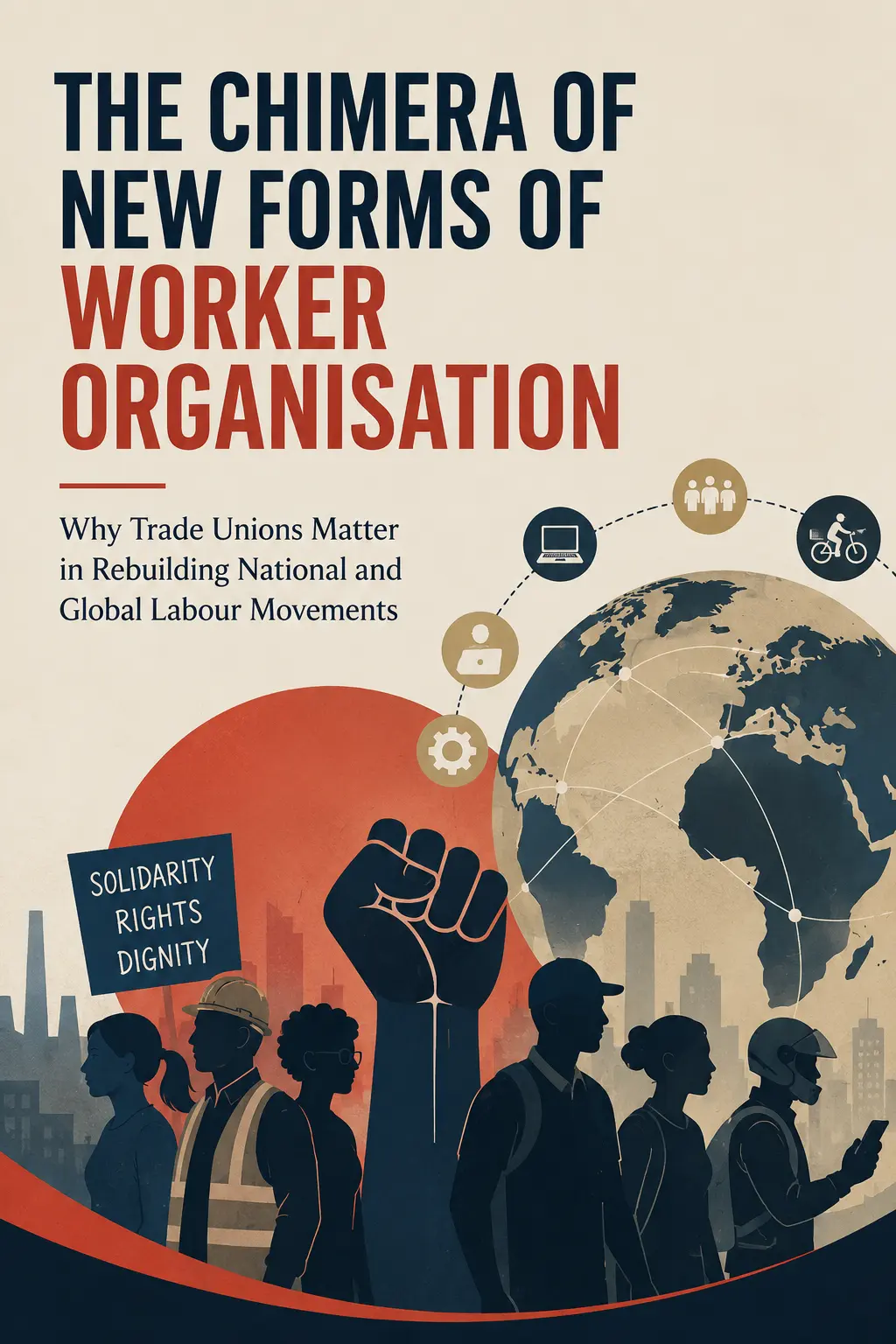
The chimera of new forms of worker organisation: why trade unions matter in rebuilding national and global labour movements
The decline in union representation is occurring globally even as the working class has been growing, especially in the global South. The decline in the global organised workforce contradicts expectations that trade unions would grow in response to growing levels of exploitation prevailing especially in poor countries integrated into global production chains. However, trade unions are not growing stronger but are weaker as industrial and service workers are growing in number. This article reprises the concept of new forms of worker organisation (NFWO), advocated and advanced over the past 25 years and rooted in independent labour entities, including worker centres, syndicalist organisations, and autonomous, unaffiliated unions, and even NGOs. The record of these entities thus far demonstrates that new forms of worker organisation are expanding in response to rank-and-file activism but are ineffective as a replacement for traditional union models in building and consolidating labour power to challenge the rise of precarious and contract labour. This article examines the mixed record of new labour organisations and their failure to confront neoliberal capitalism. To remedy this structural defect, this article contends that existing unions must engage in activism rooted in the precarious working class of the global South to build trade union power.
Key words corporate restructuring • precarious labour • new forms of worker organisation • worker centres • global South • labour militancy
To cite this article: Ness, I. (2023) The chimera of new forms of worker organisation: why trade unions matter in rebuilding national and global labour movements, Work in the Global Economy, XX(XX): 1–18, DOI: 10.1332/27324176Y2023D000000002
The neoliberal era of capitalism has given rise to the decline in trade unionism of vast proportions. The steep drop in trade-union membership is not isolated within the USA and other advanced capitalist economies with legacies of conservative antiunion sentiment and legal infrastructures but has occurred in countries throughout most of the world, regardless of pro-union or anti-union sentiment. Paradoxically, the decline in global union membership is taking place at a time when the global working class is in ascendancy, larger than at any time in the history of capitalism, as the number of workers in the global South continues to grow (van der Linden, 2021). The literature on the decline of union membership since the worldwide institution of neoliberal capitalism is expansive and well documented. Although working-class activism remains formidable, in the global political economy has been passed down from labour scholars including Harry Braverman (1974), Michael Burawoy (1979) and Staughton Lynd (1992) recently packaged by Joshua Clover (2016) and echoed by a chorus of modern-day adherents who claim the age of working-class subjectivity and agency is over. South African labour scholars Edward Webster and Lynford Dor vehemently object to that omnipresent position.
Still, labour scholars are obligated to ask the question, ‘Just what kinds of workingclass organisation?’ as existing labour unions in the global North haemorrhage members and most of the working class in the global South is not even recognised, let alone in possession of organisational agency. Over the past 30 years, the failure of existing trade-union mobilisation and organising by established national tradeunion federations or labour centres has resulted in their rupturing as independent formations. New organizational models have formed to compete for membership and leadership of the unorganised working class. The fragmentation of labour centres has been primarily motivated by trade unions’ accommodation with management and government authorities, and by ideological disputes among leading national trade unions, often inflected by leaders’ personal contestations for power. In many cases, new trade-union federations form to represent labourers ignored and neglected by the established trade unions in emergent sectors of the economy, especially as a growing share of the workforce falls into precarity. Most scholars in the west attribute the decline in unionisation to the withdrawal of welfare states and policies intended to reduce poverty and inequality, which began in earnest during the 1970s (Cowie, 2012; Martin et al, 2017).
Surprisingly, however, trade unions are also declining in the global South, where the expansive growth of manufacturing industries would be expected to contribute to higher levels of labour organisation even if workers are highly militant (van der Linden, 2021; Bieler and Nowak, 2022). Ever since the mid-1970s, most trade unions, in both the global North and global South, have declined as the application of neoliberal policies has pressed states to contain and reduce workers’ power. A strong and vibrant labour movement would inhibit financial investment as capital always moves to countries and regions with the lowest labour costs, where the highest levels of surplus value can be extracted from workers. The absence of trade unions is considered an advantage for states seeking to attract foreign capital investment. In view of the expansion of neoliberalism, two primary explanations have been advanced to explain the steady decline in trade unionism:
- Employers and finance capital have exercised labour-union avoidance strategies on a global scale and unions have failed to gain institutional power on a national basis.
- Existing trade unions are irrelevant to the lives of today’s workers, who prefer not to join unions and seek autonomy from established trade-union organisations.
Certainly, trade unions encounter fierce opposition from private and public employers, and, apart from its capacity to mobilise unorganised workers, is often the object of disillusionment and indifference for the present-day working class. In turn, labour unions and their supporters have sought explanations and applied strategies to stem and remedy their decline in membership.
It is nearly a decade since the publication of New Forms of Worker Organization: The Syndicalist and Autonomist Restoration of Class-Struggle Unionism (NFWO), the death knell of established unions as workers’ representatives and heralding the requirement to turn to alternative forms of representation to stanch the systemic decline of bureaucratic, ineffective, undemocratic and defective unions (Ness, 2014). NFWO categorically rejected the notion that most existing trade unions were effective agents for rebuilding the power of workers and instead asserted that new representative structures would emerge as democratic and representative bodies capable of engaging in class struggle to extract concessions from businesses for workers. NFWO contended that few unions were capable of transforming, and the working class should turn to their own traditions and devices to form working-class organisations. NFWO maintained that workers did not require existing trade unions, which only served as middlemen to represent organisational interests against management, not worker interests. Rather, working-class organisation established and controlled by labour was the most effective means to improve conditions and advance worker interests on the job.
As capitalism pushes ever harder to reverse the labor gains established in the early to mid-twentieth century, workers are developing new forms of antibureaucratic and anticapitalist forms of syndicalist, council communist, and autonomist worker representation, rooted in the self-activity and democratic impulses of members and committed to developing egalitarian organizations in place of traditional union bureaucracies. In turn, these new forms of representation, which are gaining currency throughout the world, are expanding the democratic capacity of workers to advance their own economic, political, and social interests without external intermediaries. (Ness, 2014: 1)
From the 1990s to the 2020s, autonomous workers organisations were expanding as representatives of the working class, rejecting lacklustre, bureaucratic, and often corrupt existing trade unions that had presided over a 50-year decline of organised labour in the west and worldwide through negotiating concessionary agreements, agreeing to the tiering of workers’ status and wages, intensifying divisions among labour performing the same job tasks, and driving workers away from trade unions in the process. Most trade unions shunned workers seeking organisational resources and experience to help them gain equality and a voice at work. Rarely, if ever, did unions recruit workers in the workplace to act as a class, instead organising strategies based solely on expanding membership.
Certainly, ever since the 1970s, neoliberal capitalism had permitted management to expand opposition to labour unions through replacing striking workers and sharpened rhetoric against labour unions as dishonest third-party agents seeking more members and higher dues. It is therefore unsurprising that trade unions incessantly failed to mobilise workers into trade unions, and rarely went on strike to improve wages and working conditions. In the USA in 1995, a new national leadership formed and replaced the AFL-CIO, confident that all that was necessary was for its constituent national unions to devote more funding and resources to organising. In the ensuing 25 years, the national labour federation found that redirecting funds to organising almost always failed to win campaigns. Historically, workers have been prone to organise into unions in the manufacturing and government sectors, but are not in service and retail sectors, which form the largest component of the US labour market. Trade unions have lacked the expertise to be effective here.
From 1955 to 2020, US union density fell from a high of 35 per cent to barely 5 per cent of the private-sector labour force. In the US public sector there is a far higher share of unionisation, with density hovering around 10 per cent. A similar pattern of trade-union erosion occurred in western Europe and throughout the world, with the exceptions of Brazil, South Africa and Korea in the 1980s and 1990s, and then China in the 2010s to the present, where working-class opposition to corporate abuse sustained established trade unions and prompted new ones to emerge (Silver, 2003; Booth et al, 2022). In particular, Beverly Silver’s approach compels us to consider trade unions as evolving forms of working-class organisation rather than static and hidebound institutions incapable of changing or even transforming to meet the new realities of the global political economy. The rise of neoliberalism demands that labour unions modify and even transform their strategies and organisational forms.
Power resources approach
In 2018, Schmalz et al (2018), recognising the decay of the established labour movement in both the global North and global South, interposed a significant reminder and important mnemonic into the debate, the Power Resources Approach (PRA), to demonstrate that the labour movement is continuously responding to changes in the structure of capitalism and is not restricted by existing labour organisations. Working-class agency, as shown by Silver in Forces of Labor (2003), reconstitutes itself, primarily in the global South, where the labour force is growing most rapidly. In the context of the 1970s and 1980s, Schmalz et al claim:
A new worker militancy and a new form of unionism emerged that went beyond collective bargaining and actively engaged in political and community issues. These unions challenged authoritarian rule and the lack of social infrastructure in the working-class communities of countries such as Brazil, South Africa, the Philippines and South Korea. This new wave of worker militancy was labelled social movement unionism as it blurred the demarcation between unions as formal organisations and social movements as loosely structured networks of action. (2018: 114)
The rise of neoliberalism and the restructuring and relocation of production have not transformed labour into a spent force, but, as Silver argues, precipitated adaptation and recovery of labour organisation as worker agency in all global regions of class struggle. Marginalisation and corporate restructuring do not spell the end of working-class organisation but lead to their revitalisation through adaptation (Visser, 2019). The new working class is reorganised into new structures to advance its power. From the 2000s to now, labour has mobilised in new ways which are not exclusively rooted in the factories and workplaces, but have expanded into working-class communities that make demands on the state (Schmalz et al, 2018). The PRA reveals that labour organisation is not entirely eviscerated by the restructuring of capital, but often uses existing and new means to maintain relevance, namely: structural economic power, associational power, institutional power and societal power, reflecting the antagonistic relationship between labour and capital (2018: 116).
Schmalz and colleagues provide succour to those who deny working-class labour organisation is irrelevant and inject a crucial corrective to the pessimistic view that the global evisceration of trade unions is a permanent fait accompli. However, trade unions have undeniably been much diminished over the past 50 years, and even if workers exert latent power in new ways outside the dominant framework established in the twentieth century, on balance they are far weaker than in the past. New forms of worker organisation (NFWOs) typically emerge among the most exploited workers, who encounter significant challenges in confronting capital in the neoliberal era; and although the PRA approach certainly confers agency to workers, capital’s current capacity to ignore or override labour organisations is greater than ever.
The transformation of the global North from industrial to service economies was responsible for the most significant share of the decline in union membership as manufacturing workers are the most predisposed to organise and join unions. However, Silver (2003) persuasively establishes that we can expect worker mobilisation to take place in strategic centres of capital formation, notably the global supply chains of the global South. But in North America and Western Europe, since the imposition of neoliberalism, trade unions representing industrial workers have been less effective in mobilising their traditional base of manufacturing and warehouse workers. For the past 50 years, existing unions have lacked the capacity to mobilise and recruit the lowest-wage workers into unions, especially migrant labourers who predominate in agriculture, construction, food services, manufacturing, care work and, since about 2015, platform work in the gig economy (Ness, 2023).
New forms of worker organisation in the USA
From about 1995 to 2020, new forms of worker organisation proliferated throughout the world, in the global North and global South. How successful were NFWOs during this apogee of organising? The most prominent form was the worker centre, an organisation that emerged among those workers who trade unions were indisposed to mobilise. Typically, NFWOs represented workers in small and dispersed establishments with high turnover as well as migrant workers employed in agricultural, production, retail and service sectors, including meatpacking and food production, restaurants, delivery and care workers. In some cases, workers were employed in industries vacated by unions; for example, the meatpacking industry, in which the United Food and Commercial Workers (UFCW) had been defeated by management in contract negotiations. We must follow the work, not the worker, to understand the transformation of labour: the restructured meatpacking industry transformed into minimum, or below-minimum, wage jobs in factories employing migrant (often undocumented) workers. Following the defeat of the UFCW in meatpacking, few existing unions attempted to reorganise the sector. However, meatpacking remained a significant sector of the labour force. Moreover, NFWOs had also rarely tried to represent or organise these workers, who typically worked in factories in small towns in the Midwest or South of the USA. When the US Immigration and Customs Enforcement raided Postville, Iowa’s meatpacking plant on 12 May 2008, no organisation was present to defend the interests of the Somali workers who had laboured there (Grey et al, 2009). While workers’ centres formed thereafter in the Midwest, they had negligible effect in safeguarding and advancing the interests of migrant workers.
While, however, this article posits that NFWOs are on the whole imperfect, they represent an organisational form that responds to the ineluctable technological innovation and modernisation in the means of production that are set into motion by capitalist accumulation (Galenson, 1960). By necessity, the application of technology and economic policies restructures labour markets and compels representative organisations to change or contend with irrelevance. If NFWOs are not the archetype of labour organisation, they are at any rate a representative form that responds to the immediate demands and requirements of the working class in diverse contexts. An optimistic perspective would expect trade unions to respond or new organisational forms to emerge or workers to develop their own effective forms in response to the constant new labour market challenges presented by the constant restructuring of capital and technology; for example, workers formed new trade unions formed after capital’s investment of surplus profits in the reorganisation of craft to industrial, assembly-line manufacturing processes in the early twentieth century. In the developed countries of North America and Western Europe, workers mobilised spontaneous job actions, downed tools and undertook long strikes, forming the basis for the emergence of new labour organisations. Notably in the USA, the Congress of Industrial Organisations (CIO) displaced the American Federation of Labor (AFL) as the dominant labour federation. In response, AFL unions quickly followed suit through redeploying their resources to workers in the dominant mass-production industries. In this context, initially some labour observers have considered loose affiliations, collaborative partnerships between existing unions, as a model for the future (Avendañoand and Hiatt, 2012).
This article next considers the capacity and effectiveness of NFWOs in responding to neoliberal economic restructuring, relocation of production to the global South, and the emergence of precarious labour and platform technology. The crucial question in evaluating the record of NFWOs thus far is to determine if they are a provisional phase of experimentation or a precursor to future organisational forms.
Workers’ centres as NFWOs
Workers’ centres are typically formed as non-governmental organisations (NGOs) external to direct labour struggles and with supposedly altruistic purposes to support workers deprived of institutional representation and in desperate need of essential services. From the 1990s, when workers’ centres first appeared, to the present, most have not organised workers into effective equivalents of trade unions. Though several have tried to mobilise workers into organisations, in almost every instance they have failed to consolidate effective representative power and have typically faded once grants, donations, and foundation funding have been exhausted. Workers’ centres have proliferated widely, most notably in the global North, but reflect an institutional weakness in representing, organising and mobilising the most exploited and oppressed, including migrant workers, women and marginalised workers shunned by trade unions.
The most prominent workers’ centres in the USA formed in large metropolitan areas with diverse populations. Taxi Workers United (TWU) was founded in 1998 to represent exploited taxi drivers, a labour market that unions had historically avoided. It was admitted as the National Taxi Workers’ Alliance NTWSA into the AFL-CIO in 2011 as one of its 57 constituent unions of the federation. NTWA is probably the most successful example of worker-centre organisation, as it entered a growing unorganised industry and gained the attention of drivers, with many paying dues. But as the for-hire transportation model has transformed with the advent of the gig economy, the NTWA has found itself outflanked by UBER, Lyft, Via and other ride-hailing services which have been far more difficult to organise than taxi drivers in New York, Philadelphia and San Francisco, its primary bases.
Other workers’ centres proliferated in the 2000s with great fanfare, notably the Restaurant Opportunity Center-NY (ROC-NY and then ROC) following 9/11 and the collapse of the World Trade Center, which toppled the restaurant on the top floor of one of the two buildings, killing all the workers present there and rendering the rest jobless. From its inception one year later, in 2002, the organisation expanded and may have had as many as 500 worker members. Rather than operating as a workers’ centre with an active membership, ROC (now ROC United) concentrated on campaigns to raise public awareness in New York City about the plight of restaurant workers, the vast majority of whom were migrants from Mexico and Central America. Unlike NTWU, at no time did ROC establish an enduring office or drop-in-centre or union hall for the tens of thousands of migrant restaurant workers in New York City. Like NTWA ROC tried to form a national union, but by 2015 it had disappeared as an organising force. ROC offshoots formed in New York, challenging the original leadership which had wholly converted from an organising workers’ centre into an advocacy organisation for restaurant workers on a national stage, with the support of corporate foundations that did little to improve working conditions.
Likewise, the Domestic Workers United (DWU) formed in 2000 to represent home cleaners, care workers and other primarily migrant women workers in New York City. Like ROC, DWU largely transformed into an advocacy organisation by 2015, though fragments of the organisation continue to support exploited domestic workers in various locations. In addition to ROC and DWU, the Freelancers Union (FU), ‘a non-union equivalent to a workers’ centre promulgates legislation to enforce the payment of wages, offers medical insurance, conducts research on the shift of the labour market from employees to contractors, and part time workers while conducting periodic workshops’ (Greenhouse, 2013). Based in New York City, most members learn about the FU through advertisements in the subway and the NGO is keener on selling health-insurance plans than directly representing and organising precarious workers (Paul, 2014).
Sociologists Courtney Frantz and Sujatha Fernandes (2018) observe that the founders and leaders of worker centres primarily function to advance their prestige as champions of the poor and unorganised working class and to gain media attention. In fact, though, such figures have done little to tangibly organise collectively with the workers they claim to represent. In this way, workers’ centres, formed as a replacement for trade unions, are essentially NGOs marketing human-rights causes and raising money through foundation grants and well-heeled donors. Taken collectively, the largest workers’ centres do not represent actual constituencies of workers but operate as NGO advocates of social causes. This in turn draws money, media attention, and recognition from government officials in the same way as Human Rights Watch and Amnesty International do on a global basis. Those less prominent workers’ centres continuously struggle for funding to keep their organising efforts among precarious workers afloat. They are successful after media attention is drawn to abused workers and seize on cases of the most severely exploited workers in food services, restaurants, ride-hailing and for-hire transport, domestic and care industries.
NFWO: theory and practice
NFWO maintained that emerging models of unions are essential to building a robust workers movement shattered by nearly a century of bureaucratic trade unions, and 50 years of neoliberal capitalism. In place of top-down unionism, syndicalism and other forms of representation could foster democratic practices and more directly involve precarious workers in fundamental decisions that affected their everyday work life.
Syndicalist, autonomous, and shop-floor substitutions for trade unions
NFWO claimed that autonomous unions represented an alternative to hidebound bureaucratic unions which formed in the twentieth century and are now incapable of challenging management and capitalist hegemony. To remedy the decline in unionisation, NFWO harkened back to the syndicalist model of unionism in the early twentieth century, a new worker-driven model at that time which challenged craft unions which did not require collective bargaining contracts or even formal organisation but were embedded in the self-activity of workers rather than being a disciplined organisation. Syndicalism was an extension of the collective action of workers rather than decisions by a central leadership. Drawing on this past and applying it to the neoliberal era of globalisation from the 1980s to the 2020s, as existing unions declined, NFWO proposed new autonomous organisations which would emerge to challenge established trade unions and appeal to the majority of workers outside them, akin to the blossoming of the Industrial Workers of the World (IWW) and other worker-led organisations in the early twentieth century. The IWW, formed in 1905, tapped into the working-class and democratic impulses of workers demanding social equality for all members. Moreover, syndicalism was an antidote to the meddling of established trade unions, which, in the twentieth century, consolidated workers’ power to form large, often unwieldy organisations which could not engage
in direct working-class democracy (Ness, 2014). However, the IWW did not require members to pay dues, nor did it negotiate contracts with management. The romantic notion that workers will contribute to the union and management would honour the verbal agreements negotiated during strikes contributed to the rapid decline of the IWW in the 1910s (Dubofsky, 1969; Cole et al, 2017). The IWW was significant because it recognised the magnitude of industrial unions to challenge union bosses in factories and mills. However, the IWW syndicalist dogma revealed the weakness of organised labour at that time, not its strength. As governments prohibited workers from organising strong and vigorous unions recognised by the state, the IWW formed in western Europe, North America, South Africa and Oceania as a means to circumvent anti-labour laws. However, proponents of syndicalist unions today maintain a quixotic perception of the syndicalist model which did not negotiate contracts with employers, did not demand dues from members, but advanced work actions and strikes against employers, with the ultimate objective of building ‘one big union’ of the working class. One way or another, syndicalists believe that their model is the most effective means of building working-class power.
What is clear is that workers devoid of organisational power will not successfully challenge employers or restrain their capacities. Consequently, we must reject those like Clover (2016) who believe labour autonomous action and trade-union representation are doomed to continued decline under neoliberal capitalism. Defaulting to riots and uprisings which neither organise the working class nor consolidate power are hollow pursuits which expose the nature of the political left rather than further workers’ concrete economic demands for durable power and a reorganisation of society towards socialism. The proposition of ‘riot, strike, riot’ is no way to build a viable workers movement or plan for a future of socialism.
Organising poor and exploited workers
Corporate restructuring and the shift to vertical production have significantly reduced wages, especially in the global South, where the vast majority of workers are employed in global production chains across several countries, producing electronics, smartphones, semiconductors, automobiles and machinery. Accordingly, it is impossible to organise workers across the borders of nation states. Thus, a defining feature of the chapters in NFWO is the changing nature of employment which motivates workers to form organisations independent of traditional unions. In most instances, NFWOs emerge when employers are enterprises that serve as contractors for large national and multinational companies (MNCs). Those contractors, which are chosen by major firms, are plainly companies agreeing to produce products or deliver services at the lowest cost. Plainly, larger firms will subcontract to firms which will extract the highest surplus value from workers to fulfil low-cost orders from MNCs. In the period from about 1945 to 1970, vertically integrated companies produced all elements of commodities. In this way, leading automobile companies such as General Motors and Ford produced all their own drivetrains, autobody parts, interiors and electronics. The neoliberal restructuring of production now sources parts globally, and typically only assembles the parts into an automobile. Outsourcing of production and services is now the common practice of most successful firms. Consequently, commodity production does not depend on specific workers as it used to do in the post-war era. The Apple iPhone is commonly used as an example of a commodity that does not depend on any of its contractors. If workers strike at a screen contractor in Zhuhai, Apple, and its contractor Foxconn, can source the screen to a competing firm which produces the same component part. Contracting and outsourcing reduce the capacity of workers to engage in job actions as it may lead to the closure of the firm.
What defines NFWOs is the erosion rather than strengthening of workers’ power to challenge employers. In this way, by definition, advocating for new organisational structures in place of existing trade unions is occurring under neoliberal capitalism, without contracts protecting the rights of workers. It is certainly better to have syndicalist rank-and-file unionism where no union exists, giving workers more control over union decisions and actions; but, unmistakably, NFWOs emerge in response to the decline in importance of the individual firm, where vertical production weakens the power of the subcontractor and the workers who are seeking out influence over corporations that dominate their lives. But will NFWOs of precarious and replaceable workers become the organising force of the twenty-first century as industrial unions were in the early twentieth century?
NFWOs emerge in those industries and workplaces where production and services are outsourced, which, as a matter of course, decreases the capacity of workers to refuse to work. Consequently, NFWOs will occur in restructured industries where workers are disillusioned with existing unions’ defence of their interests. In Italy, Confederazione dei Comitati di Base (Cobas) formed as a rank-and-file syndicalist organisation in opposition to the Italian Confederation of Labour and other unions, which could not deliver higher wages and improved working conditions (Manicastri, 2014; Wright, 2017). Analogous rank-and-file organisations formed in France and elsewhere in Europe as wages declined and working conditions became harsher.
India’s experience also reveals the exploitative nature of work through a two-tiered production system where a small fraction of the employers are considered employees and the majority of workers at a firm are contractors without rights. In Gurugram, an industrial hub southwest of Delhi, approximately 20 per cent of Maruti-Suzuki’s 2,500 workers are considered permanent employees and about 80 per cent are temporary employees who have no guarantee of a job and are paid a fraction of the full-time wages of about $300–400 a month, that is, around $50–$100 a month. In 2013, fulltime workers formed the Maruti Suzuki Independent Workers’ Organization (SIWO), encompassing all the workers in the company’s two factories in Manesar. What made the union unique is that it was unaffiliated with the dominant national union federations and functioned as an autonomous labour organisation. Maruti-Suzuki refused to accept the SIWO, leading to a violent assault on the workers by bouncers (companyhired thugs) who set fire to the plant and also caused the death of a manager. In the aftermath of the company’s violence, all the part-time workers were fired and many of the union’s leaders were arrested, with some facing life sentences (Ness, 2015).
Subcontracting is ubiquitous in industries once considered secure forms of permanent employment, spreading precarity throughout the global economy. In turn, more and more workers are losing access to once secure jobs and are now employed in a range of work (Standing, 2011). But, as Jan Breman cautions, we must refrain from comparing the conditions of restructured labour in the global North with stagnant wages in the South as ‘footloose labourers’, where it is commonplace for workers to work in a succession of jobs: for example, two weeks unloading cargo at the docks, a month harvesting rice in the fields, and two weeks carrying concrete at a construction site. Taken today, the experiences of workers in the global South are structured by uninterrupted oppression (Breman, 1996; Sinha, 2021). This is a far cry from the global North, where workers are required to retrain and enter new industries. Even in the global North, those most exploited are recent migrant delivery workers employed in the gig economy or as care workers restricted to the homes of their employers, subject to relentless demands. As noted, following the work rather than the worker reveals how economic restructuring transforms the nature and condition of labour.
Precarity and working-class resistance in the global North:
Amazon Labor Union
The growth in transportation of finished commodities, warehousing and delivery has significantly expanded the importance of logistics workers in the global economy. In rich countries of the global North, union members continue to pursue independent unionism, notably, the Amazon Labor Union (ALU), which won a union representation election to represent 8,300 workers at Amazon’s logistics warehouse in Staten Island, New York in March 2021 (Weiseand and Scheiber, 2021).The union representation victory sent shockwaves through corporate America and organised labour, notably the Retail, Wholesale, and Department Store Union (RWDSU), which had failed on several occasions from 2000 to 2022 to win National Labor Relations Board elections for the right to represent analogous workers in Bessemer, Alabama, and beyond, despite the expenditure of substantial union resources and public support generated by elected officials and civil rights-leaders (Scheiber, 2022). Even though the ALU won a union election victory, the absence of money, legal and organisational resources, and support from rank-and-file members, impeded their capacity to negotiate a collective-bargaining agreement thus far, or even to win concessions. Similar to other independent labour organisations, the ALU victory pressured Amazon to marginally raise wages. Workers may have improved wages, but no lasting organisation has been established to ensure that they continue to exert power against management. Notwithstanding the lack of resources, the ALU’s decisive shortcoming was the absence of political or organisational position. Organising entailed signing union-recognition cards, and as most warehouse workers felt exploited and alienated, they registered their dissatisfaction through signing ALU representation cards and voting for unionisation. Even before the union election, Amazon’s human-resources strategy had been to replace warehouse workers on short order as the job is so arduous. As a result of the exploitation on the job, most workers in Amazon warehouses do not consider their employment as careers or even steady jobs, but as quick fixes to earn money under extreme forms of exploitation (Alimahomed-Wilson and Reese, 2021). As the ‘organise to win’ model of the AFL-CIO failed to increase membership through spending more money on campaigns due to the transformation of the US economy from manufacturing to services and technology, unions turned to low-wage sectors of the economy, including warehouses, big-box department stores, and public-sector workers. Big unions did not seek to organise small bargaining units, as they were far more difficult and not cost-effective. Even if they could win a campaign and bargain a contract, it was far too onerous to track small shops. Thus, they sought bargaining agreements across single units in the same chain. Baristas at Starbucks have achieved a modicum of success through organising workers at multiple coffee shops. But organising and unionising workers at coffee shops with 25–50 workers, one at a time, will only increase membership incrementally, and not reverse the sustained decline of trade unions in the private sector. Consequently, apart from Starbucks, existing trade unions have eschewed organising small establishments in favour of seeking to mobilise and organise large enterprises.
Assessment of worker centre strategies in advanced capitalism, 1990s–2020s
In the absence of established trade unions, workers have engaged in autonomous forms of resistance through job actions and wildcat strikes or have had to depend on support at the local, regional, and national levels. As the bond between unions and political parties have eroded, rather than waging strikes for union representation and improved wages and conditions, it is more likely that independent interest groups and NGOs will lobby elected officials for improved conditions. In view of these drawbacks of small-scale enterprises, how could independent workers’ organisations which are even successful in organising members gain power through organising single f irms in food industries, retail services and the gig economy, which predominantly mobilise migrant low-wage workers (Roca, 2020)? Sociologist Stanley Aronowitz’s last book (2015), The Death and Life of American Labor, recognised sporadic NFWOs but avoided the periodic hyperbole which follows whenever such a faint pulse can be detected. He sees American labour as trapped in a cycle of decline, for which reason his book might have been better titled ‘The Life and Death of American Labour’. As Schmalz et al (2018) and Webster and Dor (2023) among others assert, trying and failing is necessary before success is achieved, and such experience will enable NFWOs to eventually materialise as strong class-struggle organisations representing militant workers.
Precarity and NFWOs in the global South: Casual Worker Advice Office
The decline in labour organisation is not confined to rich countries in western Europe and North America, but encompasses the entire world, especially poor and middleincome countries where industrial labour is growing most rapidly. Labour unions are becoming weaker even within industrial hubs of the global South where the size and share of manufacturing workers has expanded significantly as global demand for inexpensive commodities has expanded. Industrial workers in Africa, Asia and Latin America are integrated into global production chains controlled by capital in the rich countries of the global North. This has given rise to the formation of industrial installations in the South through the injection of foreign direct investment (FDI) and subcontracting of essential production by MNCs to produce vital components and commodities which are consumed by middle-income residents in rich countries that form the most important markets for the global exchange of value. In this way, middleincome workers in rich countries who buy products produced in poor countries are of foremost importance in the realisation of surplus value and the expansion of capital accumulation. Certainly, the departure of trade unions has produced greater levels of inequality within rich countries, but the widest levels of poverty and inequality are situated in poor countries of the global South.
NFWOs in South Africa and the Casual Worker Advice Office
As precarity grows on a world scale, workers’ centres, or their equivalent nontraditional union organisations, have formed throughout the world to advance the cause of the most exploited workers who are often neglected by established unions due to lack of interest or resources. South Africa represents a crucial case study of NFWOs, as several emergent labour organisations have contended for leadership over the established trade-union movement. This process has exposed the stagnation and inertia of both the established labour federation, Congress of South African Trade Unions (COSATU) and its constituent unions, which formed a national bloc after apartheid ended in 1994. The promise of democracy and equality for the black South African majority population after the fall of apartheid had not come to fruition, and one decade later raised expectations gave way to widespread despair among a working class which was mired in poverty. Today, economic inequality is greater in South Africa than in any country in the world where data is collected by the World Bank. Between 2000 and 2014, the last year of available data, South Africa’s Gini coefficient grew from 57.8 to 63.0, far higher than other countries in Africa south of the Sahara. Brazil, with a 53.3 Gini coefficient in 2017, has the world’s second highest Gini coefficient (World Bank, 2023). The Gini index reflects the degree of income, wealth and consumption inequality, where an index of 0 represents perfect equality and an index of 100, absolute inequality. South Africa’s inequality is an outcome of the failure of the African National Congress (ANC) to achieve economic redistribution to the black majority. A thin layer of South Africa’s black educated elite and those proximate to state power improved their economic status after 1994, while most black citizens remained mired in poverty and the white minority maintained its economic power. The emergence of the ANC Government and its Tripartite Alliance with COSATU-affiliated unions and the South African Communist Party (SACP) had encouraged a veneer of optimism for a more egalitarian South Africa. However, wages among the black South African working class stagnated and even declined due to the introduction of new technology and neoliberal reforms.
By the early-2000s, the post-apartheid state had not delivered on the promise of improved wages and redistribution of land. Ten years after the end of apartheid, black working-class South Africans had become disillusioned and began protesting through unprotected strikes, with some forming new unions to replace the dominant ones already in existence. The mining industry was the most notable example, as wage decline and stagnation contributed to the growth in sit-down strikes and violence. This challenged the hegemony of the National Union of Mineworkers (NUM), formerly led by South African president Cyril Ramaphosa, who had subsequently become a member of the board of Lonmin, a British mining company that was one of the three major producers of platinum, a vital source of South African foreign exchange earnings. In 2013, the South African police fired on thousands of unarmed strikers in Marikana, killing 43 and wounding hundreds during a conflict for control over representation of the mineworker industries between the NUM and the rival African Mineworkers and Construction Union (AMCU), contributing to even further militancy in the mining belt and outrage among the broader black South African working class. Some believed that AMCU would potentially replace NUM as a more democratic rank-and-file organisation (Sinwell, 2016). However, under its leader Joseph Mathunjwa, AMCU developed autocratic tendencies as wages in the platinum fields stagnated in the decade after the major strikes of 2013 (Ness, 2021).
Precarious labour also expanded around major urban centres, including Johannesburg, Durban and Cape Town, and inter-union conflict over defending worker rights caused a split within COSATU, led by the National Union of Metalworkers of South Africa (NUMSA), a militant union representing workers in manufacturing industries. In December 2013, NUMSA withdrew its support of the ANC and, after its expulsion from COSATU, formed a new national labour federation, the South African Federation of Trade Unions (SAFTU) which sought to challenge the Tripartite Alliance for leadership of South Africa’s working class. NUMSA represents yet another trade-union alternative, as it is linked to the social movements that form part of the United Front, an alliance of community organisations throughout South Africa. But, SAFTU has not expanded, and the union has not formed a viable political party to challenge the ANC leadership.
As interunion conflict expands, a divided South African workers movement is becoming weaker, leading to torpor among the unorganised working class with few organisations to turn to for support. Growing apathy about the potential of trade unions to challenge the growth of precarious labour has led some workers to turn to other forms of organisation, notably the Casual Worker Advice Office (CWAO), formed in 2011 to represent neglected precarious workers in the Eastern Rand region of Johannesburg and Gauteng Province. They have successfully mobilised workers in a number of campaigns against employers and have also filed legal disputes for underpayment of wages and failure to comply with labour laws at South Africa’s Labour Court. The latter has compelled businesses to grant temporary employees permanent employment status after working for six months under the South African Labour Relations Act (LRA), which became law with the end of apartheid. In 2015 the LRA was amended further to require employers to make jobs permanent after three months (Brambleand and Barchiesi, 2019; Ness, 2021; Williamsand and Satgar, 2021). Even though CWAO has assisted workers to organise, challenge employers, file claims with the Commission for Conciliation Mediation and Arbitration (CCMA), and strike, it does not seek to form a union. NUMSA also frequently challenges the South African Department of Employment and Labour with the CCMA to enforce labour laws, especially around the replacement of firm-level full-time employment with temporary services (Khumalo, 2020; Runciman and Hlungwani, 2022).
The CWAO is a vibrant worker centre drawing thousands of workers to its office and community hall in Germiston, Gauteng every weekend and it helps organise campaigns to ensure employers pay living wages and retain workers rather than hiring workers temporarily. The success of the CWAO is evident through successful strikes and strike threats which cause employers to capitulate to wage and workplace demands (Ness, 2021). However, CWAO represents workers on a case-by-case basis, especially when exploited workers demand action in response to exploitative conditions, nonpayment of wages, and under-payment of wages. Furthermore, the nature of precarity and the growth of contract work contribute to the incapacity of the CWAO and other organisations to maintain pressure on behalf of workers who cycle in and cycle out, inhibiting their ability to sustain lasting campaigns or directly organise workers for the long term. Most existing unions of the global South are uninterested in marginal and precarious workers with few rights. They lack institutional knowledge and the capacity to organise, mobilise, represent and bargain for such workers to achieve durable agreements with employers. As Dor concludes, in the burgeoning low-wage manufacturing sector of South Africa, precarious workers encounter a range of employer strategies that are not equivalent. Thus, Dor contends in the context of the CWAO organising strategy:
Workers in manufacturing have been experimenting with different forms of organisation and representation (often jumping repeatedly between organisations) to harness the different power resources available to them. The future for labour in this sector is, therefore, clearly alive, but yet uncertain of its own direction and form. (Dor, 2023: 96)
The CWAO provides a credible form of precarious resistance, even if it is ephemeral and temporary, it has been successful in mobilising and advancing worker interests. However, taken together, NFWOs’ primary drawback is a failure to unify workers into viable organisations in the long run. Even if NFWOs succeed in mobilising workers and forcing the hand of employers through the courts and strike threats, most organise one-by-one, rather than form an enduring organisation capable of representing workers in perpetuity.
Conclusions
It cannot be denied that NFWOs have a propensity to organise among the most vulnerable workers who are shunned by existing unions, for example, migrant workers without documentation status. The most defenceless workers require representation, and, as Davide Pero convincingly shows (2019), independent unions and labour organisations are crucial in defending worker rights. But we must ask ourselves: Why is it that the weakest labour organisations with the fewest resources organise highly exploited workers, but the strongest organisations do not? A decade after publication of NFWO, we must recognise that it is possible to maintain both organisational capacity and innovative strategies to mobilise and represent workers atomised by lack of legal documentation and those who are shunted from one firm to another through the rise of temporary services.
In spite of the dramatic expansion of industrial workers in the global South who are integral to strategic global supply chains for commodities, trade unions have been incapable of organising workers as a social force. Instead, working-class representation has declined in almost all regions with the exception of China, where trade unions have encouraged workers to join the All-China Federation of Trade Unions (ACFTU), the state union affiliated with the Communist Party of China, which permits municipal organising. Is it possible to form strong and robust unions when existing unions are out of vogue or ruthlessly crushed by capitalist states? Are existing unions the only agents capable of providing the necessary resources and organisational support to defend dispersed workers who have a propensity to work in new employment sectors which have not established labour laws? What is the future of existing unions in the global North and global South which have haemorrhaged members? In the global North, trade unions have declined in absolute numbers, merged and faded as a national institutional force for workers. In the global South, trade unions emerged primarily in the independence area as representatives of workers in the government sector, with some exceptions. Southern trade unions have also declined significantly in the post-1980s neoliberal era as governments have subcontracted services and public operations to the private sector.
Why are resource-rich unions disinclined to enter struggles in new industries? Clearly, they seek to preserve their bureaucratic status and leadership continuity, thwarting exogenous constituencies from entering their privileged organisations and threatening to dislodge a disengaged leadership. NFWOs convincingly expose the big bang that established union movements in the early twentieth century, as they were founded in response to mass rank-and-file self-activity and disruption. So far, with perhaps the exceptions in Southern countries with growing manufacturing, NFWOs lack the capacity to challenge capital and do not pose a significant threat to employers who typically challenge and defeat embryonic amorphous worker centres deficient in organisation, or, in the west, formed and dependent on corporate foundations which can dictate the actions of their leaders.
The space deserted by trade unions has contributed to enthusiasm for the NFWO model, one with potential for galvanising the power of precarious workers, including some worker centres, independent unions and fledgling unions. They can engage in unique struggles in the communities and against the state, as is suggested by PRA analysts, but NFWOs have significant obstacles that prevent sustained class struggle. This notwithstanding, the dialectical force of worker opposition will ultimately coalesce into organisation. The challenge today is to identify and build organisational power ready to challenge growing employer exploitation under neoliberal capitalism.
Funding
The author(s) received no financial support for the research, authorship, and/or publication of this article.
Conflict of interest
The author declares that there is no conflict of interest.
Recent News